Practical starting point
Reduce repeated rehearsal by moving the resting area away from the door and masking unavoidable noise at a comfortable level. Practice mild door sounds separately from real deliveries. Offer calm reassurance if the dog seeks it; fear is not simply rewarded into existence by comforting them. Avoid forced hugging, which may make a worried dog feel trapped.
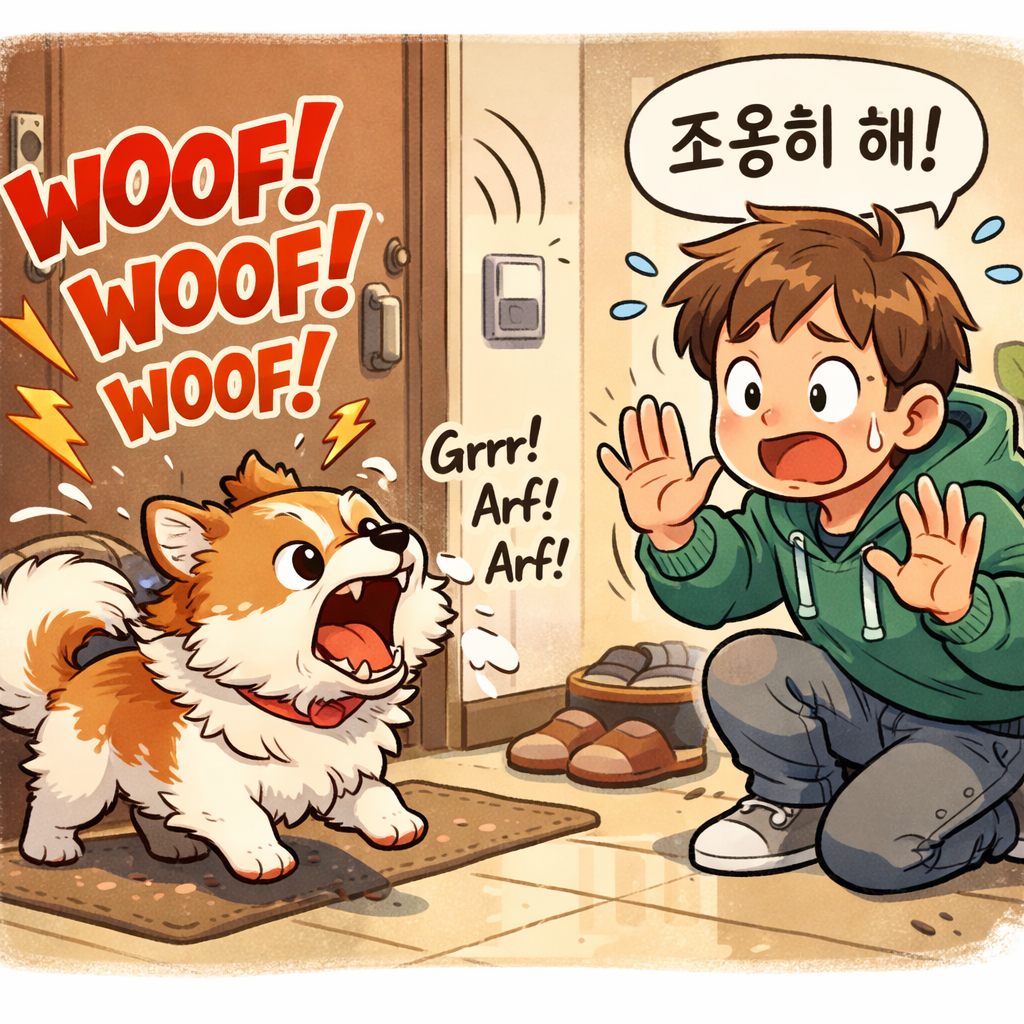
What you’ll solve in this guide (3 things):
- Figure out why your dog barks at the door (territorial vs anxiety vs demand).
- Use a simple 3-step routine (Environment → Place/Mat → Desensitization).
- Handle barking in 10 seconds when the delivery person or elevator triggers it.
Summary (save this)
- Door barking is usually territorial/alert, anxiety/startle, or demand/excitement.
- Don’t yell “Quiet.” Build a new pattern: sound → place → reward.
- Aim for shorter + softer + faster recovery, not “zero barking.”
30-second check: Which type is your dog?
Door barking looks the same from the outside, but the fix depends on the pattern.
1) Territorial / alert barking
- Runs toward the entrance, body leans forward, “I’m guarding!” vibes.
2) Anxiety / startle barking
- Reacts to any small sound, takes a long time to calm down, may freeze or hide.
3) Demand / excitement barking
- Barking makes you react (talking, holding, opening the door, giving attention), so barking becomes a “button.”
Most dogs are a mix. That’s fine. The plan still works.
The first rule: stop “barking = success”
Door barking often continues because it works:
Bark → you rush over / talk / hold / give something → dog learns “success.”
Do this instead:
- Don’t shout “Quiet” (it often adds excitement).
- Offer calm reassurance if your dog seeks it. Avoid forced hugging or restraint.
- Reward the first tiny pause (even 0.5–1 second) of quiet.
The 3-step “SaramGom” routine (simple and realistic)
Step 1) Environment setup (reduce sound + line-of-sight)
Training is important, but environment is 50% of success.
Try these small changes:
- If your dog can stare at the front door, barking gets easier. Block the view (gate, screen, furniture shift).
- If hallway sounds echo, soften them a little (mat near entrance, draft stopper, anything that reduces sharp noise).
Goal: not perfect soundproofing—just slightly less intensity, so your dog can learn.
Step 2) Build a strong “Place/Mat” (3 minutes a day)
We’re replacing “run to the door” with “go to your place.”
Daily Place training (3 minutes):
- Lure onto the mat → mark (“Yes!”) → treat
- Four paws on → mark → treat
- Hold 3 seconds → mark → treat
- Add the cue: “Place”
- Gradually increase distance/time (even when you step away)
Important: master Place when it’s quiet first. If you start only during real door triggers, your dog stacks failures.
Step 3) Sound desensitization (start below reaction level)
This is the core skill: build tiny wins.
3-day desensitization routine:
- Prepare sounds (doorbell / hallway steps / elevator “ding”) on your phone
- Play it very low (below your dog’s reaction threshold)
- Sound plays → if your dog stays calm/quiet → treat immediately
- Next day, raise volume a tiny bit only if yesterday was easy
If your dog starts barking, the volume is too high. Lower it and restart with success.
When barking starts: the 10-second response plan
Delivery arrived. Someone passed the hallway. The elevator dinged.
Do only this:
- Reduce your reaction (don’t call the dog’s name, don’t hype the moment)
- Break the visual (close a door, turn body away from entrance, block sightline)
- Cue “Place” → reward even 1 second of success
- Repeat
“Don’t bark!” is weaker than “Come here and do this.”
5 beginner mistakes that make it worse
- Shouting/using the dog’s name during barking (adds arousal)
- Forced holding when the dog is trying to move away
- Training only when guests arrive (no practice = no results)
- Putting the mat right next to the door (too close = too exciting)
- Doing one long session daily (short + frequent works better)
In Korean apartments, this gets reported fast (Korea context)
In Korea, many apartments have tight hallways and loud echo points—elevator dings, delivery footsteps, doors closing.
So barking can escalate quickly into:
- uncomfortable elevator encounters
- “hallway tension” with neighbors
- management office calls (especially if it happens daily)
Practical tip: your first goal is not perfection. It’s reducing frequency + shortening duration so complaints don’t pile up.
Quick phrases you might hear in Korea (Korea context)
(These are common examples—tone varies a lot by person.)
- “강아지 소리가 너무 커요.” = “Your dog is too loud.”
- “현관 앞에서 계속 짖어요.” = “Barking keeps happening at the door.”
- “엘리베이터 소리만 나면 짖네요.” = “Your dog barks whenever the elevator sounds.”
- “관리사무소에 민원 들어갔어요.” = “A complaint was filed with the management office.”
If you’re nervous speaking Korean: a simple “I’m training now, sorry” + consistent improvement often matters more than perfect language.
Small changes that work in Korean hallways & elevators (Korea context)
- Keep treats by the door (so you can reward Place fast)
- Practice “Place” before peak times (morning commute, lunch delivery, evening returns)
- Elevator practice: stand calmly, feed tiny treats for quiet, exit before your dog gets overwhelmed
When to ask a vet/trainer in Korea (Safety)
Get professional help if you see:
- sudden barking increase with no obvious trigger
- snapping/lunging or bite risk around the door
- panic signs (drooling, self-injury, nonstop pacing)
- suspected pain (ear infection, dental pain, mobility issues)
Safety first. Training should feel like “small wins,” not daily chaos.
Today / This Week plan (realistic)
Today (10 minutes total):
- Put a mat in a calm spot (not near the door)
- Do Place reps for 3 minutes
- Play door/elevator sounds at very low volume and reward calm
This week (5 days):
- Place training 3 minutes/day
- Desensitization 3 minutes/day
- Track: “How many barking episodes?” + “How long to calm down?”
Your goal: both numbers go down.
Checklist
- My dog’s barking pattern: territorial / anxiety / demand (or mix)
- Mat is away from the door
- I reward quiet pauses, not barking
- I practice without real guests first
- Sound training stays below reaction level
FAQ
Q1. Should I say “No” or “Quiet” when my dog barks at the door?
A. Usually it adds excitement. Use a cue your dog can do (“Place”), then reward calm.
Q2. My dog barks the moment the elevator dings. Is this normal?
A. Very common in apartments. Train with low-volume recordings first, then real-life distance practice.
Q3. How long until barking improves?
A. Many dogs show change in a few days if you stay below threshold and reward correctly, but consistency matters.
Q4. What if my neighbor already complained?
A. Start the plan today, reduce intensity fast (environment + Place), and focus on shorter episodes first.
Q5. Is this separation anxiety?
A. Maybe. If barking is much worse when you’re away, add a separation plan and consider professional support.
Read in Korean (원문)
현관 인기척에 짖는 강아지: 아파트 짖음 줄이는 법 by 사람곰 사람곰과 강아지
Related guides
English edition copyedited and supplemented on October 9, 2026.