Practical starting point
Use a camera to identify the dog's comfortable absence duration rather than starting with an arbitrary number of minutes. Keep practice below distress level and arrange care for unavoidable longer absences when possible. Soundproofing can help neighbors but does not treat panic. Seek veterinary support early if the dog cannot eat, rest or remain safe when alone.
3-line Summary Box :
- Separation anxiety is panic, not “stubbornness.” Forcing it (“cry it out”) often makes it worse.
- In Korea, apartments/officetels amplify noise, so your first goal is shorter episodes + faster recovery (so complaints don’t stack).
- The safest way is seconds-to-minutes training: cues → micro-absences → calm returns.
What you’ll solve in this guide
- Tell separation anxiety apart from normal barking
- Build a step-by-step alone-time plan that works in small apartments
- Reduce neighbor stress: fewer howls, less door scratching, less chaos
1) Separation anxiety vs. “I’m bored” barking (quick check)
Signs that point to true separation anxiety
These commonly show up when you leave (or even before you leave):
- intense pacing, drooling, trembling
- nonstop barking/howling that doesn’t settle
- door scratching, destruction near exits
- can’t eat treats once you’re gone
- accidents even though potty training is fine
When it’s more likely routine/under-stimulation
- barking starts later (not immediately)
- dog can still eat/chew and settle between noises
- behavior improves a lot after more exercise/sniff time
If you’re unsure, treat it like anxiety first. Safer and kinder.
2) The #1 mistake: making departures “a big event”
Many dogs learn:
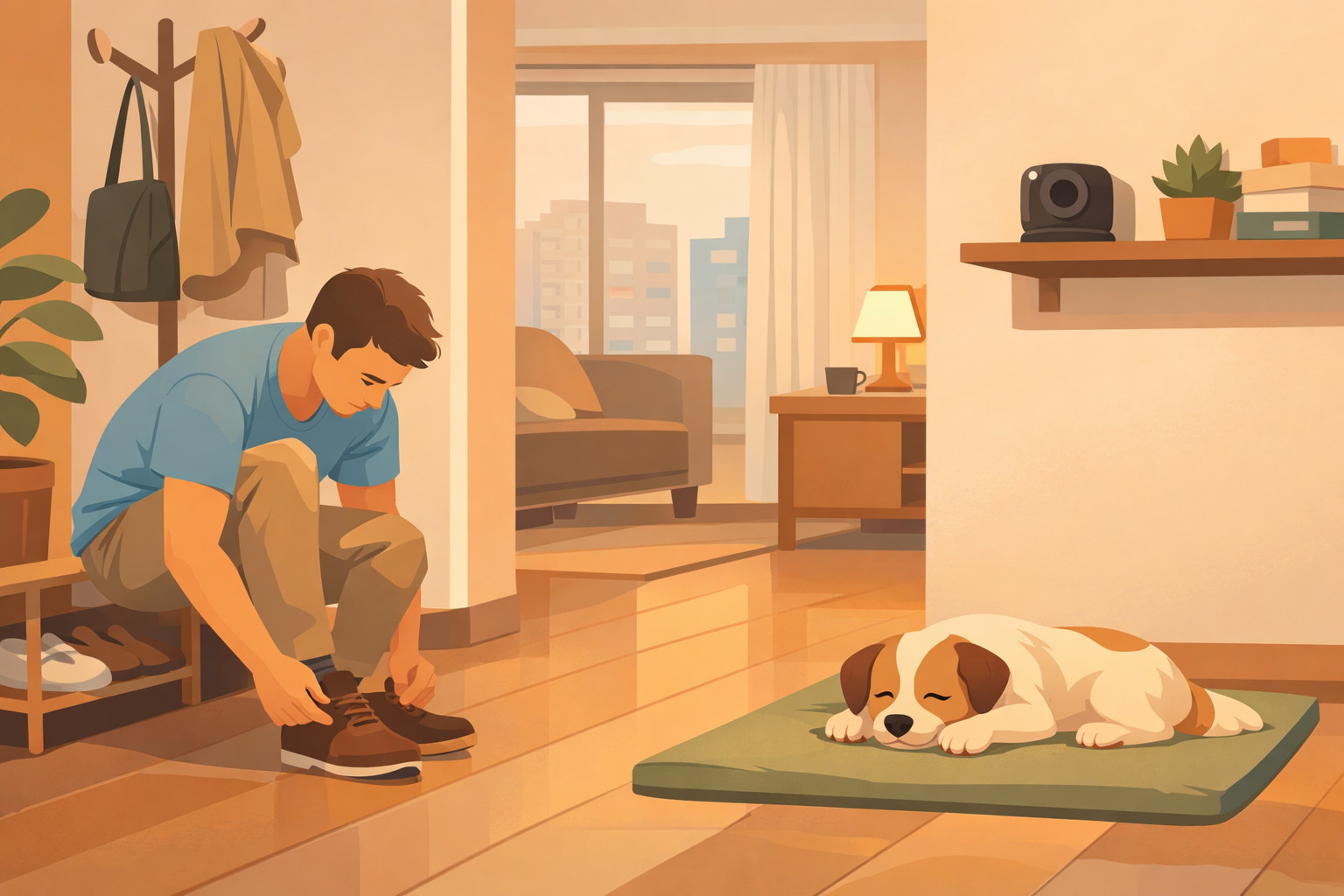
keys / shoes / coat = scary moment is coming.
So if you do emotional goodbyes, dramatic cuddles, or come back “OMG I missed you!”… it can accidentally make leaving feel bigger.
Do this instead:
- Leave and return calmly (boring is the goal).
- Reward calm behavior, not panic.
3) The SaramGom “Seconds-to-Minutes” training
Step A) Neutralize departure cues (keys/shoes/coat)
Your dog panics before you’re even gone. So we start here.
Do 10–20 reps/day for 3 days:
- pick up keys → put down → sit
- put on shoes → take off → sit
- wear coat → walk around → take off
No leaving yet. We’re telling your dog: these cues don’t always mean abandonment.
Step B) Micro-absences (2 sec → 10 sec → 30 sec…)
This is the heart of the plan.
- Start with 2 seconds outside the door
- Come back before your dog explodes
- Repeat 5–10 times
- Increase very slowly: 2s → 5s → 10s → 20s → 30s → 45s → 60s
Rule: if barking/howling starts, you went too fast. Drop back to the last successful step.
Step C) Create a safe base (mat/crate/room setup)
Pick one “safe spot”:
- a mat in a quiet corner (not facing the door)
- a crate (only if your dog is already comfortable with it)
- a small room area with water + safe chew
Pro tip: Don’t rely on chews if your dog is too anxious to eat. That’s a sign you need smaller steps first.
In Korean apartments, this gets reported fast
In Korea, many buildings have:
- echo-y hallways
- frequent delivery knocks/door sounds
- neighbors passing very close to your door
So “alone-time barking” can quickly turn into management office calls or awkward neighbor encounters. (It varies by building/community, but the stress is real.)
Your goal isn’t “perfect silence.”
Your goal is less often + shorter duration + quicker calm.
Quick phrases you might hear in Korea
Common examples (tone varies):
- “강아지 소리가 너무 커요.” = “Your dog is too loud.”
- “관리사무소에 민원 들어갔어요.” = “A complaint was filed.”
Simple calm response you can use:
- “죄송해요. 지금 훈련 중이에요. 최대한 조용히 관리할게요.”
(Sorry—we’re training. I’ll manage it as quietly as possible.)
Short + consistent improvement usually matters more than perfect Korean.
Small changes that work in Korean apartments
- Avoid starting training at peak noise times (lunch delivery / evening arrivals).
- Put a draft stopper / mat near the entrance to soften sudden sound spikes (even a little helps).
- Use a phone camera or pet cam to check the exact minute barking starts (that’s your training boundary).
4) Today / This Week plan (realistic)
Today (10 minutes total)
- 3 minutes: keys/shoes desensitization
- 3 minutes: “safe base” mat practice (calm settle → treat)
- 4 minutes: micro-absences at 2–10 seconds only
This week (5 days)
- 5 minutes/day: micro-absences (increase only on success)
- 5 minutes/day: departure-cue drillsTrack 2 numbers:
- how many barking episodes
- how long to calm down
Checklist
- I practiced keys/shoes cues without leaving
- I started micro-absences from seconds (not minutes)
- I return calmly (no big greetings)
- My dog can still eat treats during training (under-threshold)
- I have a safe base away from the front door
FAQ
Q1. Should I ignore my dog’s barking until they stop?
A. If it’s true separation anxiety, “cry it out” can increase panic. Use smaller steps and return before meltdown.
Q2. My dog starts barking the moment I touch my keys. What now?
A. Do cue drills first: keys up/down without leaving, 10–20 reps/day for a few days—then micro-absences.
Q3. Are chews/Kongs enough?
A. Helpful only if your dog can actually eat while alone. If they refuse food, you’re too far over threshold.
Q4. How long does this take?
A. Some dogs improve in 1–2 weeks with consistent “boring wins,” but severe cases need longer. Consistency beats intensity.
Q5. When should I ask a vet or trainer in Korea?
A. If you see self-injury, nonstop panic, sudden behavior change (possible pain), or bite risk around the door—get professional help. Safety first.
This article provides general training guidance, not a diagnosis. If your dog shows self-injury, extreme panic, sudden behavior change (possible pain), or bite risk, consult a vet or qualified trainer for a safety-first plan
Related guides
English edition copyedited and supplemented on October 9, 2026.