Practical starting point
Drooling alone cannot distinguish motion sickness from fear, and both can occur together. Record when signs begin: approaching the parked car, entering it, starting the engine or moving. Discuss nausea with your veterinarian before practicing longer rides. Use suitable vehicle restraint and never leave the dog unattended in a parked car during training.
Comprehensive summary of dog excitement, drooling, and barking in the car: solutions by cause (Saramgom version)
3 key things
① Quickly distinguish whether drooling is due to motion sickness or anxiety.
② We will teach you the steps to safely reduce window scratching (window brushing), barking outside, and wandering around.
③ We will organize the seat (mat) routine that works even in the car so that you can apply it starting today.
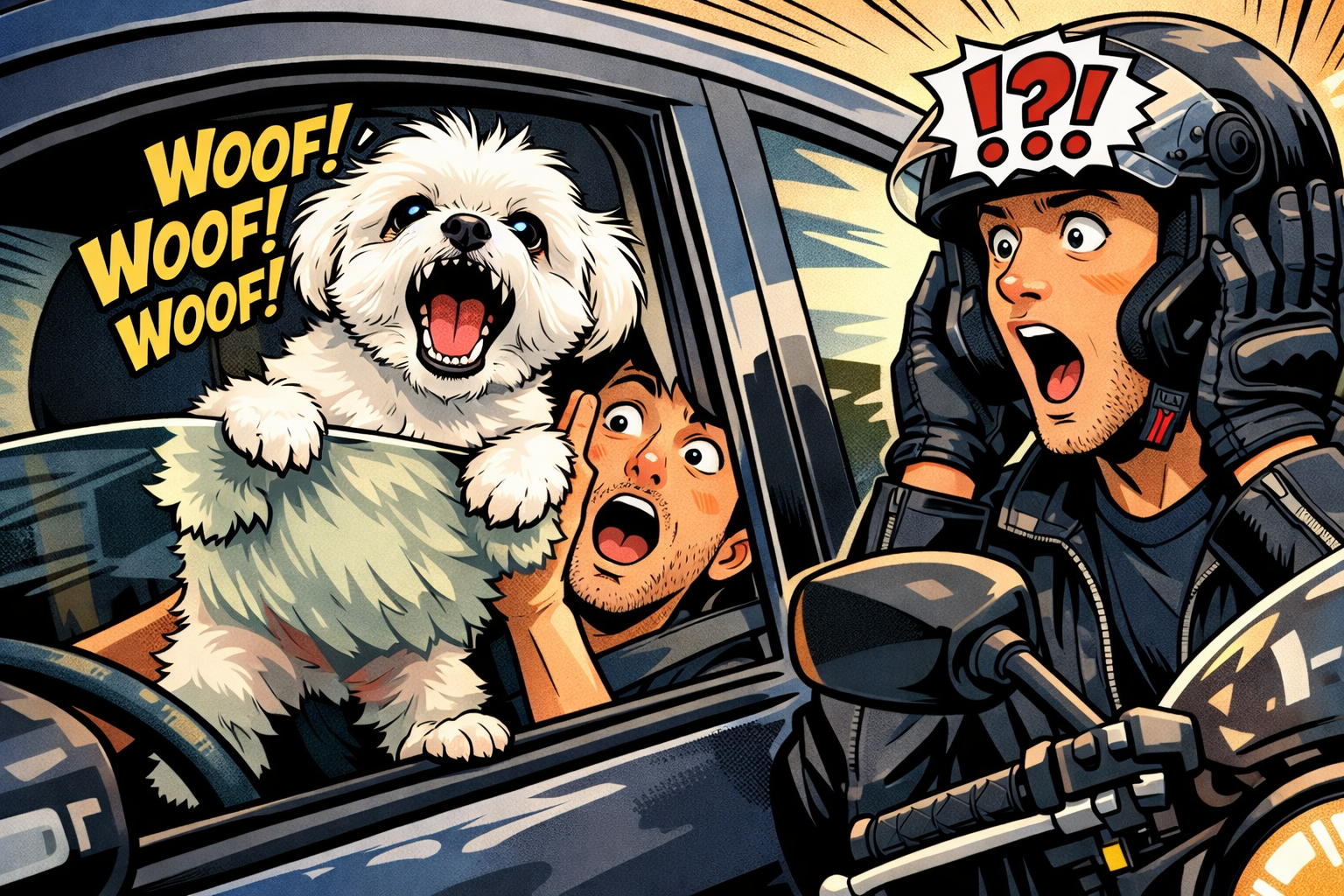
The moment you get into a car, you may be concerned about excitement (scratching the window, jumping over the front seat), excessive salivation (motion sickness, anxiety), and barking at external stimuli. You may be wondering whether this situation involves training, whether you need to go to the hospital, or whether you need equipment such as a kennel. In this article, I will tell you why and how to solve it!
3 major causes of problem behavior in the car
There are three main causes of problem behavior in cars.
1) Motion sickness (nausea)
- Excessive salivation, loss of appetite, vomiting, nausea
- Increased yawning and lip licking, drooping
- Feature: If you feel uncomfortable “even when you are still”, you are likely to get motion sickness.
2) Anxiety, fear (tea = stress memory)
- Run away and resist even when near the car
- Immediately after boarding, I started panting, shaking, my eyes got bigger, and my body stiffened
- Feature: It is already difficult even before the car starts moving.
3) Overexcitement, frustration (outside is too stimulating)
- Scratching (window brushing), barking, jumping forward
- If you can’t see them, they get more annoyed and sometimes whine
- Features: There are many patterns that explode “when you look outside.”
Safety First: Basic Rules to Prevent Accidents (Before Training)
The car problem is ‘training’, but at the same time, it is the risk of an accident. It is very dangerous if your dog runs around or jumps onto the front seat while driving.
Harness fixation vs. carrier (crate, kennel) selection guide
- Excessive excitement, rushing, falling over the front seat, scratching the window → Crate is the cleanest.
- Suspicious of motion sickness + more anxious in narrow spaces → It may be easier to start with fastening the harness + seat belt.
- One key point: ‘Fixing’ it so that it cannot move around freely.
Block access to windows and front seats (as soon as today)
- Opening the window halfway and sticking out your face may increase the risk of foreign objects, sudden stops, or falling.
- Just fixing the rear seat + adjusting the view (cover, blocking the light) reduces excitement and barking to the first degree.
Summary of symptoms & solution routine
① Scratching the window (window brush) + excitement
Candidate cause: Excessive external stimulation (people, dogs, motorcycles) + habituation to excitement
Today (management)
- Block access: Fixation of carrier or rear seat + Restriction of view from window (cover, shading)
- Alternative behavior payment: The moment you get into the car, you will receive one “car chew (safe gum/toy)”
- Breaking the arousal loop: Silent vision/distance control is faster than “verbal soothing”
Training method (7 steps)
- Ignition OFF: Sit in the car for 10 seconds → 1-2 snacks → Get out immediately
- Increase to 30 seconds (excitement level 0-1 only)
- Ignition ON (no movement) 10 seconds → reward → End
- Very short drive (one lap in front of the house) → reward → end
- Increase the distance starting from areas with less stimulation outside the window
- Create success by lowering the difficulty level by covering sections with strong stimulation
- At the end, open the cover little by little and switch to “Reward if it is quiet”
Point: When it comes to primary training, short and frequent wins, not “long at a time.”
② Drooling profusely (including panting and vomiting)
There are two main types of acupuncture: sickness (motion sickness) or nervousness (anxiety).
Signal for motion sickness
- Worse after starting driving, nausea, vomiting, drooping
- Solution approach: environment, routine adjustment + veterinarian consultation
when necessary
Signs of anxiety
- Spitting before moving, avoidance and resistance near cars
- Solution approach: Desensitization (Cha = Re-learning comfort)
Desensitization: Systematic desensitization is a method of ranking situations that cause fear or anxiety according to their level of difficulty and then facing them first. If you are suddenly faced with a situation that is too burdensome, you do not get used to the situation. Rather, it causes enormous fear and can backfire, so you challenge yourself with what you can handle. If you systematically face it from a low level like this, you gradually become more insensitive to the situation and no longer feel any fear even if you are in the same situation.
Today (emergency routine)
- Avoid overeating 2-3 hours before boarding (there are individual differences)
- Temperature and ventilation are stable (if hot and stuffy, drooling and panting)
- If car = walk and hospital were repeated, sit in the car for a moment and then go straight home mixed in with “purposeless riding”
Caution: If drooling suddenly gets worse, or you experience vomiting, diarrhea, lethargy, or pain, you may need to check at the hospital before training.
③ Barking at people, dogs, and motorcycles outside
Cause pattern: Wariness (feeling scared) or frustration (wanting to go but can’t)
Today (management)
- Do not leave the field of view 100% open, but lower the intensity of stimulation by covering or blocking
- If you start barking, say “Quiet!” It is much faster to adjust distance and field of view than to shout
Training (in-car version ‘it’s okay to watch’)
- The moment you see a stimulus from afar (when you are not barking yet) “Good” → Snack
- Continuous reward when the gaze returns to the guardian after looking at the stimulus
- Building “success without barking” by controlling distance and sight
The goal: not to eliminate stimulation, but to create a physical condition in which you can remain quiet even when looking.
④ Whining, moving around, falling over the front seat
Mostly it’s a mixture of anxiety, hyperexcitability + lack of rules.
- 1st priority: Fixing (mobile rack, belt)
- Second priority: Same use of seat (mat) signal in cars
- 3rd priority: Reinforcement of settlement behavior with “special snacks and toys only available in the car”
3 key training points (in-car version)
1) Bring the “seat (mat)” into the car
- Install the mat you used at home in your car
- Sitting on the mat, lying down = reward
- Rather than scolding them when they wake up, quietly encourage them again
2) Desensitization (a method of adapting to a larger stimulus by repeating the stimulus weakly) + Counterconditioning (short, frequent, comfortable)
Tea can easily become a “big event.” So 10 seconds to 1 minute is powerful. Build up “comfortable success” often rather than going for a long time all at once.
3) Design of alternative behaviors (chewing, licking, switching)
- Rather than suppressing excitement by saying “Hold on!”, create a channel for energy to flow
- Chew (safe gum), lick (licking mat), sniff (find treats), etc.
Hospital, signal that expert consultation is a priority
If any of the following applies, it is safer to go with a veterinarian or specialist rather than pushing for “training only”.
- Sudden explosion of drooling + accompanied by vomiting, lethargy, and pain
- Just riding in a car Panic (hyperventilation, escape attempt, self-harming scratching)
- The barking becomes stronger and spreads to the level of threatening people (safety equipment + behavioral counseling recommended)
- A situation where the risk of an accident is high because the guardian must attempt training while driving alone
Summary box
① Car problems usually start with one of motion sickness, anxiety, or hyperexcitability (including combinations).
② The solution sequence is Safe fixation → Stimulus management (field of view/distance) → Short desensitization training.
③ If spitting, vomiting, or panic is severe, it is faster and safer to consult a hospital or specialist before training.
Checklist (apply immediately)
- [ ] Rear seat fixation (carriage rack or harness seat belt) completed
- [ ] Adjust stimulation intensity by window view (cover/shading)
- [ ] Prepare 1 tea-only reward (gum/licking/snack)
- [ ] “Purposeless riding” sessions of 10 seconds to 1 minute, 4 to 6 times a week
- [ ] When barking begins, instead of shouting, adjust distance/field of view first
- [ ] If spitting + vomiting / lethargy / pain, check at the hospital first
FAQ
Q1. Whenever a dog gets in a car, it drools. Is it motion sickness?
A. It could be motion sickness or anxiety. If drooling starts before driving, there is a high possibility of anxiety, and along with driving if it worsens and is accompanied by vomiting, there is a high possibility of motion sickness. If it is accompanied by sudden worsening or lethargy, it is safe to consult a hospital.
Q2. Scratching the windows and getting excited. Should I scold you?
A. Blocking access + alternative action + short adaptation is faster than scolding. When you are excited, it is difficult to stop and driving safety becomes dangerous. Start by fixating/adjusting the field of view first.
Q3. Is barking at people outside your car a lack of socialization?
A. There are many “vigilant, anxious” or “frustrated” patterns rather than just socialization issues. The key is to lower the field of view (cover) and relearn it by ‘rewarding if it is quiet even when viewed from a distance.’
Q4. The crate looks rather unstable. Can I use it?
A. It depends on the child. If the dog is overexcited or has a lot of rush, the carrier is safe, but there are also individuals who develop fear in small spaces. In that case, it is better to start by fixing the harness and then proceed with adjusting to the transport space separately.
Q5. How long does training take?
A. Mild excitement is often relieved immediately with a “management setting,” but when anxiety and motion sickness are mixed, it can last for several weeks. The key is to build success in 10-second to one-minute increments, not for long periods at a time.
If your dog barks or panics in the car, it is dangerous to train and drive alone. There are times when consultation is quick, starting with safety settings after looking at the situation (car structure, movement pattern, stimulus).
Related guides
- Dog Aggression Warning Signs: When to Stop an Interaction
- Puppy Training Basics: Sit, Down, Stay and Come
English edition copyedited and supplemented on October 9, 2026.