Practical starting point
Alternate short practice with sniffing and exploration. Reward a voluntary check-in, practice one easy turn, then release the dog to investigate a safe area. A walk is not an obedience test from start to finish. If your dog is already lunging or frightened, create distance first instead of demanding a long sit near the trigger.
Dog walking training, proper walking method and basic training that can be done while walking
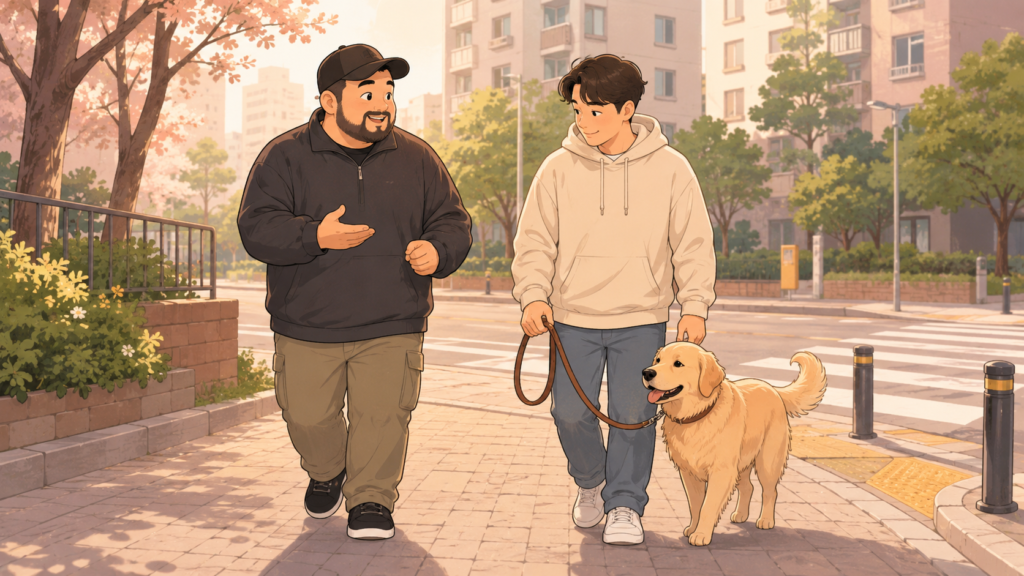
Hello, I’m Saramgom, a dog trainer. Today, let’s look at how everyday walks can help your dog practice useful skills.
Walking a dog is not just a time to go outside and walk.
Walking is an important educational time where a dog learns about the world, communicates with its guardian, and manages its excitement.
However, many guardians have these concerns even though they go for a walk every day.
- When I go out for a walk, the leash is pulled too much.
- When I see a person or a dog, I get excited and run.
- Only smells and does not listen to guardians.
- Even after going for a walk, I feel more excited at home.
In this case, walking time may actually be time to practice excitement.
Today, we will summarize the correct way to walk and basic exercises that can be done while walking.
- Know what the right walk is.
- You can learn 7 basic exercises that you can do while walking.
- You can create a walking routine that reduces leash pulling and excitement
A proper walk is not a long walk, but a practice of walking together
Many guardians think that dogs will naturally become calmer if they go for long walks.
Of course, sufficient walks help relieve energy.
However, if the quality of the walks is not good, problem behaviors may be repeated.
For example, if the dog pulls on the leash, the owner keeps being pulled, and the dog only moves in the desired direction, the dog can learn like this.
“If you pull, you can move forward.”
“If you’re excited, you’ll get to where you want to be.”
“External stimulation is more important than the guardian.”
On the other hand, a good walk gives your dog a different experience.
“Good things happen when you walk next to your guardian.”
“If your name is called, you just have to look at your guardian.”
“If you wait, you can move again.”
“You can explore the world even without being excited.”
In the end, a proper walk is not a time to tire your dog, but
a time for it to learn how to move with you.
Preparation before a walk is half the battle
Walk training doesn’t start outside the home.
In fact, it already begins the moment you see the harness or leash.
As soon as the dog gets ready for a walk, it starts running, barking, and spinning around, and if the owner quickly puts the harness on and then goes right out, that excitement can continue throughout the walk.
Before a walk checklist
- Make sure the harness or leash fits well.
- Make sure the leash is not too short or too long.
- Have a small snack or reward tool ready.
- See if your dog can stop for a moment in front of the front door.
- Don’t go straight out the door excited.
There is no need to make them wait completely from the beginning.
If their feet are on the floor even for a second and they look at their guardian once, praise them quietly and open the door.
If you repeat this, the puppy will learn little by little.
“When you become calm, the walk begins.”
7 basic exercises you can do while walking
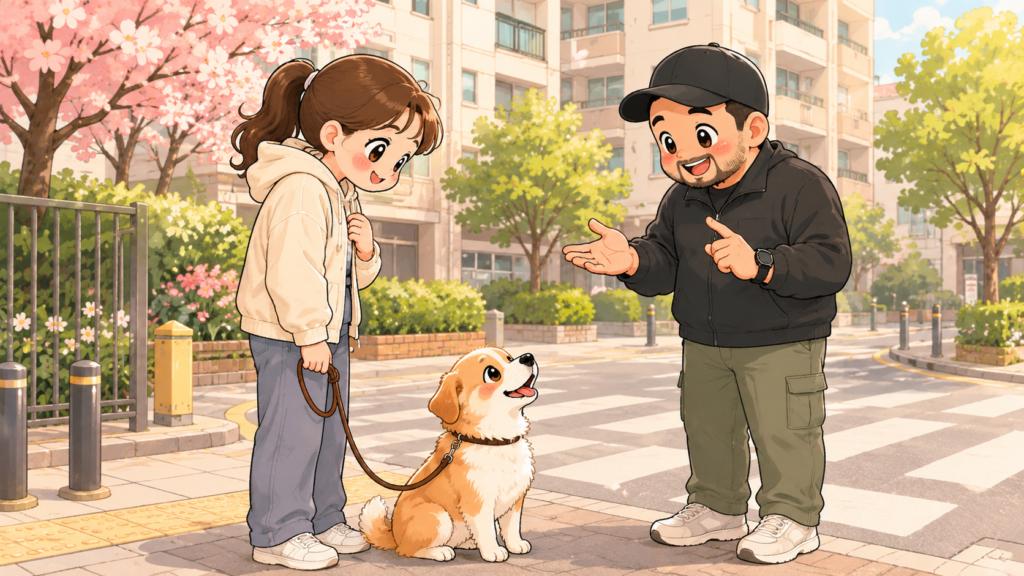
Training while walking does not need to be long. Rather, it is better to do it briefly and frequently.
If you try to fill the entire 30 minutes of the walk with training, both the dog and the owner will get tired.
Most of the walk can be done by walking, sniffing, going potty, and exploring the surroundings.
However, the quality of the walk will change if you add basic training briefly in between.
1. Look at me when my name is called
The first training required during a walk is name response.
All walk training begins with the dog looking at its owner when its name is called.
- As soon as the dog is not too excited, call its name.
- Praise the puppy as soon as he looks at you.
- Snacks are provided at a location close to the guardian.
- Walk naturally again.
The important thing here is not to use names as scolds
“It’s a bear! No!”
“It’s a bear! What’s wrong with you!”
“It’s a bear! Don’t do it!”
If the name is repeated in this way, the dog may not feel good about the owner even after hearing the name.
The name should be a signal that something good will happen when called.
2. Walking on a loose leash
The most common problem while walking is leash pulling. What a dog pulling on a leash needs is not strength, but the experience of being able to move forward when the leash is loose.
- When the dog pulls on the leash, the guardian stops.
- Praise the puppy when the leash loosens slightly or when the puppy turns to look at you.
- Walk forward again.
- When walking well, reward the child next to or close to the guardian.
The key is simple.
If you pull the rope, it stops, and if the rope is loose, it moves forward
Don’t try to walk the entire walk perfectly from the beginning.
An initial goal of 5 steps is sufficient.
Praise when you take 5 steps well, then slowly increase to 5 steps, then 10 steps.
If the string is too tight, please also refer to the article below.
👉 How to fix dog pulling when walking, human-style 7-day routine
3. When you stop, stop together
Training to stop while walking is more important than you might think.
Your dog should be able to stop with you at a crosswalk, in front of an elevator, in a car driveway, or in situations where he encounters another dog.
- While walking, the guardian quietly stops.
- Praise the puppy when he stops with you or looks back at you.
- You do not need to sit down at first.
- Once you get used to stopping, you can even connect it to “wait.”
Stop training is especially necessary for large dogs or strong dogs.
This training is not only about etiquette, but it is also related to the safety of both the owner and the dog.
4. Sit and wait
“Sitting” while walking is not just a personal skill. This is an exercise in which the dog briefly lowers his excitement and listens to his guardian’s signals.
Good places to use it are:
- Before the crosswalk
- In front of the elevator
- In front of the front door
- In front of vehicle access road
- Situations where people or dogs are seen far away
If you make it wait too long from the beginning, it may fail.
You can succeed if you wait just 1 second at first.
Then slowly increase it to 2 seconds, 3 seconds, and 5 seconds.
The important thing is to release your puppy before he fails. It is better to succeed briefly and end it than to endure too long and fail.
5. Come here, change direction
Changes of direction during a walk are great for correcting leash pulling and controlling excitement.
When the dog looks forward and tries to run, the guardian quietly changes direction and praises the dog when it follows.
At this time, it feels better to have the guardian move first and help the dog follow rather than to feel the dog being pulled by the lead.
It is best if the signals that can be used are short and simple.
- Come here
- Let’s go
- This way
- Let’s turn
If each family member uses different words, the dog may become confused.
It is best to use the same word for walking signals across the family.
6. Ignoring passers-by and dogs
The most difficult situation during a walk is when you encounter another person or a dog.
Many owners call their dog’s name after it has already barked, jumped, and lunged at him.
But it is often already too late at this time.
The timing of training is before the dog gets excited.
- Spots a person or dog from afar.
- When my dog is still watching quietly, I call his name.
- Reward when they look at you or stand calmly.
- Close your distance before you get too close.
The key is not “Hold on!”, but
to let people know “You can be calm even when you see that stimulus”.
If the dog aggressively charges at another dog, has uncontrolled barking, or is accompanied by biting and aggression, it is better not to try to correct it by directly hitting it while walking.
In this case, it may be necessary to check with an expert about setting a safe distance and how to lead the guardian.
7. Cue the start and end of sniffing
Sniffing is very important when walking a dog.
For a dog, smelling is a time to read information.
However, the rhythm of walking with the guardian may be disrupted if the dog is dragged and sniffed everywhere.
So, it is a good idea to provide start and end signals.
- Smell
- Take a look
- Let’s go
- Now move
For example, say “sniff” and let the child smell for a certain period of time.
Afterwards, say “let’s go” and praise the child if he or she follows the guardian.
This way, your dog can learn both freedom and rules during walks.
Walking principles required for dogs that pull on a leash
If you try to overcome a dog pulling on the leash, a walk will be tiring for both the owner and the dog.
There is a risk of injury to the owner, especially for medium to large dogs that are strong.
The important thing is to teach your dog clear standards.
Basic principles of leash correction
- If you pull, it will not move forward
- If the line is loose, move forward.
- reward is provided next to or close to the guardian.
- Do not grab or scream suddenly.
- Practice in a quiet place first rather than a place with a lot of stimulation.
Leash pulling may not go away completely in a short period of time.
However, if you repeat the same standard every time you walk, your dog will gradually come to understand the rules of the walk.
If your dog gets excited during a walk, distance control comes first
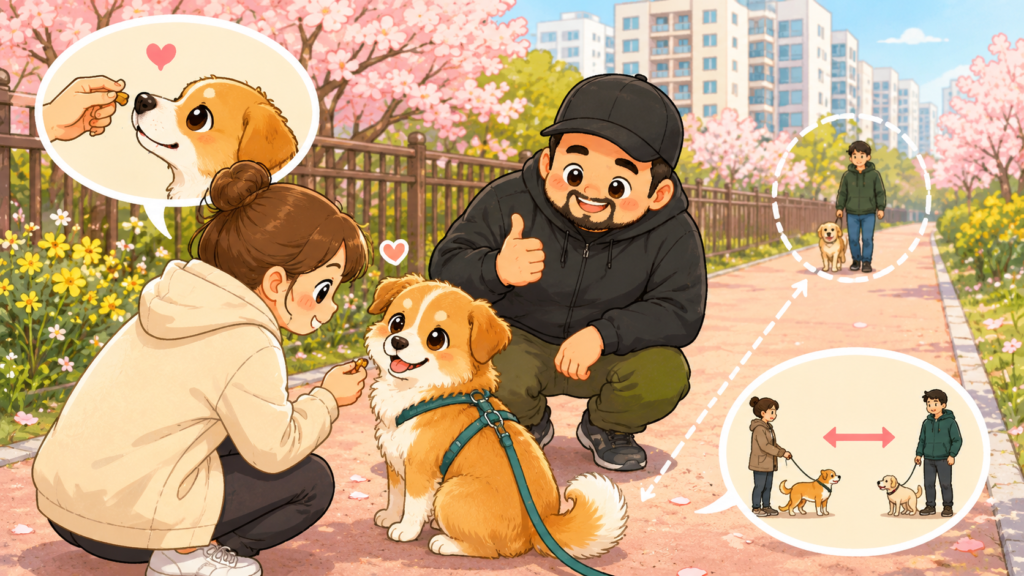
It doesn’t mean that a dog that gets too excited during a walk can’t be trained.
In most cases, it’s just that it’s facing a stimulus from too close a distance.
It may be too difficult to tell a child who gets excited when he sees another dog to “sit!” while having him pass right by.
You should practice looking from a distance at first.
Distance control training sequence
- Start at a distance where the dog will not react.
- Praise the child if he or she remains quiet despite the stimulus.
- Reward your guardian when you see him/her.
- Shortly reduce the distance.
- When they get excited, they increase their distance again.
This training is important for all fearful dogs, very excited dogs, and dogs with poor social skills.
Walking should not be a time to blindly experience a lot of stimulation, but a time for the dog to learn about the world at a distance that the dog can handle. In situations where it is difficult to control the distance, the guardian moves and blocks the space, giving the dog a sense of stability.
If your dog is afraid and has a hard time going for walks, you may want to read the article below first.
Walking routine to be practiced by guardians starting today
There is no need to start walking training in a complicated way.
Starting today, just following the routine below can change the flow of your walk.
What to do today
- If you get excited by the harness, don’t go out right away
- Wait calmly for 3 seconds in front of the front door
- Practice looking up 5 times when your name is called while walking
- Praise when the strings are loose
- If you pull the rope, it won’t be dragged and will stop
Repeat in the future
- Practice stopping in front of a crosswalk
- Practice changing directions 3 times a day
- Choosing the start and end of sniffing
- View a person or dog from a distance and reward them when they are calm
- Check whether your dog is well rested after a walk
Changes to check in 2 weeks
- Has the string pulling decreased?
- Do you see each other more often when you call them by name?
- Does your reaction distance decrease when you see another dog?
- Do you rest better at home after a walk?
- Does the guardian find walking less difficult?
Walking training checklist
- □ Excitement level was checked before wearing the harness.
- □ I waited for a moment in front of the front door.
- □ Practiced name responses while walking.
- □ Praised when the line was loose.
- □ When I pulled the rope, it didn’t get dragged around.
- □ Allow time to smell.
- □ Do not allow people or dogs to meet too closely.
- □ Briefly practiced sitting, waiting, and changing directions.
- □ Checked to see if the dog was stable after the walk.
Walking problems requiring consultation
Not all walking problems can be solved by the guardian alone.
In particular, in the situations below, safety comes first.
- When he sees another dog, he barks violently and lunges at him.
- Running towards people, bicycles, and motorcycles.
- There are attempts to bite or attack while walking.
- It is so strong that it is difficult for the guardian to hold on to the rope.
- I’m too scared to move outside.
In this case, rather than exposing the dog to excessive walking, it is better to first check the distance the dog can handle and the guardian’s lead method.
If you are struggling with walking problems, leash pulling, excitement, or aggression in the Pohang and Gyeongbuk areas, you can check the current situation together through an on-site training consultation.
A word from the Saramgom
Walking is not a time to tire your dog, but a time to safely learn about the world with your guardian.
Not pulling on the leash, waiting, and watching your guardian are all not completed at once.
The best walk training is to build up success in short bursts each day.
FAQ. Dog walking training frequently asked questions
Q1. How many times a day should I walk my dog?
It depends on the breed, age, health, and energy level of the dog.
Generally, more than 1-2 times a day is helpful, but the quality of the walk is more important than the number of walks.
A short, calm, interactive walk may be better than a long walk while the dog is overly excited.
Q2. I smell too much while walking. Can I just leave it alone?
Sniffing is an important exploratory activity for dogs.
However, it is not a good idea to follow the dog as if it is being pulled in all directions.
It is a good idea to create “sniff” and “let’s go” signals to distinguish between free time and travel time.
Q3. Should I be scolded when I pull the rope?
Rather than scolding, it is better to teach the dog the rule of moving forward when the leash is loose.
If you stop when you pull the leash, walk again when the leash is slack, and so on, your dog can learn the standard.
Q4. I get excited when I see another dog. Should I say hello?
It is not a good idea to greet the dog unconditionally.
If you repeat the greeting while excited, the dog can learn that “it is okay to run when you see the dog.”
It is safer to first practice looking calmly from a distance.
Q5. When do I need expert consultation for walking training?
If the leash pulling is too severe and there is a risk of injury to the owner,
the dog barks and lunges at other dogs or people,
if there is bite, aggression, or extreme fear response, professional consultation is recommended.
Especially for large dogs or strong dogs, it is recommended to start training at an early stage.
Good article to read together
If you are curious about walking etiquette and city walking checklist, please read this article.
If your dog pulls the leash a lot, check the 7-day routine.
A different approach is needed for dogs that are afraid and have difficulty walking.
I hope that today will be a more comfortable walking day for you and your dog.
If passing dogs, scooters or people are difficult, start with more space and a quieter route. Our guide to leash reactivity on narrow sidewalks in Korea explains how to spot early tension, practise a U-turn and build calmer walks.When your dog barks or lunges on walks
Related guides
English edition copyedited and supplemented on October 9, 2026.