Practical starting point
Teach each cue in a quiet place before combining it with distractions. Say the cue once, reward the useful response, and make the next attempt easier if the puppy is confused. For recall, use a secure area or suitable long line; do not test a new cue beside traffic. End a stay with a clear release rather than waiting for the puppy to fail.
Hello. As I was searching for topics to write my blog posts based on my experience and consultation, I finally realized that there were no posts about basic training. In fact, when you first start raising a puppy, the thing that owners most want to look for and know about is basic training.
Basic dog training is not simply about teaching individual skills. Signs such as sit, down, wait, come, turn, bark, and quiet are the basic language used by you and your dog to communicate with each other. If taught well, going for a walk, greeting guests, visiting the hospital, grooming, using a cafe, and even preventing problem behavior become much easier.
In today’s article, we will summarize the order in which basic dog training should be taught, in line with the reward-based training principles that have recently been widely used internationally. It is not a method of pushing the dog or forcing it into a position, but a method of letting the dog choose its own behavior and letting it know that that behavior will lead to good results.
Key!!
- You can find out in what order you should start basic puppy training.
- You can learn how to practice sit, down, wait, come, turn, bark, and be quiet at home.
- You can reduce the reasons why dogs do not listen and the mistakes that guardians often make.
To summarize, basic training of a dog is more about “making it understand the guardian’s signals” rather than “making it listen to commands.” At first, you should try to achieve success briefly in a quiet room, reward success immediately, and gradually increase the location and distractions. It is much better to train for 3 to 5 minutes several times a day rather than one long session.
Why is basic dog training necessary?
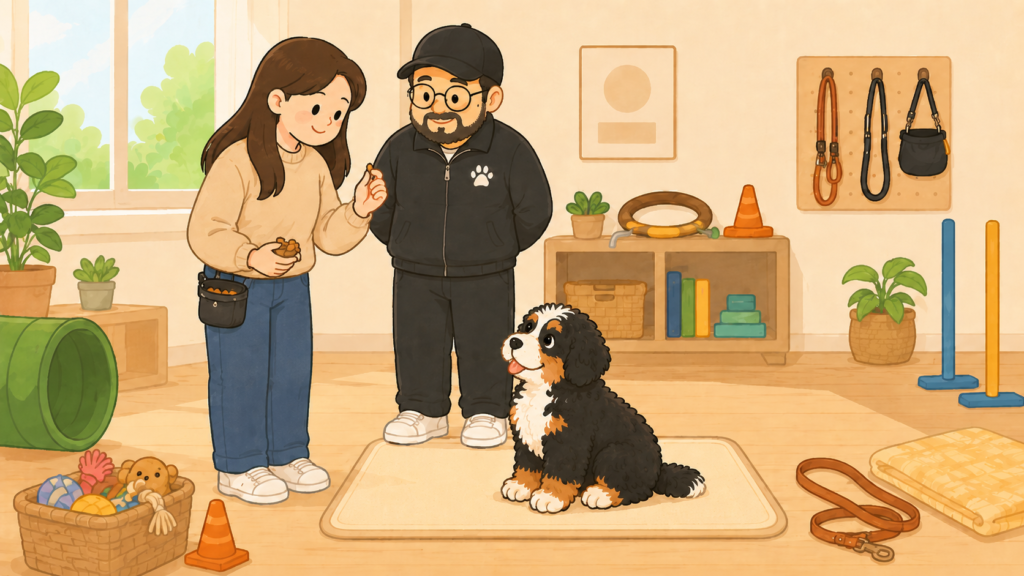
Basic training is not a technique for controlling a puppy. It is a promise for the guardian and the dog to live together. “Sit” can be a starting point for lowering arousal, and “wait” can help reduce door rush or pre-meal excitement. “Come here” is an important signal to protect your dog from dangerous situations during a walk.
Many guardians think of basic training as “a process to check whether our dog is smart.” But the point of training is not intelligence testing. This is the process of letting your dog know what kind of behavior will lead to good results. Puppies learn through repetition. If the owner praises and rewards the dog at the correct timing, the dog is more likely to choose that behavior again.
On the other hand, if the guardian repeats the signal, scolds the dog when he does not do it, and forces the dog to behave, the dog may feel that training is a burdensome situation rather than a pleasant communication. So basic training should be short, easy, and start with a high success rate. If your dog is timid or sensitive to new environments, Approaches to training a fearful dog would also be good to see.
Basic principles close to international standards: reward-based training
The most important trend in modern dog training is reward-based training. This is a method of encouraging the dog to repeat the behavior by giving rewards such as treats, praise, play, walks, and freedom when the dog performs the desired behavior. The important thing here is not to blindly lure your dog with a treat, but to accurately indicate and reward the desired behavior when it occurs.
There are four basic principles. First, start with an easy environment where your puppy can succeed. Second, praise and reward the desired behavior as soon as it occurs. Third, if your dog fails, lower the difficulty level rather than scolding him. Fourth, after practicing well indoors, gradually change the location to practice, such as the entrance, elevator, or walking path.
For example, there is a dog that is good at “sitting” at home but not on walks. This is not because the dog is stubborn, but because the walk is much more difficult. If there are too many distractions, such as smells, people, dogs, bicycles, and car sounds, it is difficult for dogs to focus on their guardian’s signals. If you get too excited or pull on the leash while walking, start with basic training It is recommended to apply it together with the 7-day dog walking routine.
To prepare before training
There is not much to prepare before starting training. A small snack, a quiet space, a short amount of time, and a calm attitude from the caregiver are all that is needed. Treats are small enough for your dog to eat in one bite. Snacks that are too large can take longer to eat and can disrupt the flow of training.
It is not recommended to train for a long time at once. At first, 3 minutes is enough. Finish before your puppy loses focus and looks forward to the next training session. If the guardian becomes greedy and repeats it for a long time, the dog may get tired and ultimately end up experiencing failure.
Another important thing is the reward word. It’s a good idea to set a single compliment like “Good,” “That’s right,” or “Yes.” The moment your dog performs the desired behavior, give this sign and reward immediately. This makes it easier for your puppy to understand what behavior earned him a reward. Because small success experiences help the dog’s stability and confidence, It would be good to see it in conjunction with How to Raise Your Dog’s Self-Esteem and Confidence
Recommended order of puppy basic training
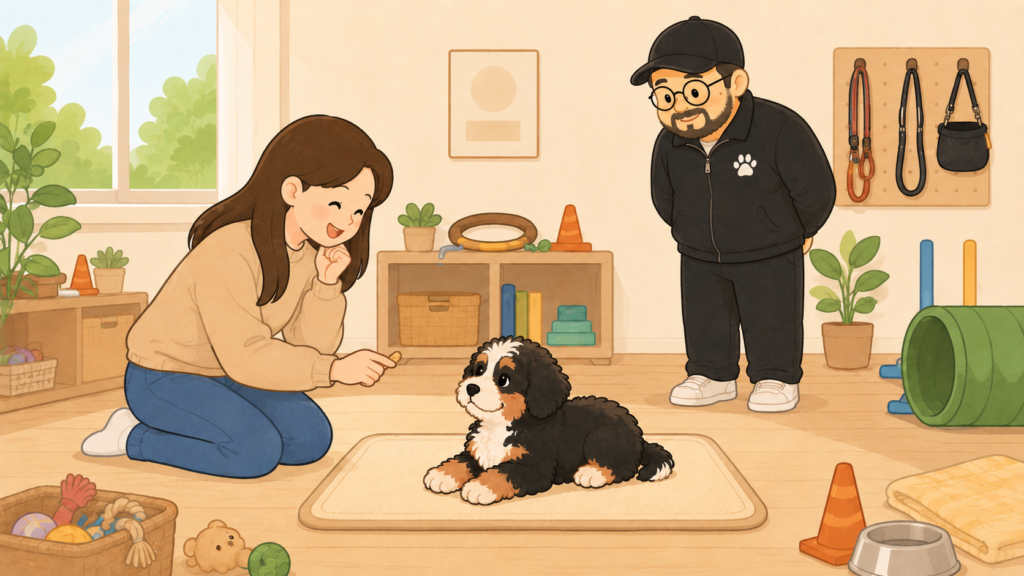
It may seem that basic dog training can be done in any order, but in reality, it is better to go from easy to difficult. I usually recommend the order of name response: sit, lie down, wait, come here, let go, be quiet, and turn around.
| Sequence | Training signal | Purpose | Difficulty |
|---|---|---|---|
| 1 | Name Response | To guardian Concentrate | Easy |
| 2 | Sit | Lower excitement, create basic posture | Easy |
| 3 | Lie down | Calm posture. Create | Average |
| 4 | Wait | Impulse control, etiquette at the door and before meals | Average |
| 5 | Come here | Prevent dangerous situations, connect with caregiver | Importance High |
| 6 | Put it away / Spit it out | Manage foreign objects, toys, food | High Importance |
| 7 | Quiet | Barking Control | Medium~Difficult |
| 8 | Turn / Bark | Trick training, increase confidence and concentration | Fun training |
This order is not an absolute rule. But once you get the name response and sit first, the rest of the training becomes much easier. If the puppy does not have the habit of looking at the owner, but starts by waiting or coming, there is a high chance of failure.
1. Name reaction training
Name response is the starting point of all training. When the dog’s name is called, the first thing the dog looks at is the guardian. Many guardians scold their children after calling their name, forcefully hold them, or start doing things they dislike, such as bathing or cutting toenails. Then it will be difficult for the dog to take the name as a good signal.
The training method is simple. Call your dog’s name only once in a quiet space. As soon as the puppy looks at you, say “okay” and give it a treat. At first, eye contact for just one second is enough. The important thing is not to repeat the name multiple times. If you keep calling “Choco, Choco, Choco,” your puppy will learn that he can ignore the first signal.
Start at a close distance, and once you get used to it, practice at a slightly further distance. Then gradually increase the level of difficulty, such as when there are toys, when family members are moving, near the front door, or before a walk.
2. Sit training
Sitting is the most basic training. However, we do not recommend that the guardian sit down by pressing the dog’s buttocks with their hands. It is a good idea to let your dog choose the sitting behavior on his own and reward him for that behavior.
Show the treat in front of the dog’s nose and slowly raise it above the dog’s head. Many dogs naturally let their butts touch the floor as they raise their heads to follow the treat. The moment your butt touches, say “Okay” and immediately give the treat. After repeating this action a few times, if the behavior goes well, add the word “sit”.
It is better not to repeat “sit, sit, sit” from the beginning. If you repeat a word when your dog doesn’t yet know what it means, the signal will be blurred. It is cleaner to create the action first and then add the verbal signal.
3. Lie down training
This is a posture that helps calm a dog that is about to lie down. You can also use it for excitement before a walk, visiting guests, or waiting in a cafe or hospital. However, it may be a little more difficult than sitting, so proceed slowly.
First, make the dog sit down and then slowly lower the treat from in front of his nose toward the floor. When your dog bows his head and lowers his front legs after the treat, wait. Praise and reward as soon as the chest and stomach sink toward the floor. It’s okay if it’s not perfect at first. You can compensate by starting with a small movement of lowering the front leg.
If your dog retreats or stands up, the location of the treat may be too far away or too fast. At this time, don’t get scolded and just start again. It is best not to teach the child to lie down by forcefully pulling the front legs or pressing the body.
4. Wait training
Among the basic training to wait for, this is the training that guardians fail the most. The reason is because it makes you wait too long from the beginning. If you increase the waiting time, distance, and distractions all at once, you will fail. You should start by waiting 1 second at first.
While your dog is sitting, briefly show your palm and say “wait.” After 1 second, say “Okay” and give the treat. Then gradually increase it to 2 or 3 seconds. If your dog moves, don’t scold him, but shorten the time again. Failure does not mean that the dog did not listen, but that the level of difficulty was high.
What is important in wait is the release signal. You need to set up words that say you can move now, such as “finished,” “you can go,” or “okay.” If you just wait and there is no release signal, it is difficult for your dog to know how long to wait.
5. Come here and train
It is an important training that is connected to life. Accidents can be reduced if you have a good come signal when your dog loses the lead while walking, approaches a dangerous object, or runs toward another dog.
However, many guardians use Come Here when scolding. If you call “Come here!” and then give him a bath, trim his nails, end a walk, or scold him, he will learn that “Come” is the beginning of something he doesn’t like. Then it may not come when you really need it.
Start at a very close distance. The guardian says “come here” in a bright voice, and praises and rewards the puppy loudly even if it takes just one step. At first, do not grab the leash as soon as you arrive, but rather build up a lot of experience that good things will happen when you come to your guardian.
Come training begins inside the house, then extends to the yard, quiet walks, or safe spaces using a long leash. You should never practice as if experimenting in a dangerous space without a leash.
6. Let it go / spit it out training
Spitting or spitting is an important safety-related drill. This is necessary when your dog bites a foreign object on the street, puts dangerous food in its mouth, or becomes obsessed with a toy. However, if you force the dog to open its mouth and take it away, the dog may try to protect the object more.
Start with toys of low value. Show your puppy a better treat when he or she is holding a toy. The moment your puppy puts down the toy, say “Put it down” and give him a treat. Then give the toy back. This way, your puppy learns that letting go is a good exchange, not taking away.
The important thing is regular practice. If you suddenly shout “Let go!” only when your dog bites a dangerous object, it will be difficult for your dog to understand the signal. You should practice sufficiently through regular toy exchange.
7. Train quietly
Quiet training is not about suppressing barking. This is training that captures the moment your dog stops barking and connects it to the signal “Quiet.” If you keep shouting “Quiet! Quiet!” to a barking dog, the dog may feel that the owner is also excited.
Training begins in a situation where barking is relatively mild. There are moments when your dog barks once or twice and then pauses. In that brief moment of silence, say “quiet” and immediately reward it. One second of silence is enough at first. It gradually increases to 2 seconds and 3 seconds.
However, fearful barking or separation anxiety barking may not be resolved through quiet training alone. If you quietly repeat the same thing to a child who is barking out of fear, the cause will remain the same. In this case, distance control from stimuli, environmental management, and emotional change training are all necessary.
8. Barking training
Barking training is not a necessary basic training. However, when used in conjunction with quiet training, it can help cue barking. However, if your dog already has a lot of demanding barking, it is better to calm down first and control his excitement before proceeding.
Barking training can be taught by capturing the moment your dog naturally barks. For example, if your child barks briefly at the sight of a toy, reward him by saying “bark” the moment he barks. After a few repetitions, your dog will be able to associate the barking cue with the behavior.
But the goal of bark training is not to make your dog bark more. The goal is to create a structure where the dog barks briefly only when the guardian gives a signal, and then quietly stops with a signal.
9. Turn around training
It is closer to trick training rather than essential training for daily life. However, it helps develop your dog’s concentration, confidence, and sense of cooperation with you. This training is especially good for giving fearful or passive dogs a small experience of success.
Show the treat in front of the dog’s nose and slowly guide the dog’s body to make a circle. Praise and reward your puppy as soon as he completes a lap. You can compensate for just half a turn at first. When the movement becomes natural, give the signal “turn”.
Turn training may become burdensome for your dog if you turn it too quickly. It is recommended that dogs with weak joints, older dogs, and dog breeds with long waists do not repeat too much.
When should I cut down on snacks?
Many guardians worry, “If you don’t have snacks, your child won’t listen.” However, if you try to eliminate treats from the beginning, your training may falter. At first, it is a good idea to teach the behavior with treats, and once the behavior stabilizes, keep the treats out of sight, and then expand to daily rewards such as praise, play, walks, and opening the door instead of treats.
For example, if you sit in front of a door and wait, the door opening itself can be a reward. If your child looks at you during a walk, walking forward again can be a reward. Once basic training enters the child’s life, not only snacks are rewarded, but all the good things they do with their guardians become rewards.
Mistakes guardians often make in puppy basic training
The first mistake is repeating the signal too much. If you keep saying, “Sit, sit, sit,” your puppy won’t hear the first sit as important. It is a good idea to say the signal once, then lower the level of difficulty and say the signal again if the dog fails.
The second mistake is scolding yourself when you fail. When a puppy fails during training, it is usually because it has not learned enough yet, the environment is too difficult, the rewards are weak, or the owner’s signals are confusing. Rather than scolding, it is better to see why you failed.
The third mistake is taking too long. The longer you train your dog, the better. You should succeed and finish briefly while your concentration is still alive. Especially for young puppies, short and frequent treatments are best.
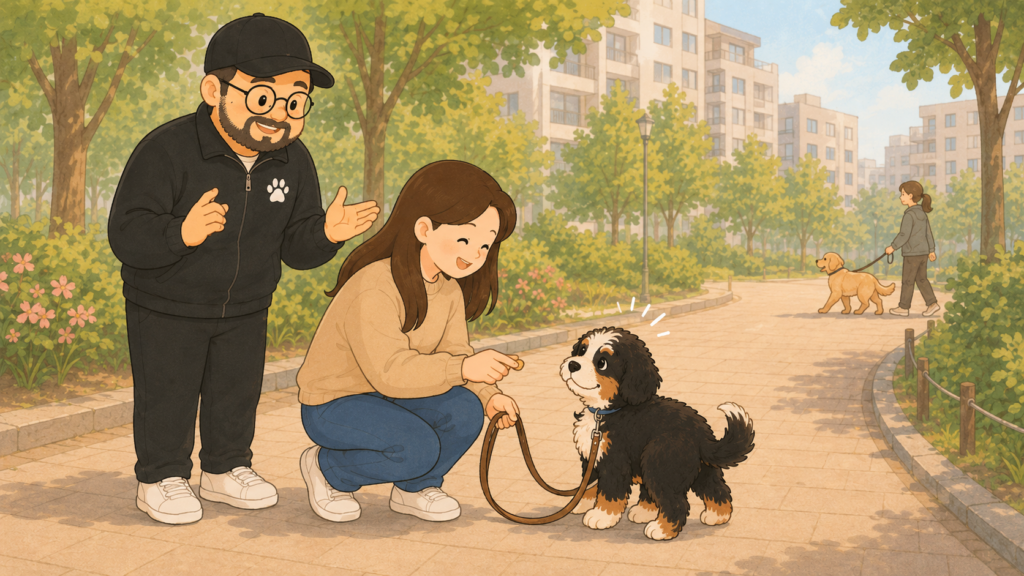
The fourth mistake is expecting indoor success to translate into outdoor success. Just because you can sit at home doesn’t mean you can do it in a park, cafe, hospital, or on a walk. A change of location is a new training experience for your dog. When you change locations, you have to start over easily.
7-day basic training routine you can do starting today
| Date | Training content | Goal |
|---|---|---|
| Day 1 | Name response, sit | Experience sitting while looking at the guardian Create |
| Day 2 | Sit and repeat, start lying down | Let them choose their own posture |
| Day 3 | Get down, wait 1 second | Experience a short pause. Create |
| Day 4 | Wait 3 seconds, release signal | Distinguish between waiting and ending signals |
| Day 5 | Come here | Good things will happen if you come to the guardian. Create |
| Day 6 | Put it out / Spit it out | Create an experience of exchanging items without them being taken away |
| Day 7 | Turn around or be quiet | Increase concentration and communication skills |
This routine is not meant to be completed in one day. This is a routine that sets the basic direction for 7 days. Every dog’s speed is different. Some children may be able to sit up in a day, while others may take several days to lie down. What matters is not speed, but the experience of success.
Basic training checklist
- When their name is called, they look at their guardian.
- You can sit down and listen to the signal once.
- You can do this without having to force yourself into a prone position.
- You can start by waiting 1 second and gradually increase the time.
- Hearing “come here” makes it fun to come to the guardian.
- When asking for an object, I learned to let it go or spit it out by exchanging it.
- The moment the barking stops, you can quietly connect the signal.
- Training is short, 3 to 5 minutes a day.
- If you fail, don’t get scolded and lower the difficulty level.
- After succeeding at home, practice in slightly different locations.
Man-Bear’s Conclusion
Basic puppy training is not a process of establishing the guardian’s authority. This is the process through which the guardian and the dog develop the same language. Signals such as sit, down, wait, and come are not just actions, but are basic promises for your dog to live safely and calmly in everyday life.
You don’t have to try to get it perfect from the start. Today you can start by looking once when your name is called, tomorrow by sitting for 1 second, and then by waiting 1 second. As small successes accumulate, your puppy will begin to enjoy learning time with you.
For dogs that have received basic training well, it is much easier to correct problem behavior. Whether dealing with issues such as barking, biting, excitement for walks, or separation anxiety, the fundamentals ultimately start with the ability to focus on the guardian, understand signals, and make calm choices.
FAQ. Basic dog training frequently asked questions
Q1. At what month should I start basic puppy training?
Short training sessions are possible once the puppy has adapted to the home and has begun to form a relationship with the owner. For young puppies, it is better to start with easy play training such as name response, sit, and short wait rather than longer training.
Q2. Can I train without snacks?
It is difficult to do without snacks from the beginning. It is a good idea to teach behavior with treats at first, and then expand to daily rewards such as praise, play, walks, and opening the door.
Q3. Why can I sit down but not wait?
Waiting is harder than sitting. This is because you have to adjust for time, distance, and distractions. Instead of making people wait for a long time from the beginning, you should start from waiting 1 second.
Q4. What should I do with a puppy that doesn’t come even when I call him to come?
You need to check if you have ever used “come here” as a scolding signal. Coming here should be a sign that good things will happen. You need to start at a close distance and practice praising and rewarding loudly when you arrive.
Q5. If you train by barking, won’t you bark more?
If your dog barks a lot, it is best to first practice quietness and excitement control. Barking training is meaningful when you create a structure where you bark briefly when giving a signal and then quietly stop with a signal.
Good-to-read-to-read-together
- How to fix your dog’s pulling while walking | Check out how basic training is connected to walking.
- How to train a fearful dog | For children who are very fearful, the training speed must be set at a different pace.
- How to increase your dog’s self-esteem and confidence|Read together why small success experiences are important.
- Collection of dog guardian education articles|Check out why the guardian’s reaction changes the training results.
- Collection of dog walking articles|Continue to see how to apply basic training to walking situations.
Guide to related articles: If you want to search articles by topic, including basic training, adoption, problem behavior, walking, and socialization, Puppy Check out the information you need in order in our collection of training information articles.
Related guides
English edition copyedited and supplemented on October 9, 2026.