Practical starting point
Prevent direct access to arriving guests with a secure barrier and a comfortable separate space. Ask guests not to reach, stare or offer hand-fed treats to a worried dog. A two-week schedule is only a planning aid, not a promise of safe greetings. Any bite history calls for an individualized plan before attempting introductions.
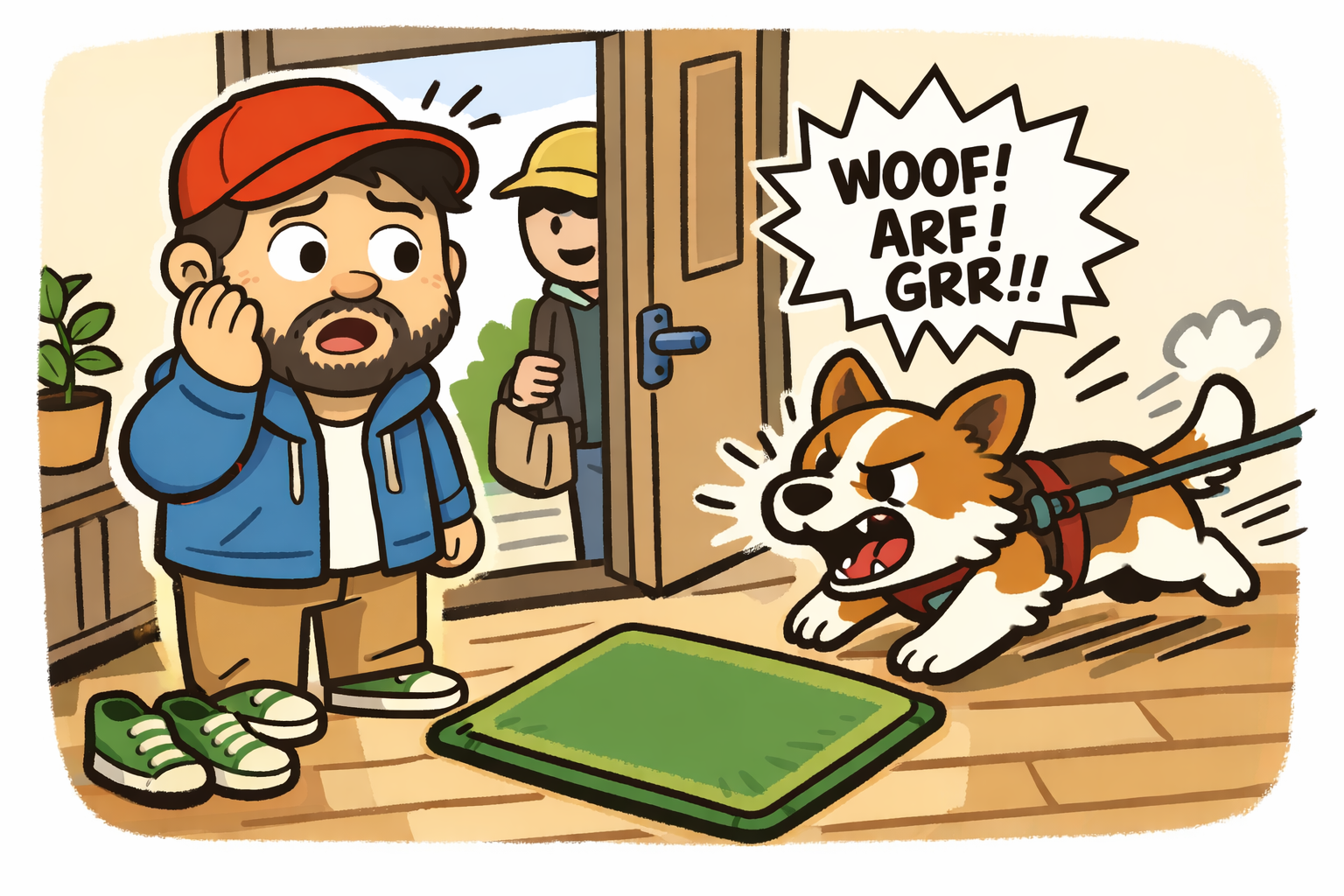
Whenever a guest comes, my dogbarks, runs at me, and even bites If… Guardians are always afraid to “open the door.”
But this is not because “I have a bad personality,” but mostly because I learned the situation that way. You can solve the problem through the information below.
- The moment guests arrive ‘Door routine’ to prevent accidents
- Sequence of changing barking and lunging into mat (place) alternative actions
- Why scolding makes things worse + Red flags that require an expert
⚠️ Safety first: If you have already bitten someone (bleeding, bruising, tearing) or have children in your home
Rather than training, such as separation, door management, and muzzle adaptation. Start with safety devices. If necessary, expert consultation is quick.
Summary
- Guest attacks usually explode with a mixture of fear + alertness + excitement.
- The solution is not “getting scolded” but in the order of door management (safety) → keeping a distance → reinforcing alternative behavior on the mat
- If bite history, increased intensity, bite without warning, expert + health check (may be suspected) is safe.
1) Why do you get especially angry when guests come?
In the guest situation, “strange events” occur all at once from the dog’s perspective.
Doorbell, door opening, stranger’s smell, footsteps, pressure entering the house… There is an intruder in my area… . This is one set.
1-1. Attack first because you’re scared (fear-based)
If you feel that a stranger coming into your house is a “pressure with no place to escape,” you may bark and run toward them and try to “Get away!” or “Go away!!”
1-2. Uncontrolled excitement (hyperarousal, impulsiveness)
From the moment the doorbell rings, my heart beats, and when the door opens, it goes out like an “explosion.” In many cases, excited situations are repeated, not out of malice, but out of out of control
1-3. Protecting territory and guardians (entrance, space, people)
The home is the dog’s core territory, and the guardian is a key resource.
The behavior of protecting “our home, our people” may be excessive.
1-4. If it suddenly gets worse: Discomfort or pain may also be suspected
If you were fine in the past but have recently become sensitive, you may suspect that you may be experiencing physical discomfort as well. (Confirmation is the domain of veterinarians)
2) “Routine 10 minutes before a customer visits” to prevent accidents today
The goal here is not “becoming friendly with customers,” but “avoiding injury + preventing explosions.”
2-1. 3 things to ask your guests first (really important)
If you say this to your guests, your success rate will increase significantly.
- As soon as you come in Do not make eye contact, extend your hand, or pat
- Until the dog calms down Ignore + stand sideways (do not face head on)
- Do not approach and say “It’s okay~” Stay still
In many cases, a customer approaching with a good heart becomes a trigger.
2-2. Door management (entrance control) = 80% of safety
Preparation before guests arrive:
- If possible, double blocking: fence in front of the entrance, safety gate, room separation
- Wear harness + leash
- Prepare snacks (bite-sized) in advance
Door opening order:
- Puppy Separation (door, fence, room) completed
- Guest entry
- After checking the dog’s condition, proceed only to controllable steps
2-3. Distancing: “No barking distance” is the starting point for training
If you try to train while barking, it will be a “fight” instead of learning.
If it starts barking, it is not a failure, but a signal that the distance is too close. We need to move further away.
2-4. Alternative action 1st priority: Mat (place)
There is only one thing for a dog to do while guests arrive:
Go to the mat → Hold for 3 seconds
Once this happens, the next one will open.
3) Why does it get worse when you get scolded?
If you loudly scold a dog that barks and runs away, it is easy for the dog to learn like this.
- “I get scared when guests come (original) + guardians also get excited (added)”
- Enhanced to “Guest event = more dangerous situation”
In other words, scolding is not “be quiet” but can add confidence that
‘customer = real danger’
4) A Gradual Plan: Teach a Doorbell-to-Mat Routine
The fastest way is to build success briefly and often.
Required materials
- Non-slip mat (fixed)
- Snack that breaks into small pieces (one bite)
- Harness/Leash
- (If there is a history of biting) reward for muzzle adaptation
Days 1-3: Making the mat itself a “good place”
Goal: When you say “mat,” go up on your own and hold for 3 seconds
- Reward immediately when your feet rise on the mat
- Slowly increase from 3 seconds → 5 seconds → 10 seconds
- Daily goal: 20 successes (short, multiple times)
What to do today (10 minutes)
- Successful mat 10 times + 3 second hold successfully 5 times
Day 4-7: Very weak connection of “door sound, doorbell”
Goal: Move to the mat even at small sounds
- Turn on the doorbell sound very low → “Matt” → Reward when you get up
- What if you bark? Rather than punishment, lower the sound and difficulty level
Tomorrow (10 minutes)
- Successfully complete 1 of 5 sound levels 10 times
- If successful, proceed to step 2 the next day
Day 8-14: “Fake Guest” Rehearsal (step by step)
Goal: Practice like a real customer, but one step at a time
Step 1: Just knock outside the door → Mat reward
Step 2: Open the door and stop → Mat reward
Step 3: Step in → Mat reward
Step 4: Come in and sit on the sofa (keep ignoring) → Mat reward
Key rule: When your dog starts barking,
do not “hold on,” but reduce the difficulty right away (retreat distance/step)
5) 7 Common Mistakes (Please Avoid These)
- The moment they bark, scold them loudly (anxiety, heightened alertness)
- Force greeting (hold and then explode pattern)
- Solution by holding (guardian resource + accident risk)
- Tightening the leash (tension contagion)
- Soothing guests with treats (uncontrolled, excitement only increases)
- If you fail, repeat the same level of difficulty (stress accumulation)
- “It will be done in one go” and only tested with actual customers (probability of failure ↑)
6) In this case, the expert plan is safer
- Bite someone and get hurt (blood, bruises, tears)
- Sudden biting or increased intensity without warning (growling)
- Aggression also occurs in family and children
- Recently, the pain suddenly got worse (possible discomfort)
Safe choice: Consultation with a behavior expert or trainer + veterinary check if necessary is recommended.
Checklist: Guest visit routine
- Guests were instructed to “ignore, do not face, and do not extend hands”
- Double blocking (door, fence, room separation) prepared before the entrance
- Harness and leash completed
- Mat and snack ready
- If someone barks, do not punish them, but adjust it by lowering distance and difficulty
- The goal is to maintain the mat for 3 seconds rather than to become friendly
- If you have a history of biting, adapt to the muzzle at the same time
5 FAQ
Q1. When a guest comes, can I just send them a mat?
A. The key is not to “unconditionally,” but to ensure that the mat is maintained at a successful distance and stage. If it barks, you need to lower the difficulty level.
Q2. If you give a treat the moment the barking stops, doesn’t that reinforce the barking?
A. It’s the opposite. If you reinforce the ‘moment of stopping,’ you will learn “good things to do when you stop.” Timing is key.
Q3. Don’t guests get to know you faster if you give them snacks?
A. It can be helpful if it’s controlled, but most of the time it only increases excitement. In the beginning, it is safe for the guardian to receive reward and for the guest to “stay still and to the side.”
Q4. Can I get better even if I’ve already been bitten?
A. It is possible, but safety (separation, management, adaptation to muzzle) must come first. If the risk is high, it is safer to make a plan with an expert.
Q5. When can I let guests pet me?
A. The standard is when the dog approaches on his own, his body is relaxed, and he has the option to back out. Forcible approaches are prohibited.
Finish: Before the next guest comes, just this first
Today, take just 10 minutes and start with making “20 successes on the mat.”
Next, if you connect the doorbell sound to a very low level, things will change faster than you think.
If you need consultation or help
If guests visit frequently or have a history of nibbling, the fastest and safest way is to set up a door management + mat routine tailored to the structure and movement of the house.
Good article to read together
Puppy The first thing to check when mat training doesn’t go well
Related guides
- Dog Aggression Warning Signs: When to Stop an Interaction
- Puppy Training Basics: Sit, Down, Stay and Come
English edition copyedited and supplemented on October 9, 2026.