Practical starting point
Stop optional touching and arrange a veterinary check when sensitivity is new or worsening. For training, begin with a movement the dog comfortably accepts and allow them to leave; food should not conceal forced restraint. Use professional help for bite risk or necessary medical care. Do not deliberately provoke a bite to identify the exact limit.
Solution to dog biting when touched (dislikes physical contact): How to prevent accidents today and do ‘touch training’

Hello. I am a Saramgom trainer. There is a puppy that bites when you touch it. It occurs for a variety of reasons, but some guardians are surprised and some people watch their dogs as it gets worse. Today’s article is for situations like these: “I tried to pet him, but he tried to bite me”, “He growled when I tried to hug him”, “He got angry when I touched his feet or ears”.
3 key points of this article
- Today 5 safety settings to reduce bite accidents
- 10 “Stop” signals your dog sends before biting
- 3 minutes a day, 7-day touch training routine (desensitization + counterconditioning real-life version)
Summary
1) Rather than a “bite when touched” personality, it is often a signal of discomfort, fear, or pain.
2) First, reduce ‘water opportunities’ with accident prevention settings,
3) Then, it changes when you re-learn “good things to touch” with consent-based touch + snack pairing.
Dogs that “bite when touched”, let’s start by classifying them
Check only 3 questions that can be solved quickly.
- ① Did it start suddenly? → Pain, skin, ears, and joints should also be considered.
- ② Are only certain areas sensitive? (head, ears, feet, waist)
- ③ Does it only explode in situations of restraint, such as ‘being hugged, caught, or wiping feet’?
5 safety settings to reduce accidents today
- Separate child and guest movement lines: Close doors, fences, and doors. “Don’t get close” is the number one priority.
- Create a dog resting area: kennel, cushion, mat + ‘do not disturb’ rule.
- Excessive physical contact prohibited: Touching above the head, hugging, and sudden approaches are suspended for the time being.
- Essential care is ‘short’: Foot cleaning/harness is broken down into several “1-2 second successes” only.
- Unification of 3 common family sentences: Praise (like), interruption (stop), alternative action (place).
10 “Stop” signals from your dog (pre-biting phase)
- The body suddenly freezes (freeze)
- Turn your head or avoid it
- Licking your mouth or yawning (calming signals)
- A lot of the whites of the eyes are visible
- Ears laid back or tail lowered
- Growl softly (warning)
- Open your mouth and grab air (snap)
- Push with front foot
- Breathing heavily, swallowing saliva
- Trying to run away
Point: Rather than a “bad behavior,” growling is often a warning to keep your distance. If you forcefully block this, it can lead to ‘biting without warning’.
5 causes: It’s not personality, it’s actually a combination
1) Pain, skin, ear, and joint discomfort
If it started suddenly or you are only sensitive when touching a specific area (ears, waist, feet), it is safer to see treatment before training.
2) Fear, surprise (handling fear)
I have friends who are afraid of the “feeling of being caught” the moment their hand approaches. It is especially irritating when your hand comes down from above your head.
3) Learning (accumulation of unpleasant experiences)
If care such as paw cleaning/holding/grooming/applying medicine is “always unpleasant,” the dog will avoid physical contact itself.
4) Hyperexcitability + Control Stress
If you are touched while excited, your body becomes more sensitive. First, the order is to make ‘calm action (sit down, rest)’ happen.
5) Resource, space defense
There are cases where people don’t like being touched in ‘my property and place’ such as the bed, sofa, or toys. At this time, the approach itself must be designed.
Key solution: ‘Consent-based touch’ + counterconditioning (snack pairing)
1) Stroke for 3 seconds and stop
- Gently touch a relatively safe area such as the shoulder or chest for only 3 seconds
- Release your hand and wait 2 seconds
- If the dog comes closer, “OK”, if the dog avoids, “STOP”
Once the dog has the experience of having a choice, the resistance to physical contact is often alleviated.
2) Hand approach stage (distance → light → short → expansion of area)
One rule: Finish and give the dog a treat ‘just before’ the dog becomes uncomfortable.
- Snack even when your hand comes
- Snack immediately with a light touch
- 1 second touch → snack
- 3 second touch → snack
- Expand to head and feet only after shoulder and chest success
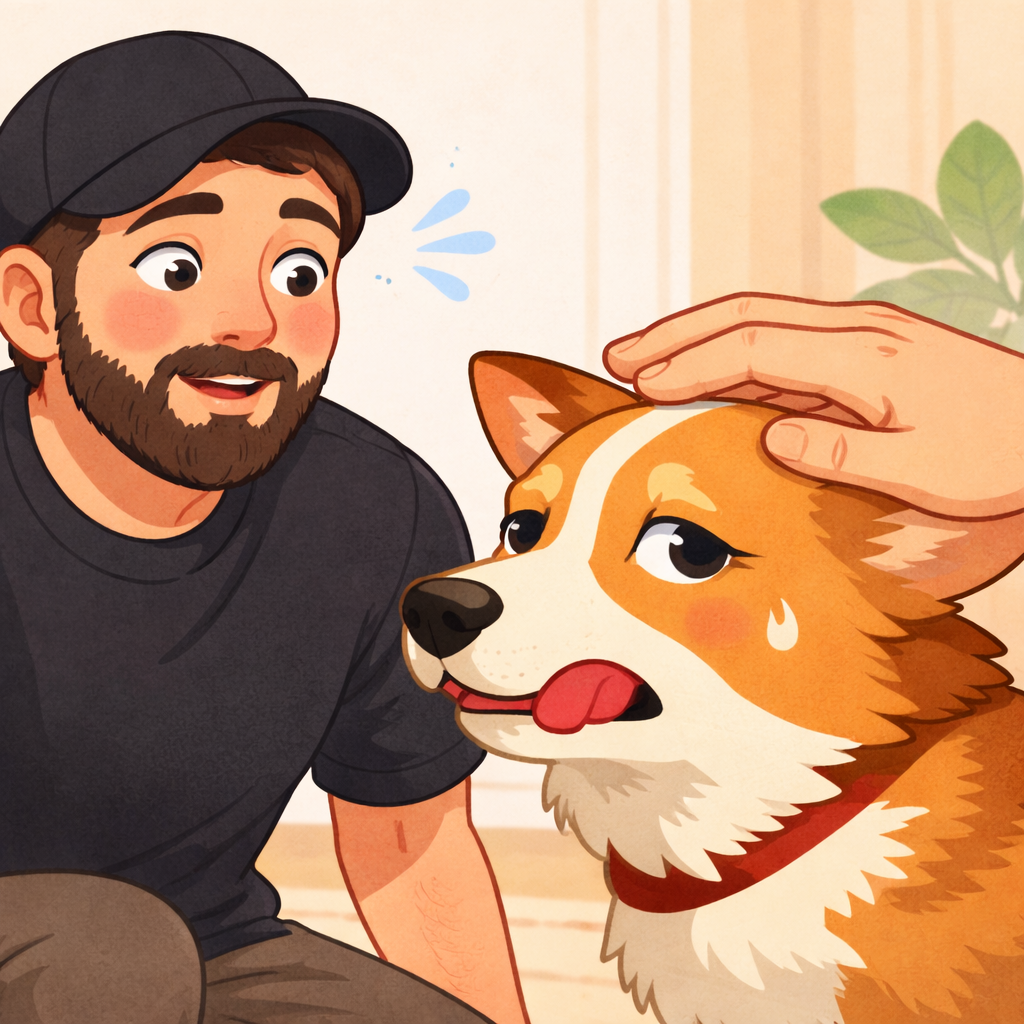
Touch training
7-day touch training routine (3 minutes per day)
Day 1–2: Hands = Good Work
- 3 minutes a day, snack when hand appears, repeat (no need to touch)
- If the dog approaches first, connect with a 1-second touch
Day 3–4: Shoulders, chest first
- Touch for 3 seconds → Release → Snack
- If avoided, stop immediately (no force)
Day 5–7: Expansion into care coordination (paws, ears, brushing)
- Not “grabbing” the foot, but touching near the foot for 1 second
- The area around the ears and mouth is the last (high level of difficulty)
- Success criteria: not “suffering quietly” but ending without signaling discomfort
Tips for each situation (holding, leash, wiping feet, grooming)
- Hugging: No “flashing”. Starting with lifting and putting down for 1 second, supporting the lower chest.
- Leash, harness: Wear at once
- Wipe your feet: The key is to dry them completely before brushing them (wet feet can be irritating).
- Beauty, medical treatment: It is much easier if you create a ‘cooperation routine’ at home.
In this case, ‘medical treatment and consultation’ come before training
- Starts suddenly + is accompanied by a painful reaction to touch (screaming/limping/decreased appetite, etc.)
- A bite strong enough to tear or bruise the skin
- Sudden bite without warning (difficult to predict)
- Child or family member has already been bitten
In this case, Accident prevention setting + expert help is much safer than “training alone”.
Checklist
- When is my puppy going to bite? (hugging, feet, head, sofa, while sleeping)
- Was there a signal before biting? (hardening, avoiding, growling)
- Did it start suddenly? Is it only in certain areas?
- Have you set up safety settings (separation, rest areas, unification of rules) today?
- Did you do the 7-day routine for even 3 minutes a day?
FAQ
Q1. If you don’t like physical contact, is the answer to just not touch it?
A. For the time being, “no-touch management” will reduce accidents. However, since there is essential care such as foot, ear, and beauty care, it is better to expand the scope to ‘consent-based touch’ in the long term.
Q2. Should I get scolded if I growl?
A. Usually, “widening distance” comes first rather than scolding someone. If you forcefully block the warning, it may bite without warning.
Q3. If you appease them with snacks, won’t they get into bad habits?
A. Now, it is not a process of ‘soothing,’ but rather a process of re-learning ‘Hands, touch = good things.’ Timing and steps are key.
Q4. I’m scared that my child will touch it and get bitten.
A. Separating child and dog movement routes (doors, fences) is the top priority. Create a “no touching” rule first, and only train when a guardian is present.
Q5. How long does it take?
A. In mild cases, changes may be seen in 1 to 2 weeks, but if the pain or fear is deep, it may take longer. The important thing is to “prevent accidents today” and “build small successes every day.”
Pohang specializes in dog training!!! Visits are also possible!!
Gomgom is a trainer, a Saramgom. We have been providing training and behavior correction in Pohang for 6 years. For inquiries regarding dog training in Pohang, please contact us using the contact information below and we will contact you within a day. Puppy, socialization, walk,
https://saramgomdog.com
Related guides
- Dog Aggression Warning Signs: When to Stop an Interaction
- Puppy Training Basics: Sit, Down, Stay and Come
English edition copyedited and supplemented on October 9, 2026.