Practical starting point
Separate vulnerable people from the dog using doors or gates and stop repeating the situation to see whether it happens again. Record the approach, object, touch or movement that preceded the incident. Sudden touch sensitivity needs veterinary attention. A bite that breaks skin also requires appropriate medical advice for the person; online exercises are not a substitute for an individual safety plan.
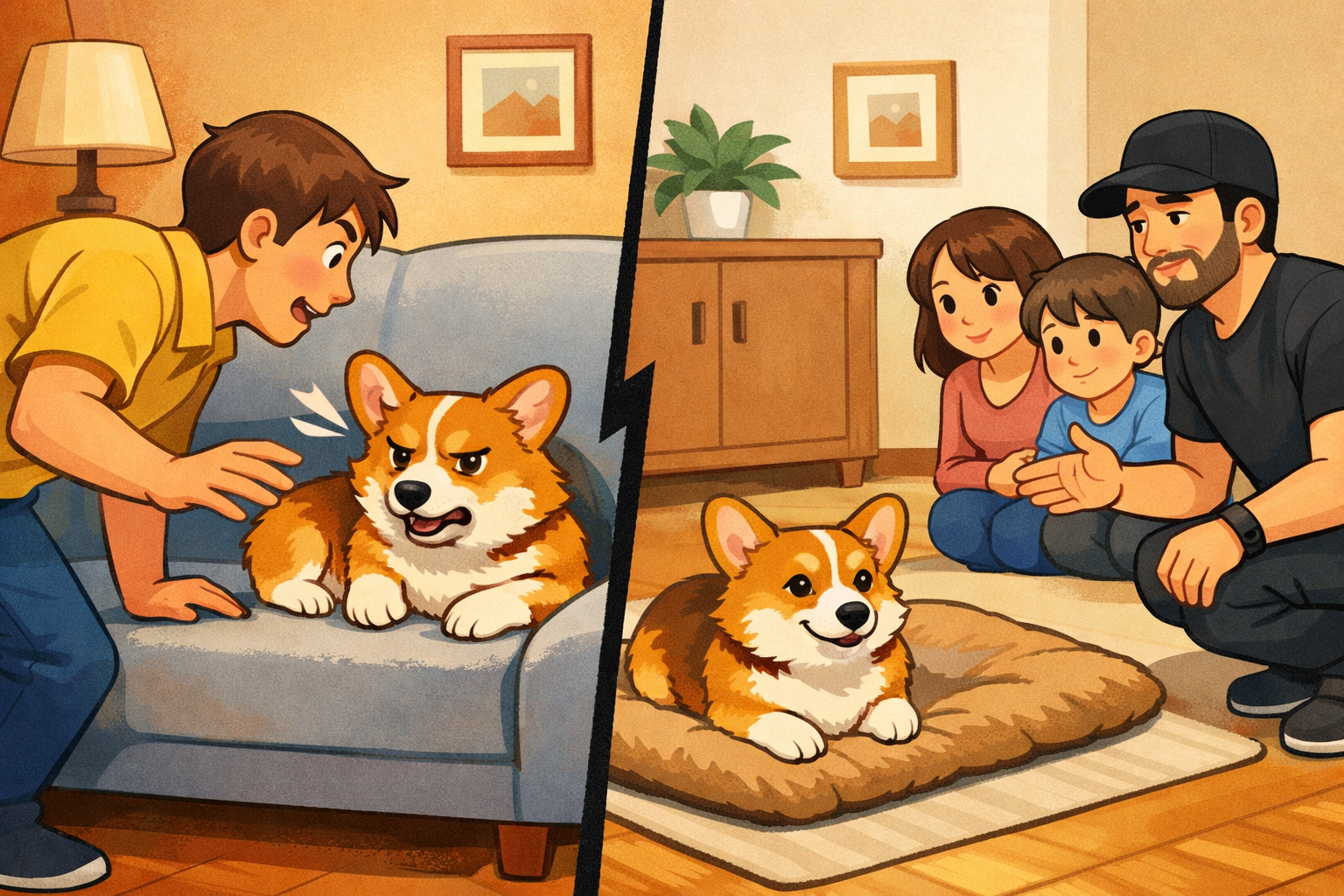
Hello. I am a dog trainer, behavior modification expert, and Saramgom.
Guardians are really embarrassed when they see a puppy only nibbling at family members. I’ve been good to him, but I remember why he’s biting me, why he suddenly does that, and whether I should scold him. However, when looking at the field, there are far more cases in which we have not yet read the reason than in cases where there really is no reason.
- Major causes of dogs biting their family members
- Accident prevention methods to apply starting today
- Behavior modification routines you can start at home
Puppies do not bite their family members “for no reason”
Even though it may seem like a sudden bite from the guardian’s perspective, there are many cases where there were already warning signs from the dog’s perspective. You may have first noticed patterns such as stiffening your body, fixating your gaze, trying to avoid it, growling, or becoming particularly sensitive in certain situations.
In other words, it means that in many cases it is “a dog biting for no reason” rather than “a dog biting for no reason”. So, in this matter, interpretation takes precedence over discipline.
Warning signs that parents can easily miss
- The body suddenly becomes stiff
- Turn your head or avoid it
- Signs of discomfort such as licking lips, yawning, or rolling eyes
- Growl or low warning
- I only become sensitive to certain people and in certain situations
Why it should not be viewed only as a ranking issue
If you interpret the fact that you are biting at your family as an “action to gain rank,” it is easy for correction to get messed up. In reality, more common reasons include fear, resourcefulness, pain, discomfort with touch, and conflict over restraint. If you miss this and press hard, it may seem quiet for a moment, but it may react more strongly the next time.
7 main reasons why you bite your family
1. Pain or body discomfort
If your pet suddenly becomes sensitive, bites only when you touch a certain area, or reacts when you pick them up, wipe their feet, or change their position, you should first suspect pain. Even though it may seem like a personality problem to the guardian, in reality, there are cases where the child reacts defensively because he or she is physically uncomfortable.
2. Resource protection
When there are objects of high value such as toys, snacks, food bowls, cushions, sofas, or beds, they may growl or bite even at family members. This is not because of bad habits, but more like a strong feeling of “This is mine”
3. Defense of rest space
Some children bite if you touch them while they are resting or sleeping. In this case, it is more correct to view it as a lack of safety in the resting area rather than a personality trait. If you keep waking it up, pulling it down, or carrying it around, it can get worse.
4. Body control such as touching, holding, and wiping feet
Because our family is close, we meet more often. However, from a dog’s perspective, the behavior of a hand coming down on its head, a sudden picking up behavior, and touching its paws for a long time can all be burdensome. If this experience is repeated, family members may also experience defensive bites.
5. Conflict-type bites that occur when being restrained
They often bite when you stop them from doing so, when you force them to get off the sofa, when you try to take something from them, or when you try to control their excitement. This is often misunderstood as a habit or hierarchy issue, but in reality, it is often a conflict reaction that occurs when desired behavior is blocked.
6. Excitement transfer
When emotions are already high, such as noises at the front door, visiting guests, stimulation outside the window, or excitement before a walk, there are times when the child bites the family member next to him. The original target of the inquiry was not a family member, but the emotions were so high that the reaction shifted to the person closest to them.
7. When each family member treats you differently
Some people keep touching, some stop by making loud noises, some take away toys, and some give treats without rules. If each family’s interaction style is different, it becomes difficult for the dog to predict and may react particularly sensitively to certain family members.
- He doesn’t like being touched when he is resting
- Sensitive when washing feet, holding them, or wearing a harness
- Stiffness near toys, snacks, and food bowls
- I become sensitive in places such as sofas, beds, and cushions
- If you scold or stop them, they will react more strongly
- The reaction is particularly strong only in certain families
- More sensitive before and after a walk, visiting guests, and after the sound of a door
- Suddenly becomes sensitive or dislikes being touched more than before
If there are three or more of the above items, it is more likely to be “biting with a pattern” than “biting without reason”.
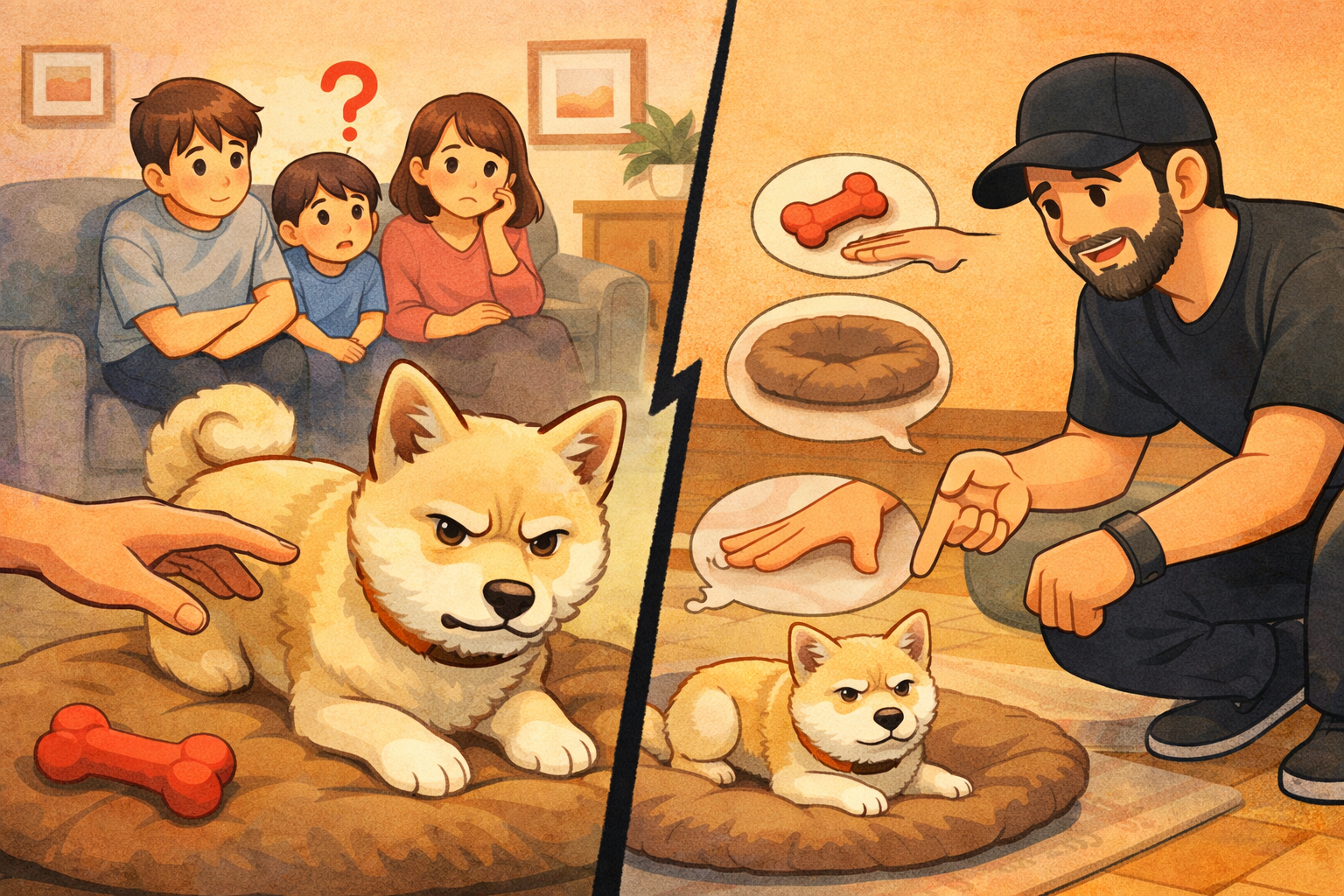
The priority is to identify the cause and prevent accidents first.
What to do first today: Accident prevention and management
The first thing to do when correcting bites is not to scold, but to manage the environment to reduce accidents. If the bite has already occurred, it is much more important to “reduce the situation in which you have to bite” rather than “to prevent the bite from happening.”
What you need to change today
- Do not touch while resting
- Do not take food, snacks, or toys directly, but exchange them instead
- If there is a conflict between sofa and bed, manage access for the time being
- Record the time and situation when the problem occurs
- In situations where excitement is high, secure distance and use space separation
- Keep children and dogs under adult supervision
Items that must be recorded to speed up proofreading
- When did you ask
- Who did you ask
- What were you doing just before
- What signals were there before the bite
- After biting, what was the reaction: running away, fixation, or re-excitation
As these records accumulate, real patterns begin to appear, such as “when touched while resting”, “when touched”, “when held with a toy”, “when restrained”, and “when excited before a walk” rather than “for no reason”.
Four steps of family biting behavior correction
Step 1: Create a trigger map
The starting point for correction is finding the cause. Write down when, to whom, under what circumstances, and how strongly you came out. The direction of correction will be clearer if you record it accurately as, “I growled and then bit my dad when he got me to get off the sofa,” rather than vaguely, “He bites me sometimes.”
Step 2: Create an alternative action first
Rather than repeating “don’t bite,” it is much more practical to teach what to do instead of biting first.
- Go to the seat (mat): Useful for excitement, conflict, and responding to guests
- Hand target (pointing) : Can be encouraged to move without forcibly holding it
- Exchange: Toys, snacks, useful in resource conservation situations
For example, if you protect a toy, you should show a better reward and reinforce the behavior of letting it go rather than forcibly taking it away. This method is much more stable in the long run.
Step 3: Change touch and approach back to good foreshadowing
Children who bite when touched should not be taught to touch a lot, but should be re-learned from very brief and predictable contact.
- Call your name
- Show your hands from the side
- Touch the shoulder or chest briefly for about 1 second
- Give snacks right away
- Don’t make it too long, just finish it
At this time, if the dog withdraws or stiffens, the intensity should be lowered. The goal is not to make it bearable, but to create predictability that “it is safe even if human hands come”
Step 4: The whole family uses the same rules
If only one person is careful and the rest behave the same way as before, it is difficult to change. The entire family must use the same standards for the dog to be stable.
- Do not touch the resting area
- Do not directly take away high-value resources
- When excited, do not block with your hands, but first secure the distance
- When calling, don’t call to scold me
- Reward good behavior immediately
Reactions you should never make
Yelling, subduing, turning over
You can make it stop briefly by pressing hard, but it does not solve the cause. In particular, bites mixed with fear, pain, and defensiveness can get worse.
Scolding the growl
Growling is a signal that prevents accidents. If you scold that signal, next time it may go in the direction of biting without warning.
Make them endure until the end
If you keep pushing into a situation that makes you feel scared or uncomfortable, it won’t get better and may build up more emotions. Desensitization should begin slowly and at a pre-response intensity.
Do it right away / Do it gradually
Do it right away
- Write down three situations in which you were asked recently
- Create a no-touch rule for resting places
- Stop taking away toys/snacks
- If you suddenly become sensitive, check for possible pain
It will be done gradually
- Seat training 3 times for 3 minutes
- Hand target 10 times
- Starting a short approach-touch-reward routine
- Put down common family rules as a note
In these cases, professional consultation is required immediately
- Suddenly became more aggressive
- Exceptionally sensitive to touch, movement, and changes in posture
- Bite at a level that penetrates the skin
- Injured a child or an elderly person
- The number of repetitions and intensity gradually increases
- It seems that corporal punishment and coercion have already made the problem worse
Especially in cases of aggression that starts suddenly, if pain is suspected, and biting that causes the skin to tear, it is safe to consider veterinary check-up and consultation with a behavior expert, not just at home.
If biting at family members is viewed only as a “habit,” resolution may be delayed. Pain, anxiety, resource protection, and conflict situations may be mixed, so evaluating the cause first.
Frequently Asked Questions FAQ
Q1. Is it a hierarchy issue if a puppy only bites family members?
Not always. In reality, it is more often explained by fear, resource protection, discomfort to touch, pain, and conflict situations.
Q2. Should I get scolded if I growl?
Growling is a warning signal, so rather than scolding it, it is better to look at the cause of why such a signal occurred.
Q3. Suddenly it started biting my family. Why is that so?
For sudden changes, you must first consider the possibility of pain or physical discomfort. This is especially true when it is severe when touching, moving, or changing posture.
Q4. Can I get better just by training at home?
Minor cases may improve, but bites on humans have safety issues, so management and evaluation must go hand in hand. If it is repeated or increases in intensity, professional intervention is safer.
Q5. What should be taught first?
It is much more effective in practice to first create alternative actions such as seat, hand target, and exchange rather than “don’t bite.”
Conclusion: Interpretation takes precedence over discipline when it comes to family criticism
The most dangerous interpretation when a dog bites a family member is to conclude that it is “because it is spoiled,” “because it has a bad personality,” or “because it is trying to gain rank.”
In most cases, biting at family members is closer to uncomfortable feelings, failure to predict, and incorrectly learned patterns than to bad intentions. Therefore, the solution should not be approached through discipline, but through identification of the cause, accident prevention, education on alternative behavior, and family consistency
Once the guardian begins to read the cause, the direction of the bite is often determined much faster than expected. If you proceed with basic control and obedience training (place training), your dog may improve more quickly.
Dogs that bite their families are often a “problem of reading the cause” rather than a “problem of getting scolded”.
In the Pohang area, we help analyze bite patterns and design custom rules for families through in-house consultations and on-site training.
A good article to read together
- Why dogs tremble (signs of anxiety) check)
- Seat (Mat/House) Complete training summary
- When touched Dog bites, doesn’t like physical contact
- The puppy Reasons for being sensitive at home, things to look at before training
- Puppy 7 things that homes where training fails have in common
Related guides
- Dog Aggression Warning Signs: When to Stop an Interaction
- Puppy Training Basics: Sit, Down, Stay and Come
English edition copyedited and supplemented on October 9, 2026.