Practical starting point
Choose a roomy, accessible surface and reward voluntary investigation before expecting elimination. Preserve normal outdoor opportunities during the transition; do not make the dog hold on until they give in. Reward success calmly and clean accidents without punishment. Older dogs, dogs in pain and dogs with strong surface preferences may need a slower, individualized plan.
How to change a puppy from outdoor potty training to indoor potty training (capturing + potty cue + 7-day plan)
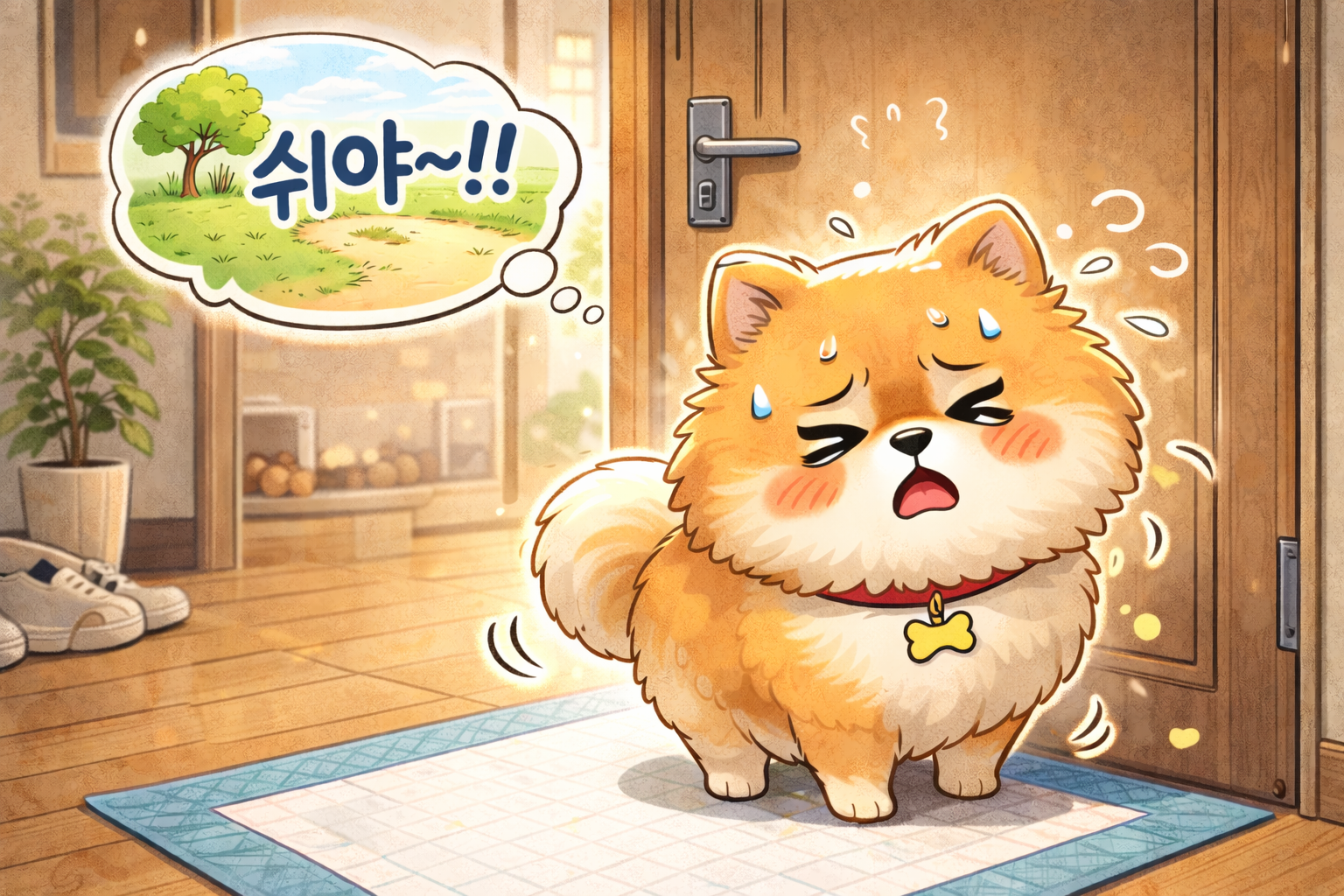
Hello. I am Saramgom, a dog trainer, behavior correction expert, and owner of a dog daycare and hotel. If you have concerns like “I only poop outside,” “I can’t go potty when it rains,” or “I just hold it in at home until the end,” I’ll explain the transition routine from outdoor defecation to indoor defecation (pad, toilet) in one post today.
- Sequence for switching a child who only used to play outside to indoor pad (including settings to reduce failure)
- A routine for using walking signals
- How to bring a potty cue (“rest, poo”) made outdoors
that can be used even when walking is difficult due to rain, night, or fine dust
The key to switching from outdoor to indoor defecation is not scolding, but setting + timing + capturing (capturing).
When defecating outside, a defecation command (cue) is created at the “moment of defecation start,” and indoors, it is tested only at times with a high probability of success.
If you just stick to large pad, restricted movement, and immediate reward for 7 days, your first success will be much faster.
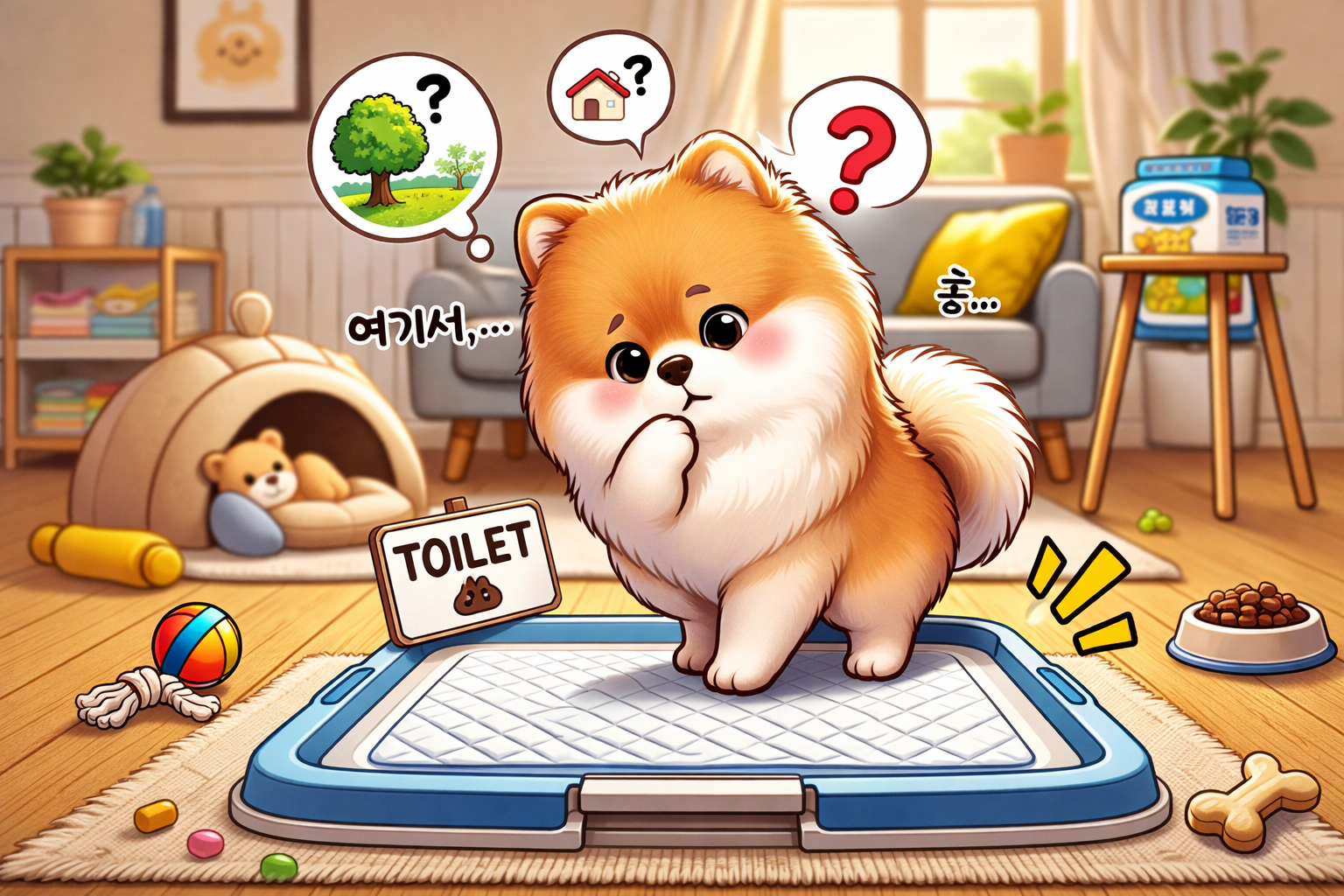
0) Check 30 seconds before starting: If there is a sudden change, ‘health’ takes precedence over ‘training’
- I urinate often, but the amount is little or I feel like it doesn’t come out even if I strain
- Blood or painful reaction when defecating (whining, flinching)
- Sudden increase in mistakes, completely different pattern from usual
This case may not be resolved through behavioral training alone. It is safe to first rule out health factors such as pain and inflammation through veterinary consultation.
1) Clearing up the misunderstanding: It is not “indoor defecation = worse than outdoor defecation”
It is not true that outdoor defecation is better than indoor defecation in relieving stress or that it is unconditionally better. Indoor potty training is not ‘training where you poop anywhere’, but ‘place training’ that teaches you to go potty in a designated place (pad, bathroom). It reduces the burden on the guardian and makes it much more comfortable for both the dog and the guardian to have an indoor option on days when walking is unstable, such as rain, snow, fine dust, at night, or due to old age/deterioration of physical condition.
2) 3 key principles that make conversion successful
- Positive Reinforcement: A correct answer (defecating on a pad) is always followed by a “good result (reward).”
- Alternative action: Learn to “go to the pad / send a signal” instead of holding back / making a mistake.
- Environmental design: Settings that reduce mistakes greatly increase training speed.
3) Materials & environment settings: This is where the game is decided
- Please prepare a large absorbent pad or a grid-type dog litter box or a lot of small pads.
- Anti-slip mat (safe around pad)
- Very delicious reward (snack/play) + praise
- Fence to reduce mistakes in the first 1-2 weeks (restrictions on movement routes)
- Defecation record (time/situation) memo
Pad location A good starting point is “a place where mistakes are often made” or “at the end of the daily flow path (corner: usually, so mistakes are made next to the sofa or at the end of the kitchen.)”. And the key in the beginning is one: Increasing the success rate by laying down a large pad at first.
- Is the pad big enough? (In the beginning, “louder” is the correct answer)
- Did you reduce the smell at the mistake site to “0 odor” with enzyme cleaner?
- Did you record and catch the timing of defecation (waking up/after eating/after playing)?
- Did the rewards amount to 3 to 5 “as soon as it was over”?
3-1) “Never inside the fence/area” Solution: The answer is not further confinement, but ‘zone separation’
Even though the child’s movement is restricted by a fence, if the child endures it all the way inside, this may not be stubbornness, but rather an instinct to not want to get dirty because they perceive “this is my living space (sleep)”. So the solution is simple: Separate the living area and toilet area ‘even within the same fence’
Core principle: ‘If you put everything in one space,’ it will endure → ‘If you put it all in one space,’ it will come out.
- If the area is too small = “This is my bedroom,” so I hold back my bowel movements longer.
- If the pad is in the center of life (near food/toys/bed) = many children do not want to do it anymore.
- The solution is distance. Separate “rest area” and “restroom area” even within the same enclosure. Alternatively, you can encourage the child to defecate outside the fence.
Setting A) Creating ‘Zone 2’ inside the fence (most recommended)
- Area ratio: Starts with 2/3 living (rest) + 1/3 defecation
- Toilet area: Place a “large” large pad/grid toilet in one corner of the pen
- Living area: Place bedding/water/toys at the opposite end (as far away from the pad as possible)
- Anti-slip: Anti-slip mat around the pad (if it is unstable, be more patient)
Important: Making the fence “too small to prevent mistakes” will actually delay success. A patient child needs ‘space (street) for a bathroom’.
Setting B) Expand the fence to a ‘living room type’ and separate defecation into a ‘fixed zone outside the pen’ (especially strong for adult dogs)
- Rather than enclosing the fence too tightly, expand the living space a little to provide a sense of stability
- Defecation is designed to be done only in a fixed pad zone outside the fence.
- Only at potty timing (waking up/after eating/playing) Move to pad zone with leash → Wait quietly
Practical routine (only for persevering children): Only try “3 minutes,” and only success is greatly rewarded
- Move to the pad zone only when the probability of success is high
- 1 to 3 minutes Wait quietly (minimum talking, minimal pressure)
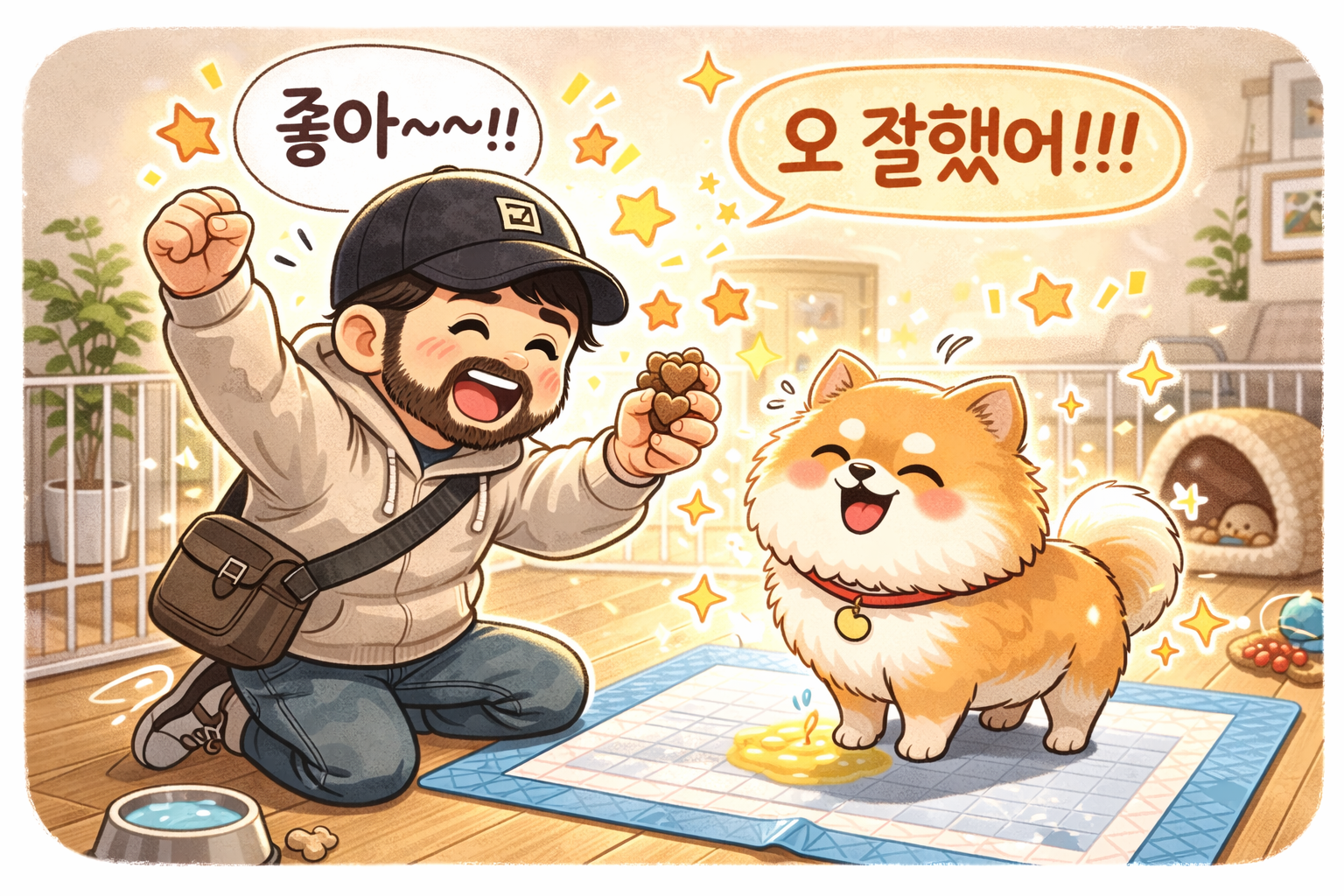
- If successful, immediately 3 to 5 snacks in a row + praise
- If it doesn’t come out, just quit and come back again in 10-15 minutes (don’t force it for too long)
Bonus tip (for children with strong outdoor toilet habits)
- Connect the toilet cue (rest, poop) indoors only “once or twice a day, at a timing with a high probability of success” (explained below)
- Or turn on the potty mode with the walk signal U-turn (to the front door and then to the pad) to increase the success rate
If holding time is excessively long, or if urination, pain, or hematuria are observed, check health factors first with veterinary consultation before training.
4) Capturing: Capturing the signal just before defecation and connecting it to ‘pad success’
The technique I use most often in toilet transition is capturing. If the “correct action” occurs even by chance, it is a method of capturing that moment and solidifying it as a reward.
4-1) ‘Signs just before defecation’ to be detected at home
- Smelling the floor for a long time
- Spinning round / going to the corner
- Suddenly stopping or fidgeting (moving back and forth)
- Looking at the door or entrance (common in children with outdoor toilet habits)
4-2) Step 3 of capturing practice
- Waiting in the pad zone: Quietly waiting at “highly likely times” such as right after waking up/after eating/after playing
- Capturing the moment of correct answer: The moment you climb on the pad or take a potty position Shortly say “Okay!”
- Continuous reward immediately after defecation: Snack immediately after defecation 3 to 5 in a row + praise
4-3) Free capturing (normal pad = creating a good place)
- 3-5 times a day, 1 snack when heading to the pad
- 1 snack when you step on the pad
- “Pad!” Learning with pad = good place by adding the same short signal word
5) Create a ‘defecation cue (command)’ by capturing when defecating outside (sudden increase in home guidance)
For a child with a strong outdoor toileting habit, it is much more powerful to capture the moment of outdoor toileting and create a toileting cue first, rather than “force it indoors.”
Key principle: “Do not ask the horse to speak first, but only at the moment of bowel movement”
- Fix one word: One of “rest/poo/toilet” (same for all family members)
- Speak quietly once at the moment of the beginning of a bowel movement (first drop/first force)
- Big reward as soon as it’s over: 3-5 snacks in a row + praise
- At least 10 to 20 times when accumulated, connections will begin to appear
The cue does not magically “generate” urine, but the cue reminds you of a defecation situation (spot/position/wait) to put you in defecation mode.
6) Bring indoors: Connect “cue + pad” (only 1-2 times a day)
- Immediately after waking up/after eating/after playing, go to Pad Zone
- Wait quietly for 10 seconds on the pad
- “Shiya (potty cue)” Once → Wait 1~2 minutes
- Instant reward for success (a series of snacks) + bonus short walk if possible
If you use too much cue indoors, it will be diluted. Start with 1-2 times a day only when the probability of success is high.
7) “Pretend to go for a walk” routine: Changing outdoor defecation habits to ‘indoor success’
Children who used to defecate only outside often enter defecation mode just by walking signals such as “front door/leash/elevator.” We use this in reverse.
Method A) Just give a walk signal and make a U-turn with the pad (safest)
- Wear a leash/harness (prepare for a walk as usual)
- Move to the front door and stop just before opening the door
- Without a word Quietly making a U-turn to the pad zone
- On the pad 1 potty cue + wait 1-2 minutes
- Instant reward if successful (consecutive snacks)
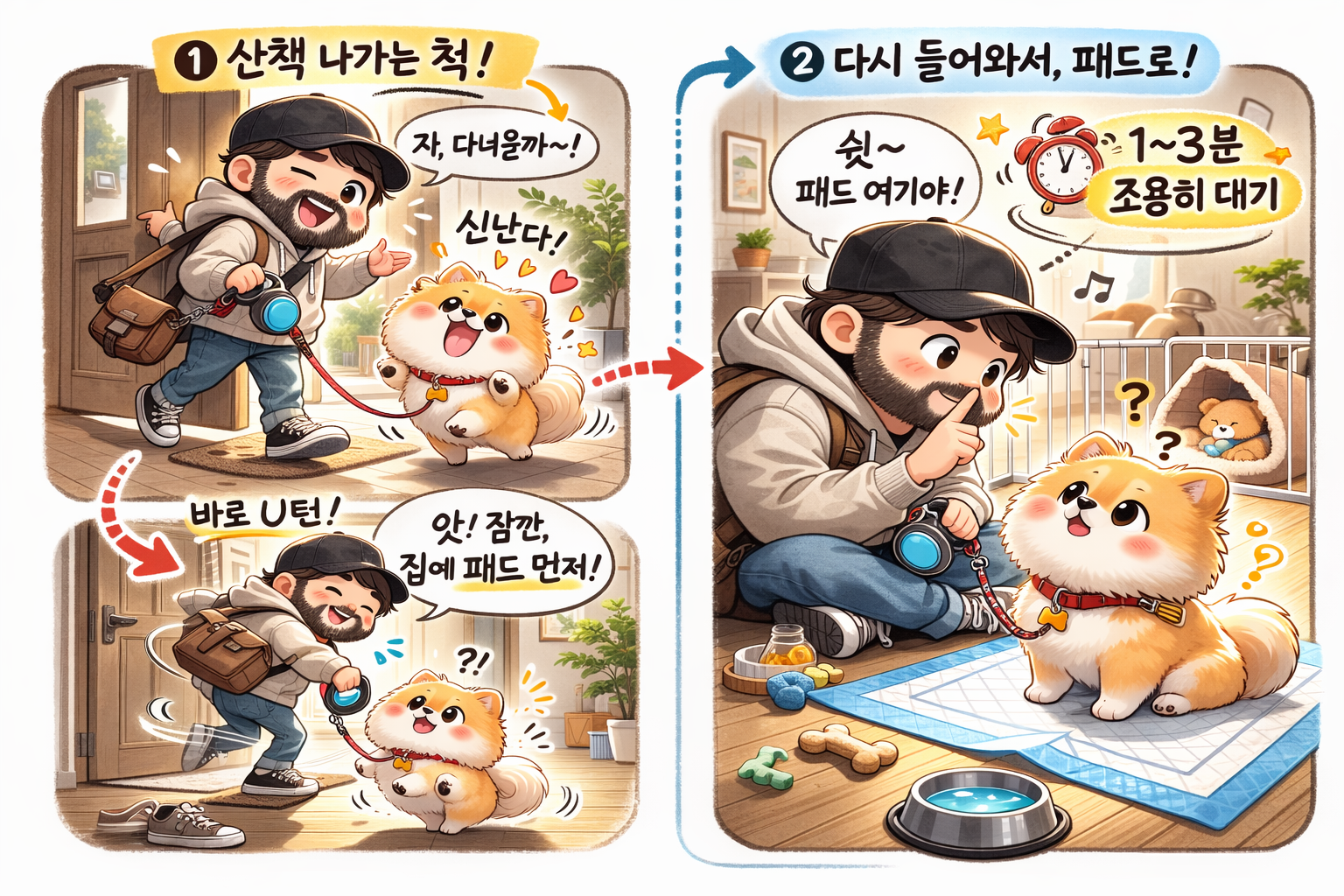
Method B) Go out for 10-30 seconds and come back right away (strong but delicate)
- Go out the front door for 10 to 30 seconds
- Go straight in and go to Pad Zone
- On the pad 1 potty cue + wait
- Big reward if successful + short walk bonus if possible
Caution: Some children may be disappointed by saying, “Huh? You’re not going for a walk?” In the beginning, only on successful days, take a walk for even 3 to 5 minutes and connect it with “If you do it on the pad, good things will happen.”
8) Creating an alternative action: Changing a mistake into ‘going to the pad/sending a signal’
Selection 1) ‘Going to the pad’ itself as an alternative action
- Usually 3-5 times a day, 1 snack
- Reward when you go up with the “pad” signal word
- “Pad” at the moment of smell/lingering right before defecation → Increased success rate
when you get on the pad.
Selection 2) Bell/Touch (Easy even for novice guardians)
- Place a bell or touch sticker near the pad
- Treat the bell → “Bell = good thing”
- Guide near the bell at the time of defecation → bell → move to pad
- Eventually, “ring the bell and go to the pad” becomes a routine
9) Move pad position (move to desired position)
If you nail it in a certain position from the beginning, failures increase. Move once the success rate stabilizes at over 80%.
- Move very little, 20 to 50 cm per day
- Check the success rate for 2-3 days after moving
- If mistakes increase: stop moving and recover success rate from that location
10) What to do when you make a mistake (Important): “Clean it up quietly + nurture the next success”
- Scolding/screaming/touching your nose → Only learn to hide defecation
- Remove odor from mistakes using enzyme cleaner (reduce recurrence)
- If there is a repeat time zone: Restrict movement during that time period + expand the pad
11) Prescription for each situation (Saramgom Q&A)
Q1. I endure it till the end at home
It is often tension/habit rather than “lack of training.” Make the pad a “safe place” with Walk signal routine (Chapter 7) + Timing catch (Chapter 4) + Pre-capturing
Q2. Tear the pad or play with it like a toy
Use a grid-type toilet or secure the pad tightly. And if there is a lack of activity/play, it is easy for the pad to become a ‘toy’. The success rate increases if you schedule a bowel movement after 3-5 minutes of short play.
Q3. Can I do it outside and at home (a mix)?
It is possible. But we need standards. Example: Establishing situational rules such as “walking to the bathroom in the morning/evening, indoor padding on rainy days/night” will reduce confusion.
12) 7-day plan that won’t get you tired (today/tomorrow/this week)
- Today: Larger pad + restricted movement line (lowering the chance of mistakes)
- Tomorrow: Timing catch after waking up/after eating/playing + 3~5 snacks if successful
- 3-4 days: Free capturing (pad access/climbing reward) accumulation
- 5-7 days: Accumulated by placing the outdoor defecation cue only at the “moment of defecation start”
- Bonus: Increase your chances of first success with the walk signal U-turn routine
The goal is not “perfection,” but consistently increasing the success rate. If you keep getting it right, your dog will learn quickly, but if you keep getting it wrong, it just gets confused. A word from the Saramgom: Training is a skill, and the environment is a cheat! Build up small successes!!!
13) FAQ
Q1. Can an adult dog that used to only defecate outdoors be able to switch to indoor defecation?
It is possible. However, in the beginning, you need to increase the success rate first by “making the pad larger + limiting the movement path + testing the cue only at the success timing” to be faster.
Q2. I’m especially bad on rainy days.
Using the walk signal (U-turn) routine makes the transition easier. “Go to the front door, then move to the pad + 1 cue.”
Q3. How many days does it take to make a bowel movement cue?
Usually, if you focus on it for 3-7 days and accumulate 10-20 times, a connection will begin to form (different for each child).
Q4. If I make a mistake, can I wipe it with disinfectant?
Even if it is clean by human standards, it may still leave a smell to dogs. If possible, clean it to as close to “odor 0” as possible with an enzyme cleaner.
Q5. My bowel movements suddenly regressed. Do I need to train more?
If there are sudden changes (pain/frequent urination/hematuria/abnormal defecation posture), checking health factors may be the first priority. It is safe to reestablish the environment/routine afterwards.
14) Good article to read together (cause/solution/advanced)
Related causes
- Mistake If the position is always the same: Cause/solution of repeating the same position
- Defecation If you just endure it: Check for anxiety signs (causes of tremors)
Related solutions
- Home When the routine is shaken: A complete summary of seat (mat/house) training
- Defecation If you whine at every timing: Routine for coping with whining
- Training If things keep going wrong: 7 things that failed homes have in common
Advanced/Expanded
If there is a blockage (more than 2 weeks) — sometimes consultation is faster
If bowel movement continues to be blocked for more than 2 weeks, or if “holding it in until the end/anxiety/hiding mistakes at home” worsens, a setting tailored to the child’s personality and house structure may be necessary.
If you are in the Pohang area, we can provide pad location, movement route, and reward design through on-site training/consultation. (80% information + 20% help, so feel free to just refer to it!)
Related guides
English edition copyedited and supplemented on October 9, 2026.