Practical starting point
First check toilet needs, temperature, comfort and signs of illness. A young puppy may need a nearby caregiver and gradual adjustment rather than being left to panic. Keep necessary night toilet trips calm and brief. Record the pattern over several nights, but seek veterinary advice promptly for pain, vomiting, diarrhea or unusual lethargy.
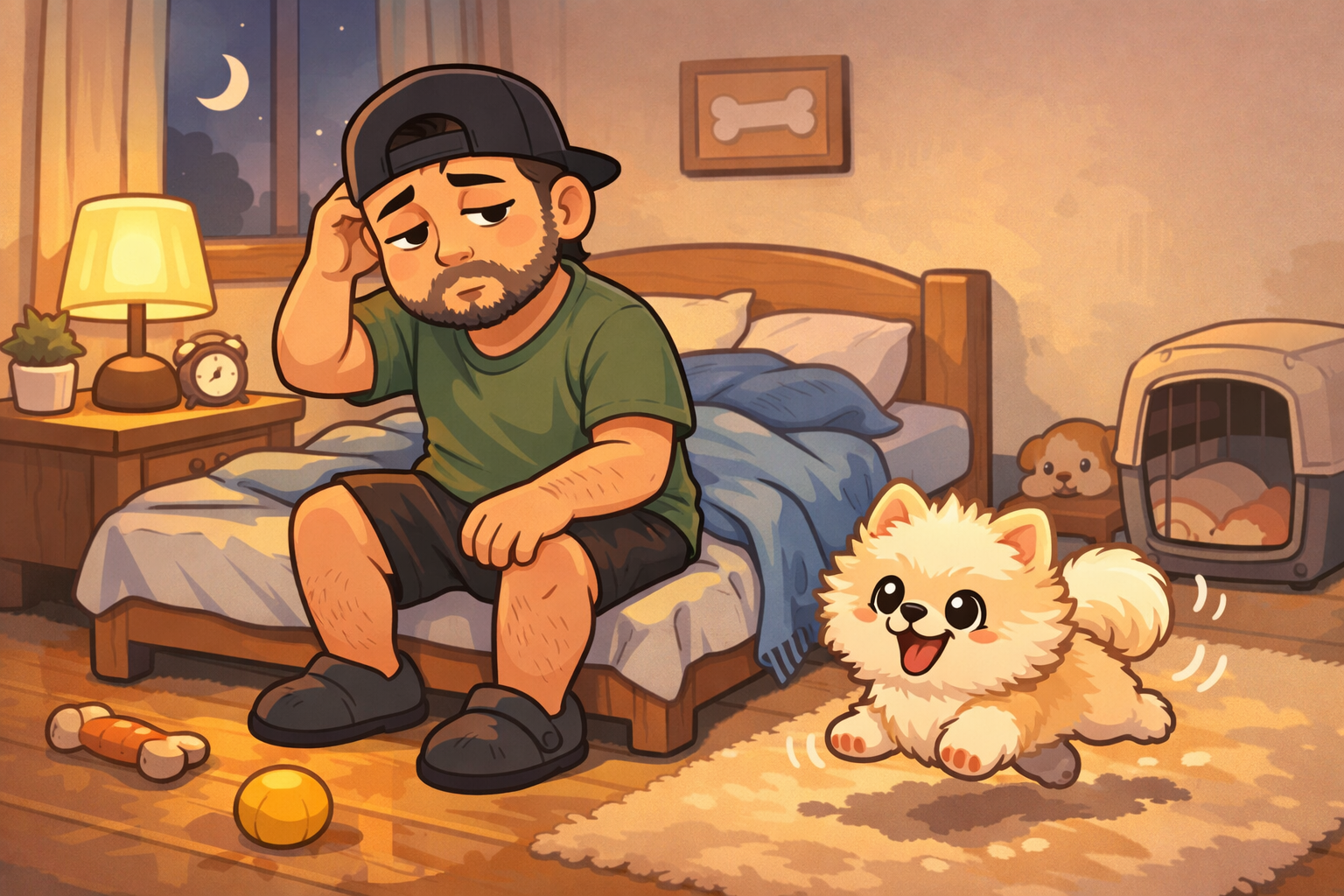
Hello. I am a Saramgom trainer. It’s really tiring when a baby puppy whines, jumps, bites every night, and wakes up the owner in the early morning.
Especially if you are a novice guardian, you may wonder, “Should I ignore this?”, “Should I play with it?”, “Is my dog special by nature?” My worries are increasing. However, in many cases, this problem is not a personality issue, but an overlap of age, routine, toilet timing, hyperexcitability, and caregiver response patterns
In this article, we will summarize the main causes that prevent dogs from sleeping, reasons why dogs behave more excessively at night, and a realistic nighttime routine that can be applied starting today.
3 things solved right away in this article
- Why your puppy gets more excited at night and can’t sleep
- How should I react when I wake up at dawn so that the pattern becomes less solid
- Bedtime routine and checkpoints you can apply starting tonight
Summary box
Puppies’ nighttime problems are often a combination of defecation, environment, hyperexcitability, anxiety, and response learning rather than “bad habits”.
If they react loudly every time they wake them up at night, the behavior may be repeated.
However, if pain, digestive discomfort, or extreme anxiety is suspected, health check and expert consultation come first than training.
You must first look at the reasons why your dog can’t sleep
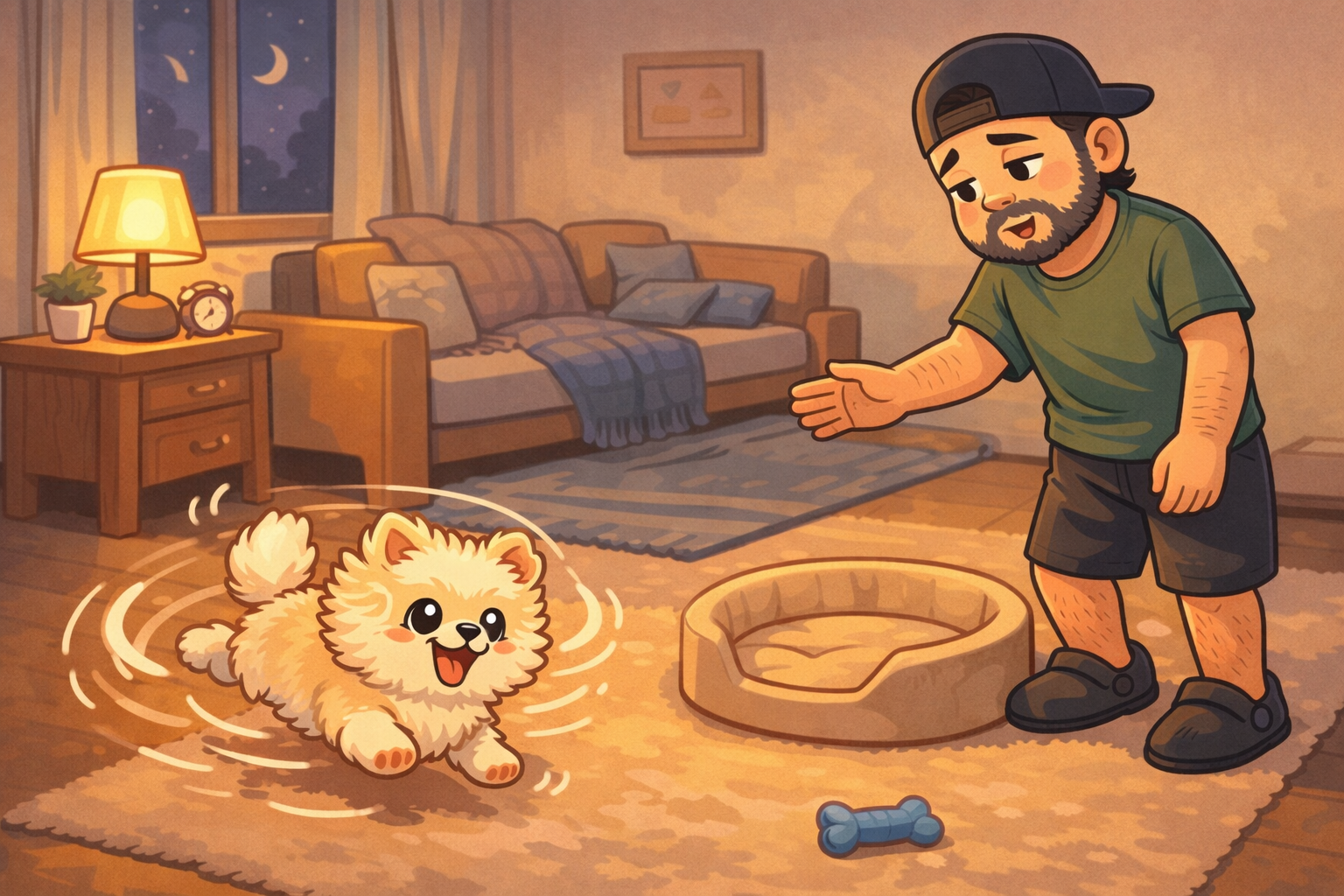
Puppy excited at night – please sleep!
1. Young puppies may have unstable sleep patterns
Baby puppies have less stable sleep-wake rhythms than adult dogs. If your nap time is inconsistent or you have a lot of stimulation in the evening, you may become more restless at night. It’s easy for caregivers to think, “It’s because they have energy left,” but in reality, it’s also common for children to be unable to sleep because they are too tired and overexcited. Creating a calm environment is important.
2. Running, biting, and barking more at night may be due to overexcitement
Suddenly jumping up and down, biting hands and feet, or clinging excessively to toys when it’s time to sleep may not be just a prank. At this stage, the puppy’s nervous system control is still immature, so the more tired he is, the more excited he becomes. (AKC) It is easy to understand if you think of it as a similar trend to a human child becoming more irritable the more sleepy it becomes.
3. There are many basic causes such as bowel movements, hunger, thirst, and temperature
Especially in young dogs, the interval between bowel movements is short, so they often wake up early in the morning if their timing before going to sleep is off. Additionally, sleep may be disrupted if the sleeping location is too bright, too cold, too hot, or there is a lot of background noise. So, for night problems, it is a good idea to organize your basic needs and environment before training.
Typical behavior that puppies show at night
Wakes up the guardian at dawn
There are many cases where a bowel movement is urgent, the environment of sleeping alone is still unfamiliar, or the child wants to check the guardian’s reaction. At this time, if you give the dog a hug or bring it out to the living room right away when it whines, the dog can learn by saying, “This sound = the guardian appears.”
The bites get worse during the night.
If you suddenly have a burst of energy, bite your hands or the blanket, and become agitated right before you fall asleep, it is likely that your evening routine was too stimulating. In particular, if you play vigorously right before going to sleep, you may end up in a situation where your body is tired but your mind is more awake.
Rather than sleeping, they bark or follow you around
Barking at the door, following the guardian every time he moves, or checking on him even while he sleeps may be a combination of anxiety, environmental changes, and separation-related stress, not just toilet problems. It is important to observe patterns because even if the behavior appears to be the same, the causes may be different.
Guardian should check first
- Is the time of the last bowel movement before going to sleep consistent?
- Did you play too vigorously in the evening?
- Are the sleeping temperature, noise, and lighting comfortable?
- Does your reaction change every time you wake up at night?
- Are nap and meal times too irregular?
5 steps of night routine to do before scolding
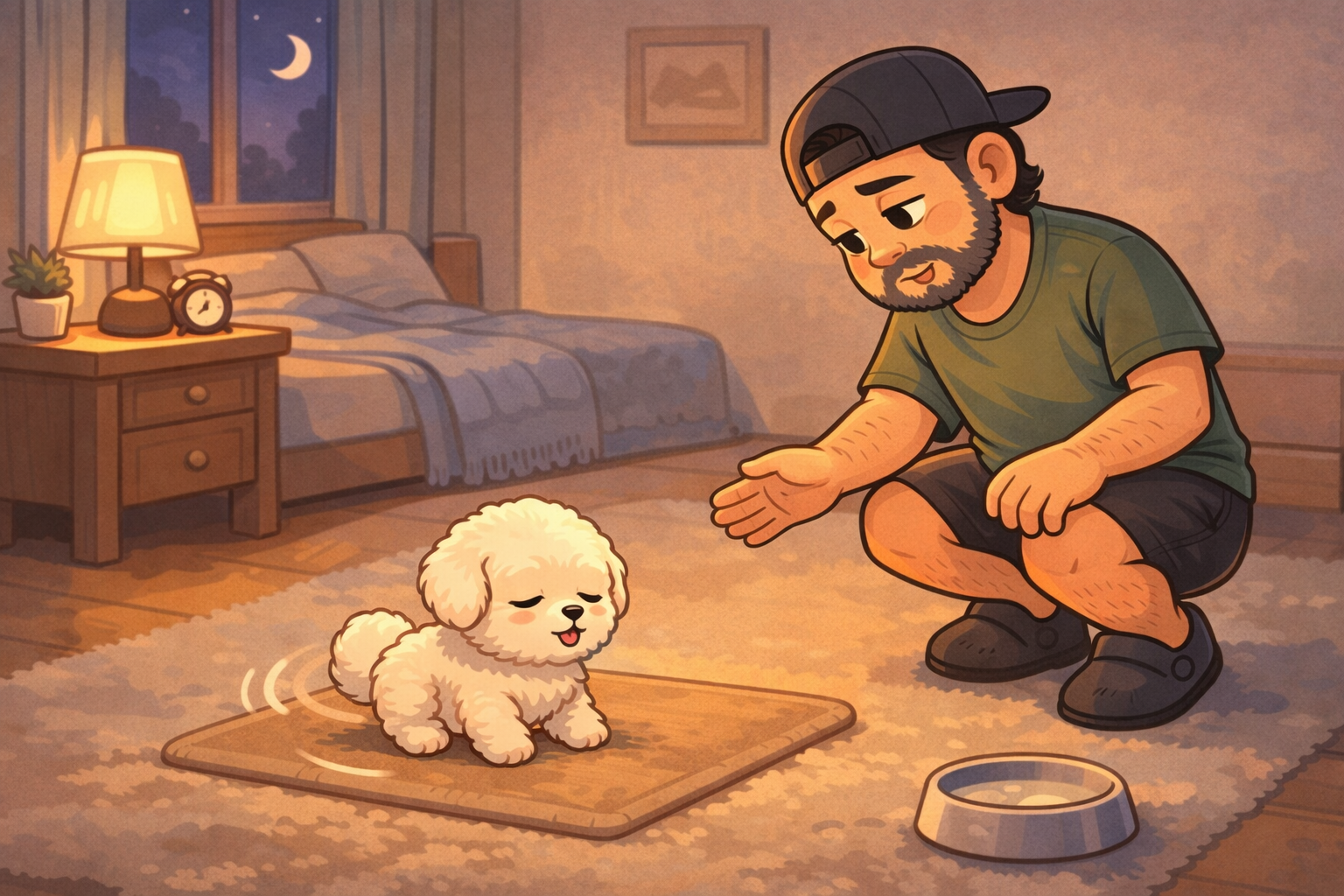
Reducing excitement in dogs that do not sleep at night
1. Clean up your surroundings and reduce your excitement level 2-3 hours before going to bed.
If you want to sleep well at night, just being quiet for 10 minutes right before going to bed is not the solution. The key is to change your entire mood 2-3 hours before you go to sleep. Creating an environment is the first step in education. Remove toys or other distractions and reduce your response. Reduce chase play, excessive tug play, loud sounds, and sudden stimulation, and also lower the caregiver’s tension. It’s also a good idea to try calming training (wait, sit training). Dogs get tired when they use their heads.
2. Please give me one more chance to defecate before going to sleep
A puppy’s early morning awakening is quite often linked to potty timing. Give your dog one last chance to go potty before going to sleep, and if he succeeds, give him short, calm praise and then clean up right away. It is important not to let this time lead to play.
3. Short, calm nose work or training is more effective than intense play.
Many children benefit from brief exploratory activities, slow chewing, and very light brain userather than vigorous play right before night. However, doing it too long or getting too excited can have the opposite effect, so it is better to end it briefly. Wait training or mat training are good.
4. Please always keep the sleeping order the same
Puppies feel secure in predictable repetition. For example, Last bowel movement → Clean up the water → Lower the lights → Move to another seat → Brief greeting → Go to bed If you repeat the same sequence every day, it is easy to form a signal that “It’s time to rest.”
5. Decide in advance what your reaction will be when you wake up at night
Nighttime behavior is often a pattern developed by the guardian’s impromptu response. If your dog appears to need to go to the bathroom, it is best to do so quietly and briefly, and if it is simply a need for attention, it is best to minimize talking and interaction. The key is not letting anything interesting happen when you wake up in the night. When you wake up in the middle of the night, refrain from hugging your child or showing excessive touching or affection.
Try to respond like this when you wake up at dawn
First determine whether it is a truly necessary signal
If it circles around the bed, sniffs the floor urgently, or goes to the door repeatedly, this may be an actual sign of defecation. On the other hand, if the sound gets louder just by looking at the caregiver’s face, or the child becomes quiet immediately when hugged, there is a possibility that there is a need for attention mixed in.
Response should be short and quiet
Even if something needs to be done at night, turning on the lights brightly and talking a lot will help you become more alert. If possible, it is best to keep the lights to a minimum, speak briefly, and maintain a routine of only disposing of defecation and then returning to the seat.
Don’t react differently every time
If you play with it on some days, scold it on some days, and hug it on other days, the puppy will actually try more different methods. Consistency is especially important for nighttime responses.
In this case, it needs to be checked, not just seen as a behavioral problem
When pain or digestive discomfort is suspected
If you wake up so often that you can barely sleep, keep licking or scratching your body, or toss and turn because you can’t find a comfortable position, you may be suffering from skin problems, pain, or digestive discomfort. In this case, checking health status may take precedence over training.
When anxiety is strongly mixed
If it is quiet when the guardian is visible, but starts whining as soon as the guardian is not visible, continues to check at night, and follows the guardian like a shadow during the day, it is necessary to check for separation-related stress.
When it is best to consider expert consultation
- Barking, biting, and hyperexcitability become increasingly severe during the night
- There is little change even if you maintain the routine for 1-2 weeks
- The sleep of both the dog and the guardian is greatly disrupted
- Signs of suspected health problems appear
Behavioral problems often have more than one cause. Especially if there is a mix of aggression, extreme anxiety, and suspicion of pain, it is safer to see your dog with a veterinarian or behavior specialist rather than trying to handle it alone.
Realistic 3-day routine starting today
Day 1
- Record the time of your last bowel movement before going to sleep.
- Note when you wake up at night.
- Reduce exciting play during evening hours.
Day 2
- Do short, calm nose work or wait training before going to bed.
- Clean up your sleeping environment by reducing lighting and noise.
- Tone down early in the morning and reduce conversation.
Day 3
- Repeat the same bedtime routine.
- Distinguish between defecation signals and demands for attention.
- Check whether whining, barking, or crying has decreased.
Checklist
- Playing vigorously until just before falling asleep
- The time of the last bowel movement is inconsistent
- The reaction changes every time you wake up at night
- We often hug or play with each other in the early morning
- Nap and meal times are too irregular
- Whining, biting, and barking appear together
If three or more of the above apply, you need to reorganize your night routine.
FAQ
Q1. If my puppy whines at night, should I absolutely ignore it?
You must be careful about blindly ignoring something. It is best to first check the basic causes such as bowel movements, temperature, and discomfort, and then keep your response short and calm if it is a simple request for attention.
Q2. If I don’t sleep at night, can I play more during the day?
Just increasing activity may not be the solution. Some children are so tired and alert that they become more excited at night. A calming routine in the evening may be more important.
Q3. Will it be resolved if we sleep together?
It may become quiet temporarily, but a child with a strong parental confirmation pattern may actually become more dependent. Your approach may vary depending on whether your current goal is independent sleep or anxiety relief.
Q4. How long is it normal to wake up for early morning bowel movements?
It varies depending on the age of the month and individual differences. However, if it does not improve at all over time or if your sensitivity becomes worse, it is a good idea to check your routine and health status.
Q5. Is biting and running at night related to sleep problems?
Yes, it is often connected. A dog that is too tired or overexcited may exhibit crying, playful biting, and barking just before going to sleep.
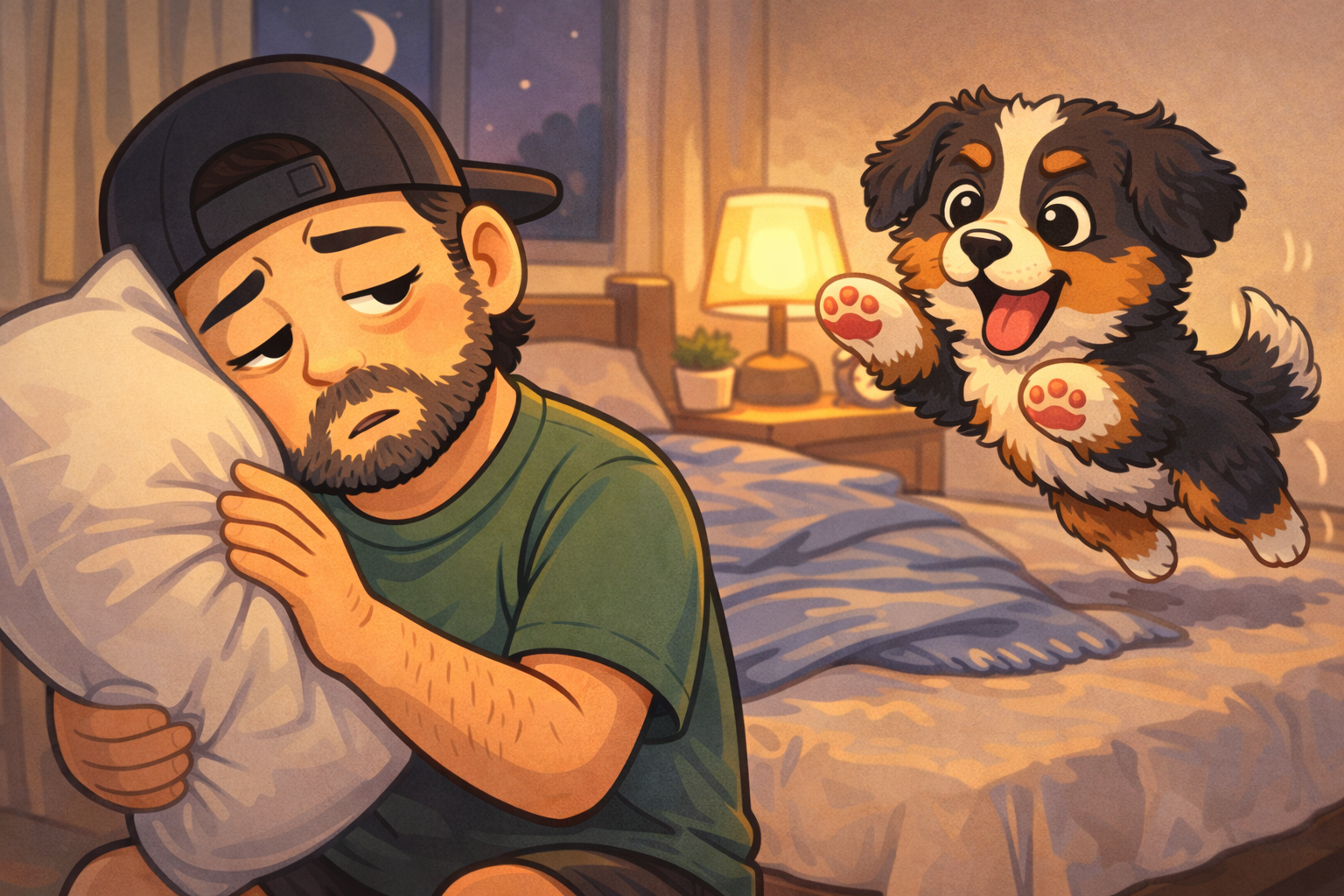
Dog not sleeping at night – please sleep!!!
Finish
If a dog is unable to sleep, the owner becomes exhausted, and nighttime can become increasingly stressful. However, in many cases, this problem is not explained by “my dog is strange” but by a problem with the young dog’s rhythm + caregiver response + evening routine design
Rather than scolding, try to make the night quiet. When an environment is created and small consistencies are accumulated, patterns often change faster than expected. Still, if barking, biting, fear reactions, or signs of health problems appear together, it is safer to consult with an expert to more accurately determine the cause rather than enduring it alone.
A good article to read together
The problem of waking up every night is usually solved much faster if you follow the steps Understanding anxiety signals → Organizing caregiver reactions → Creating alternative behaviors → Routine to rest alone. If you read the article below together, “why this behavior occurs” and “where to start” will become clearer.
Related causes
- Why is my dog shaking? (Anxiety signals/normal vs hospital signals) — If you wake up sensitively or whine every night, check anxiety signals first.
- The effect of guardian stress (tension, discomfort, etc.) on dog behavior — As the guardian becomes more tired at night, the response tone may fluctuate. Check whether our tension increases the child’s excitement
- 7 common characteristics of homes where dog training fails — If you can’t establish a nighttime routine even though you work hard, you need to look at the home’s standards and patterns, not the dog’s problem
Related solutions
- Separation anxiety, barking, hyperexcitability… Problems that arise at home can be solved with just one seat training — Sleep stability becomes much easier once an alternative behavior called seat (mat/house) is established.
- What should I do with a whining puppy? — If you have a pattern of waking up whining in the early morning, try to determine whether it is demanding behavior or anxiety first.
- How to make your puppy’s bite less painful in 3 days (real-life version) — If you get excited at night and even bite, you should also have a Puppy hyperexcitability and nibbling routine
Advanced/Expanded
- Can separation anxiety in dogs be prevented? – Causes and Prevention of Separation Anxiety — Children who become more anxious when their guardians are not visible and try to keep checking on them at night should also be considered for Separation-related stress
Related guides
English edition copyedited and supplemented on October 9, 2026.