Practical starting point
Note whether howling follows a siren, occurs during isolation or begins without an obvious trigger. A recording of an absence can help reveal distress, pacing or attempts to escape. Do not punish vocalization or assume a quiet dog is coping well. New or persistent howling, especially with other behavior changes, merits veterinary assessment.
Hello, this is Saramgom. Have you ever seen a dog howling and singing in shorts? It’s both very cute and interesting. However, if your pet dog howls all the time, it can be quite embarrassing. What is the situation and why is it like that?
There are people who know it properly and can deal with it properly, but there are probably many people who do not know the exact meaning. In this article, we will explain the meaning of your dog’s howling and how to solve it depending on the situation if it becomes a problem.
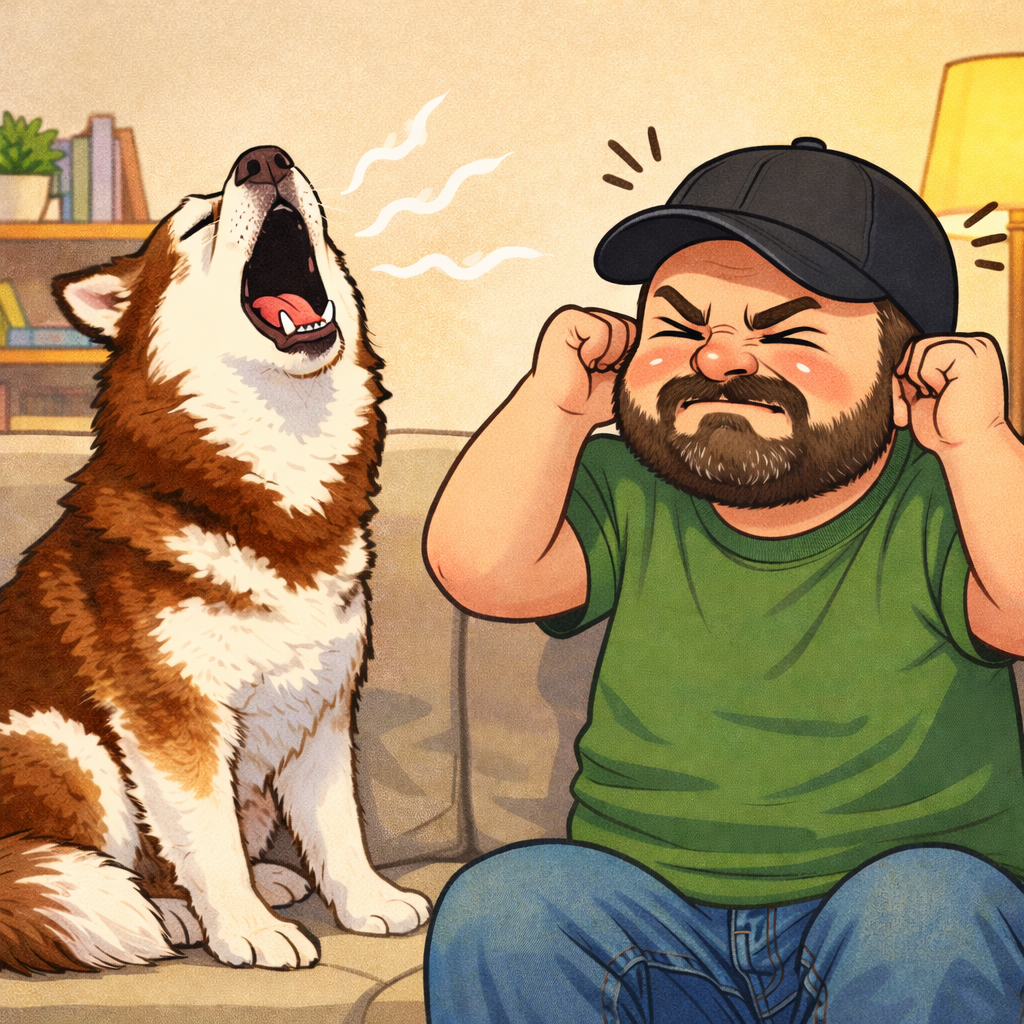
- Quickly distinguish whether your dog’s howling is normal communication or anxiety or a problem signal
- Solution routine that can be applied immediately by situation (when alone/siren/at night)
- Standards requiring hospital and expert consultation (safety check)
Howling is a dog’s “speech.” It occurs for a variety of reasons, including loneliness, anxiety, reaction to stimuli, and pain.
The core of the solution is the three steps Categorizing the cause → Blocking reinforcement (reward) → Learning alternative behavior.
If it is “sudden + sudden increase in frequency” or “older dog + crying at night,” you may want to check its health first.
1) Dog howling, is it normal?
Howling is originally one of the ways dogs announce their presence or express their emotions to someone far away. So Howling itself is not necessarily a problem behavior.
However, the meaning changes depending on “when, under what circumstances, for how long, and what actions occur together.” Check out our dog patterns in the items below first.
- Starts if left alone (possibly related to separation, isolation)
- Responses only to certain sounds (siren, music) (possibility of stimulus response)
- Repeated at night and wandering and anxiety are seen together (life rhythm, anxiety, potential issues with older dogs)
- Started suddenlyand appetite, activity, and gait changed (pain, possible illness)
2) 7 meanings of howling: the most common causes
1. “I’m alone” call howling (isolation discomfort)
If the guardian is not visible, ask “Where did you go?” There may be a howling sound.
Point: You need to build up a “success experience” from very short solitary practice.
2. Separation anxiety, separation-related stress
In addition to howling, destructive behavior, toileting mistakes, drooling, and door scratching are highly likely.
Point: You need a plan to practice “going out” itself step by step.
3. ‘Chorus’ with sirens, songs, and musical instruments
There are children who react to specific frequencies. It may be a reflex reaction, excitement rather than stress. You can hear singing puppies. It can be reinforced with attention and praise from the caregiver, or it can be controlled.
Point: Start with a very small sound and connect it to “good things (snacks, play)” to change the emotion.
4. Getting Attention (Learned Howling)
If the child cries once and the guardian comes running or talks to them, they may learn, “Ah, this works.”
Point: You should greatly reward quiet moments, not howling.
5. Boredom, lack of activity
Especially in the evening, when energy remains, it is expressed through sound.
Point: Rather than just increasing walking time, increase the proportion of brain-using play (nosework, problem solving).
6. Alertness, anxiety (corridor sounds, unfamiliar stimuli)
If you are sensitive to the sound of the entrance, elevator, or footsteps in the hallway, you can express your tension by howling.
Point: Environmental management (blocking sounds, sight) + stability routines such as ‘seat (mat)’ are helpful.
2-7. Pain, disease, cognitive changes in older dogs
If it starts suddenly, gets worse at night, or if your older dog wanders and starts crying, there may be a mix of health factors.
If howling suddenly increases along with changes in appetite, activity, sleep, or gait, a checkup may be better than training.
3) 3 steps to find the cause: The fastest diagnosis method
1. Please record only 3 days
- When? (Night, day, right after going out)
- What stimulus? (Sirens, hallway sounds, doorbells, music, motorcycle noises, etc.)
- How much? (in minutes)
- Accompanying action? (Destruction, defecation, drooling, wandering, panting)
2. Formulate only one hypothesis
Example: “Starts 10 minutes after going out → related to separation”, “Responses only to sirens → sound stimulation”
If you set up multiple hypotheses, the training may falter and the caregiver may become tired.
3. Small experiments, high success rates
If you test immediately by going out for 2 hours, there is a high probability of failure. Accumulate success in small increments, such as 30 seconds to 2 minutes.
4) Solution for each situation: 7 steps of routine starting today
1. Do not ‘compensate’ for howling (block reinforcement)
While howling, talking to the dog, hugging it, or giving it a treat can act as a “reward (attention)” for the dog. Instead, take the quiet moment and praise + reward it right away.
2. Teaching ‘state’ rather than ‘quiet’ command
- The moment the dog becomes quiet for a moment → “Okay” + snack
- Very slowly increasing from 2 seconds → 3 seconds → 5 seconds
- Label the state later: “Quiet”
3. Alternative behavior: Making your mouth, nose, and body use
- Nosework mat, treat ball, licking mat
- Change focus with 3 short tricks (sit, down, touch)
4. If you howl when you are alone (suspicion of separation): Training to go out
- Just open and close the door → come back and get reward
- Actual outing: 30 seconds → 1 minute → 3 minutes → 5 minutes (slowly)
- End always shorter than the howling time (cumulative success)
5. Sirens, if they respond to music: Desensitize the sound + change the emotion
- Play sound at very low volume
- Make snacks and play begin when you hear a sound
- If comfortable, gradually increase the volume and time
6. Environmental management: organizing sound, sight, and movement
- Block the view with curtains and reduce hallway noise with a doormat
- White noise, creating background sound with the sound of a fan
- Learning that a stable space (cushion, crate, mat) is a “good place”
7. Avoid punishment, quit safely
Screaming, covering the child’s mouth, and shocking them can increase anxiety and make it worse. Quiet moment reinforcement + environmental management + step training is the rule.
If you have a clear howling (separation, isolation) pattern when going out, just getting the ‘3-day record table + step-by-step going out routine’ right will change how you feel.
If necessary, you can organize your routine to fit “your home situation” (see bottom of article for counseling and training information).
5) When expert help/hospital check is needed
- Along with howling, there are self-injurious behaviors such as scratching of doors and windows and damage to claws
- Miss toileting, drooling, and destructionare severe (possibility of separation anxiety ↑)
- Old dog + wanders at night and cries continuously
- My life is greatly disrupted due to complaints from neighbors (I need a quick plan)
Checklist (for immediate execution)
- [ ] I wrote down 3 situations when howling begins
- [ ] During the howling, the family agreed not to give attention rewards
- [ ] “2 seconds of quiet” reward practice was practiced 10 times a day
- [ ] Prepared alternative actions such as nose work/licking mat
- [ ] If separation is suspected, practice going out begins in 30-second increments
- [ ] If sudden change/pain is suspected, health check was considered
FAQ
Q1. Is dog howling always a problem behavior?
A. No. Howling can be communication or a reaction to a stimulus. However, if it persists when alone, increases suddenly, or is accompanied by anxiety or destructive behavior, it needs to be addressed.
Q2. Can’t I comfort you when you’re howling?
A. Howling can be learned when soothing behavior becomes a “reward (attention)” for the dog. It is safe to catch quiet moments when the howling stops and compensate.
Q3. I cry whenever I hear the siren. Do I need to get it fixed?
A. If the reaction is short and light, correction is not necessarily necessary. However, if you have complaints or become overexcited at night, it is helpful to practice changing your emotions by desensitizing sound + combining snacks.
Q4. Can separation anxiety howling be solved by taking more walks?
A. Walking is helpful, but the core of separation anxiety is the feeling of being “alone,” so step-by-step training must be done along with it.
Q5. The howling suddenly started. Should I go to the hospital first?
A. If it suddenly increases differently than usual, there is a possibility of pain or illness. In particular, if there are changes in appetite, activity, or sleep, a checkup is recommended first.
Howling is often not a “sound that needs to be fixed,” but rather a “message with a reason.”
If you just pinpoint the cause, it will decrease faster than you think.
Pohang specializes in dog training!!! Visiting is also possible!!
Gomgom is a trainer, a Saramgom. We have been providing training and behavior correction in Pohang for 6 years. For inquiries regarding dog training in Pohang, please contact us using the contact information below and we will contact you within a day. Please feel free to contact us about puppies, socialization, walks, etc.
Related guides
English edition copyedited and supplemented on October 9, 2026.