Practical starting point
Replace a ranking with a household checklist: activity needs, grooming, noise sensitivity, comfort alone, handling and compatibility with existing animals. Fast learning can include learning unwanted habits. Meet the individual when possible and ask for real care records. A dog who is quick at obedience is not automatically easy to live with.
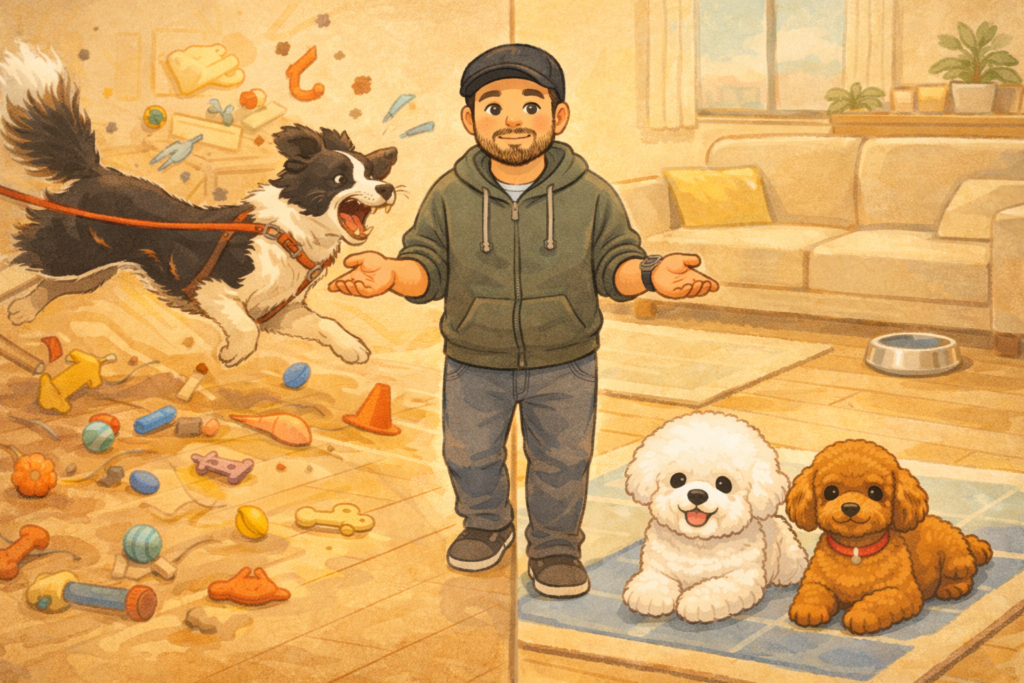
Hello. I’m Saramgom.
There are a lot of questions asked by people who want to raise a dog for the first time.
“Which dog breed is the smartest?”
“What kind of dog is easy for beginners to raise?”
“Are there any dog breeds that are prone to separation anxiety?”
“Which dog do you recommend?”
Today, I will try to organize these four things at once.
There are many people who want to raise smart dogs. It would seem that if you are smart, you will be able to understand people well, not cause accidents, and be quiet at home, but that is not the case. However, let me tell you first, dog intelligence is not a concept that can be ranked from the top like human test scores. Some dog breeds are good at collaborating with people, some are quick at problem solving, and some are strong at making independent decisions. In other words, “how you learn well” is more important than “who is the smartest.”
And in Korea, we need to see one more thing here. It is the housing environment. Overseas, retrievers are often mentioned as a good breed for beginner dog owners, but in an environment like Korea with a high proportion of apartments and apartment complexes, the story may be a little different. This is because you have to think about elevators, hallway encounters, barking issues, and indoor excitement management as well.
Dog intelligence rankings are fun, but why you shouldn’t trust them
When we often say “a smart dog,” we are actually often referring to several abilities at once.
- How good are you at reading people’s signals
- How quickly you learn new rules
- How do you control your impulses
- When a problem arises, do you try to solve it on your own?
- Or seek help from someone
So, some dog breeds are quick to respond to training, some are good at collaborating with people, and some are good at making independent decisions. If you organize this all into a single leaderboard, it’s easy to miss the more important parts of real life.
For example, herding breeds such as border collies are often known as very intelligent dog breeds. It is true that they actually have excellent learning and collaboration skills. But the important thing here is thatsmart dog breeds are not necessarily easy dog breeds for beginner owners. Smart friends also think creatively. 🙂
And, children who are quick learners learn good habits quickly, but they also quickly learn their guardians’ mistakes. Digging into just one gap. You may feel bored quickly and become more reactive to stimulation. So, if you choose a child only because he or she is said to have “good brains,” it can actually make things more difficult for the guardian.
Easy dog breeds for beginner owners, but our country is different.
Overseas, Golden Retrievers and Labrador Retrievers are often introduced as relatively easy dog breeds to novice guardians. This is because they have a good tendency to collaborate with people, and it is easy to provide lifestyle education based on relationships. If you ask GPT or artificial intelligence, most of them will recommend a retriever. That’s because it’s common overseas.
But in our country, we need to think twice here.
Retrievers are definitely a good dog breed. However, considering the large size, walking, movement, control when excited, and indoor life management, the Korean apartment environment can realistically be a burden to novice guardians. Just because a dog has a good personality doesn’t automatically mean it will be an easy dog to raise.
So, by Korean standards, I tend to value the realistic adaptability of small and medium-sized dogs more than the advantages of large dogs.
So, my #1 recommendation is the Bichon, and #2 is the Miniature Poodle
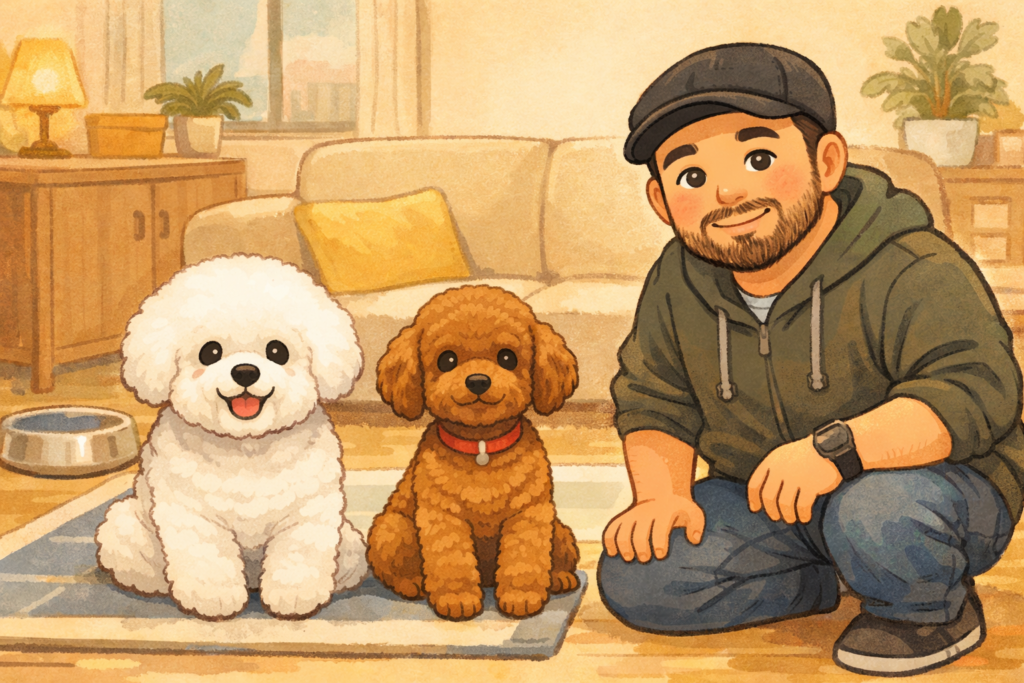
1st place Bichon Frize
The reason I put the Bichon at number one is simple. This is because they have a relatively good balance of size, bright disposition, adaptability to indoor life, and a size that is physically easy to handle by novice guardians.
In Korea, “Can I handle this child every day” is more important than “Is this breed famous?” Bichons do not require as much physical strain from moving and walking as large dogs, and as long as they have a good daily routine, even beginner owners can get started relatively stably.
Of course, the Bichon is not a breed that cannot be handled. Coat care is necessary, as well as excitement control, barking management, and socialization. However, based on the premise of living in a Korean-style apartment, I think the Bichon is the most realistic first recommendation. However, you may feel burdened by beauty care.
2nd place: Miniature Poodle
Miniature Poodles are a very attractive dog breed because they are quick to train and have great interaction with their owners. The pace of learning is fast, and life education is good.
However, I think that for a novice guardian, a poodle may be a little more sensitive than a bichon. This is because, although they learn good things quickly, they also quickly read their guardian’s reaction patterns or bad habits.
So, while the Miniature Poodle is certainly a great breed, I think it is better suited to an owner who is ready to teach consistently. Experienced people have an advantage over those who are raising a dog for the first time. In that sense, my personal recommendation order is Bichon in first place and Miniature Poodle in second place.
More important than a smart dog is resilience
In Korean apartment complexes, there is something more important than “being able to understand what is said quickly.”
- Are you overreacting to hallway sounds?
- Are you sensitive to doorbells or external sounds?
- How quickly do you get excited and then calm down again
- Are you able to practice alone time
No matter how smart your dog is, if it continues to react to the sound of the front door, elevator, delivery, or neighbors’ footsteps, it can become much more difficult to care for in a communal environment.
So, what is more important for new caregivers is not intelligence ranking but life resilience. A child who doesn’t get excited easily, can calm down when excited, and is easy to create rules with his/her guardian is actually much more comfortable.
Separation anxiety requires consideration of individual tendencies and habits rather than the breed
Since there are many homes where dogs spend a lot of time alone, they are very concerned about separation anxiety. It is difficult to pinpoint separation anxiety as a problem for a specific dog breed. Some dogs bark when their owners leave, some scratch the door, and some pant or make toilet mistakes. In other words, even if they look similar on the outside, the underlying cause may be different.
So, rather than simply thinking, “This breed has a lot of separation anxiety,” we need to pay more attention to the following tendencies.
- Child who always follows the guardian
- Child easily nervous about unfamiliar sounds and changes
- A child who immediately whines or barks when he/she does not get what he or she wants
- A child who cannot tolerate frustration well
Whether it’s a Bichon or a Miniature Poodle, there are quite a few dogs that like people. So, while recommending these two dog breeds, I make sure to say the same thing.
“You need to practice separation separately from the beginning.”
Any breed can have a hard time being left alone if raised in a way that requires constant holding, constant responsiveness, and constant attachment.
How should I choose a different dog breed?
I tell new dog owners to look at the four things below when choosing a dog breed.
1. Is it a size I can handle even on weekdays
It’s more important than being pretty. If you think about taking a walk on a rainy day, going to the hospital, encountering an elevator, or even controlling yourself when excited, size is a really big variable.
2. Is this the type that doesn’t break down from external stimuli
A child who breaks down too easily to everyday stimuli such as hallway noises, doorbells, visitors, or elevator noises will have a much harder time living in a group home.
3. Can you practice alone?
Although liking people is a strength, the tendency to become overly attached to their guardians can lead to separation-related problems. From the beginning, we need to see if it is possible to maintain distance and practice alone.
4. Can I maintain a routine for over 10 years
From walking, fur care, basic training, and health care, consistency is the most important thing. Breed recommendations should be viewed in terms of sustainability rather than trends.
One-line conclusion summarized by the Saramgom
Dog intelligence rankings can be an interesting reference. However, in Korea, size suitable for apartment living, noise resilience, possibility for separate practice, and level of difficulty that matches the caregiver’s daily life are more important.
So, to put it simply, based on my standards, it is like this.
The number one recommendation for Korean-style beginner guardians is the Bichon. Second place is the miniature poodle
The Bichon is a bit rounder and a good starter dog, while the Miniature Poodle is a bit smarter and faster, but requires more consistency. If I were to recommend one or two more friends, it would probably be a Shih Tzu or Pekie (a brachycephalic breed that has health issues).
But this is just my recommendation!!!! In the end, what is more important than the breed of dog iswhether the child can live happily in our home. Whatever the breed of dog, it is up to the guardian!!!!!!
Related guides
English edition copyedited and supplemented on October 9, 2026.