Practical starting point
For each event, record time, location, sleep, meals, drinking and the last toilet opportunity. Include successful trips so the record does not focus only on failures. Look for a manageable scheduling change before changing several variables. A log cannot diagnose infection, pain or incontinence; share unusual patterns with your veterinarian.
Hello. I am Saramgom, a behavior correction and trainer.
This is the most frustrating thing parents say when potty training doesn’t go well.
“Why on earth are you doing it over there? Why is it at that time?” The tool that answers this question the fastest is Defecation Mistake Map (time+place+record of immediate situation). It is much faster to find patterns and fix the environment/routines than to scold others.
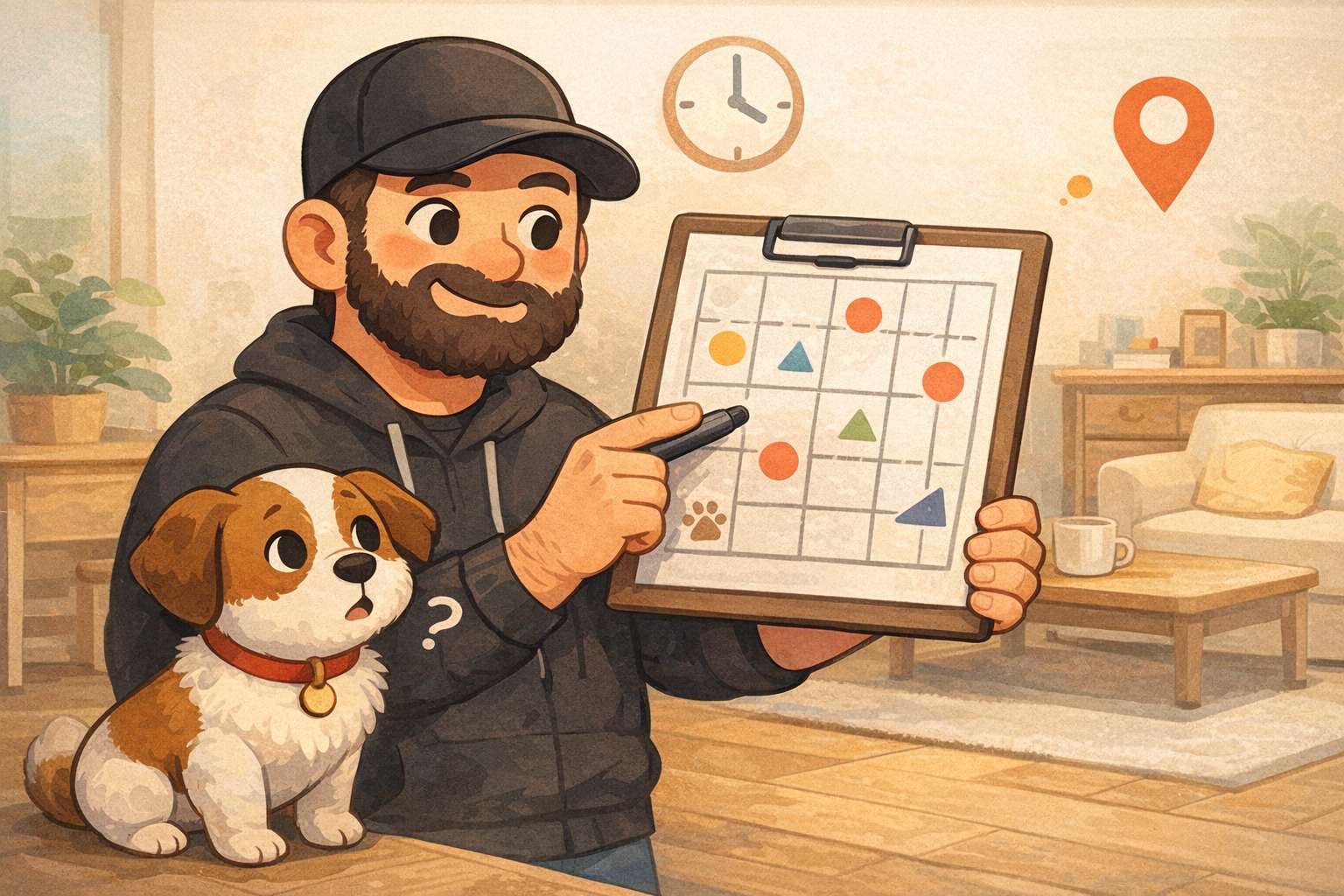
- Recording method to find time and location patterns of bowel movements within 7 days
- Rug, entrance, in front of the door, after a meal, before and after going out, etc. 5 types of representative causes Interpretation
- After finding the cause, apply today “Prescription to increase success rate”
Summary (3 lines)
① Bowel mistakes are often patterns (timetable, movement, surface, emotional trigger) rather than “habits.”
② Just by recording 7 days, the cause can be narrowed down to “why that time and that place.”
③ The best solution is to design the probability of the correct answer (pad success) rather than scolding.
1) What is a toilet mistake map?
The toilet mistake map is a method of finding repeating patterns by recording “the time of the mistake + the location of the mistake + the immediate situation”.
Surprisingly, defecation problems are often caused not by “will,” but by timetables, routes, and environment.
2) If you record just 7 days, a pattern will appear
2-3 days is also a hint, but 7 days is better if possible.
Once may be a coincidence, but repetition is almost always for a reason.
6 essential records (faster “sorting” of mistakes)
- Time (e.g. 07:20)
- Location (e.g. living room rug / doormat / in front of veranda door)
- Type (shh/poo/both)
- Previous situation (wake up/after meal/playing/guests/preparing to go out/being alone, etc.)
- Form of mistakes (a large amount vs. a small amount/slightly / appears to be in a hurry / done in a hidden manner)
- Guardian response (clean up quietly/make noise/guide with pad/just wipe, etc.)
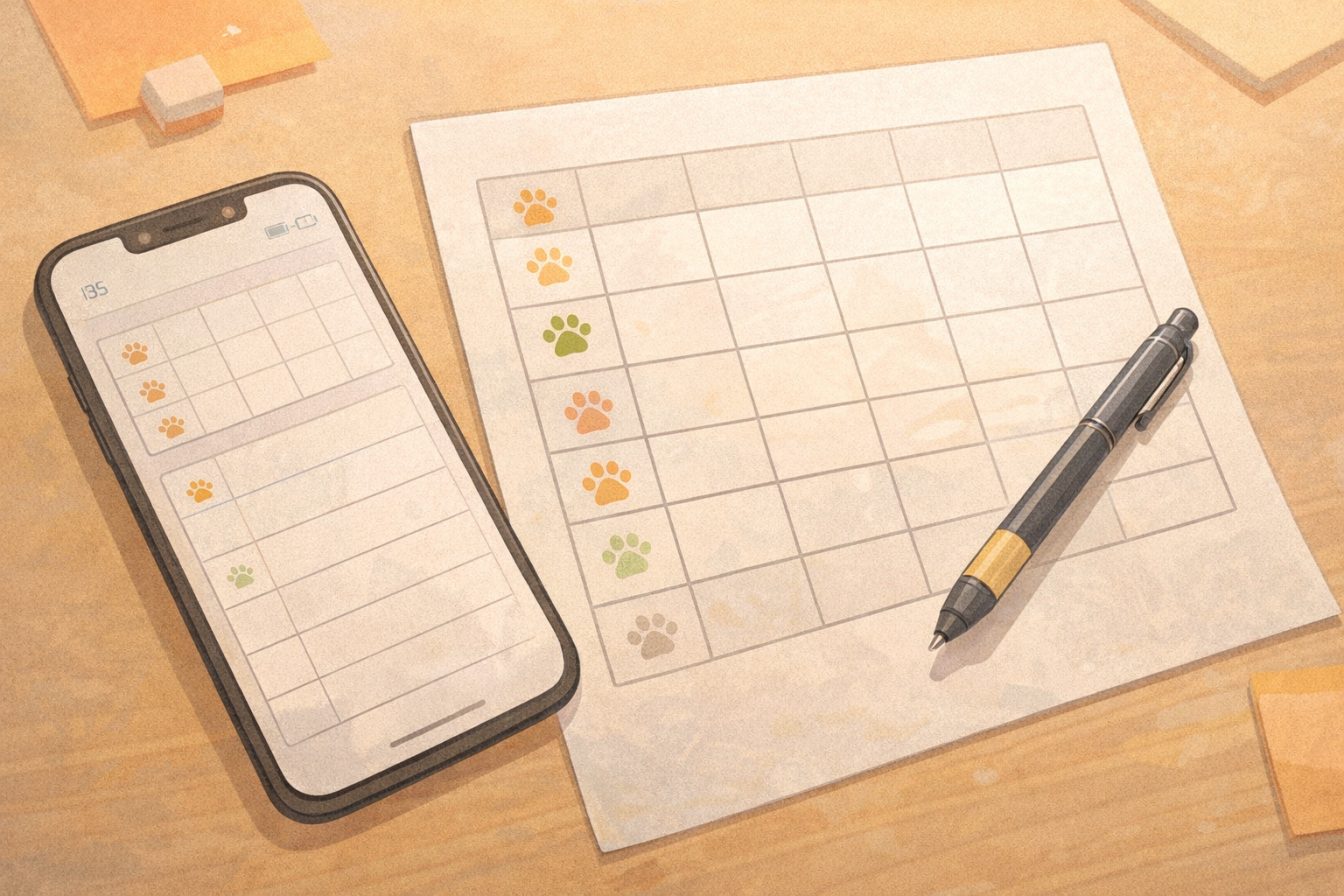
Defecation mistake record
| Date | Time | Location (exactly) | Type | Previous situation (trigger) | Real type | Probable cause note, guardian reaction |
|---|---|---|---|---|---|---|
| Example) 3/1 | 07:20 | Center of living room rug | Shh | Immediately after waking up | Plenty of quantity / Urgent | Late movement to pad + surface (rug) preferred |
| Example) 3/1 | 18:40 | Doormat | Shh | Preparation for a walk (harness) | A small amount | Walk signal excitement or marking |
3) How to make a “location map” (5 minute cut)
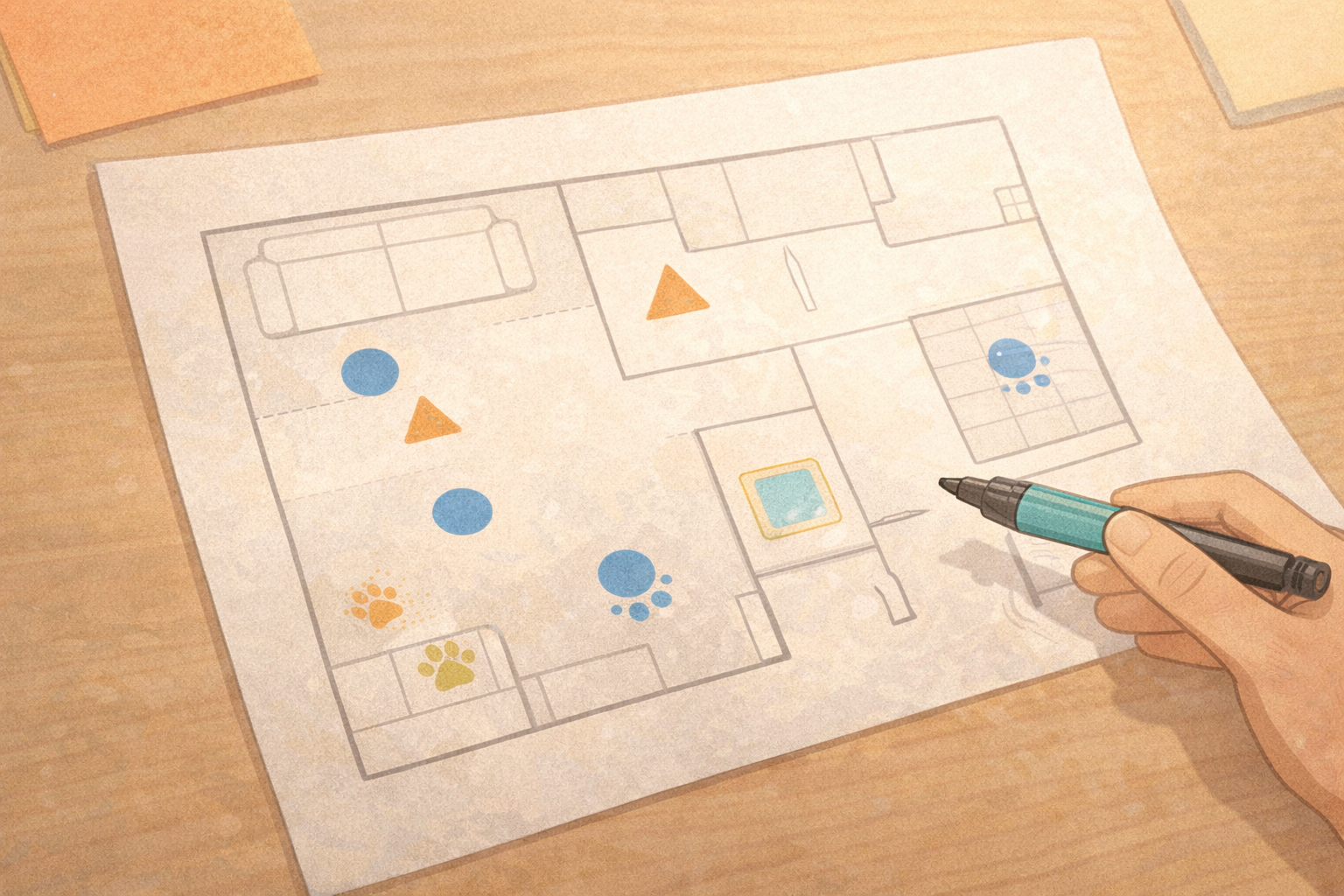
- Roughly draw the house: only the living room/room/entrance/kitchen/veranda
- Mark at the point of mistake: sh=●, poo=▲
- Also displays pad (toilet) location
- After 7 days, if there is an area where the marker is concentrated, “that is a hint”
Frequent hints
Rug/mat (surface), in front of the door (signal to go out), corner (anxiety/screaming memory), repeating the same spot (reverberation)
4) Pattern interpretation: Real numbers are usually one of five types
Type A) Real numbers only at certain times (timetable/timing)
- Immediately after waking up: Guide to the pad is late / the pad is far
- 10-30 minutes after meal: Missing the timing
- Immediately after going out/immediately after returning: anxiety/excitement/anticipation
- Night/Dawn: Last bowel movement too early or water intake too late
Prescription: “Success rate priority mode” only for that time period (moving line restriction + pad expansion + timing catch).
Type B) Mistakes only in certain places (surface/movement/smell)
- Rugs/Carpets: May lead to preference for absorbent surfaces
- In front of the entrance/veranda door: Connected to the exit signal
- Corner/Bedside: Preference for a private location (including anxiety)
- Same spot repeated: Recognized as “toilet seat” due to reverberation
Prescription: Enzyme Cleaner + Limited Access + Temporarily Placing the Answer Pad “Nearby” to Start with Success.
Type C) Post-event mistake (emotional trigger such as guest/doorbell/vacuum cleaner)
- Excited urination (especially puppies)
- Agitated urination (sound/unfamiliar stimulus/separation)
Prescription: Reinforced care 30 minutes before and after the event (pad zone waiting + short nose work + calming routine). Mistakes are quietly sorted out.
Type D) Marking pattern (especially male/adult dogs)
- The amount is small and spreads in several places
- Increased after new objects/new smells
- Put it on a wall/furniture leg
Prescription: Restriction of movement lines + Management of stimuli (outside the window/new smells) + Redesign of movement lines in the indoor bathroom.
Type E) Sudden increase in mistakes (possible health signal)
- A child who was doing well suddenly makes more mistakes
- Water intake, increased urine output, appearing urgent
- Hematuria/pain response/increased licking
Important: In this case, health check may take priority over training. If in doubt, hospital consultation is recommended.
5) Once the cause is found, the solution is “to increase the correct answer”
If you find the pattern, there is only one next step.
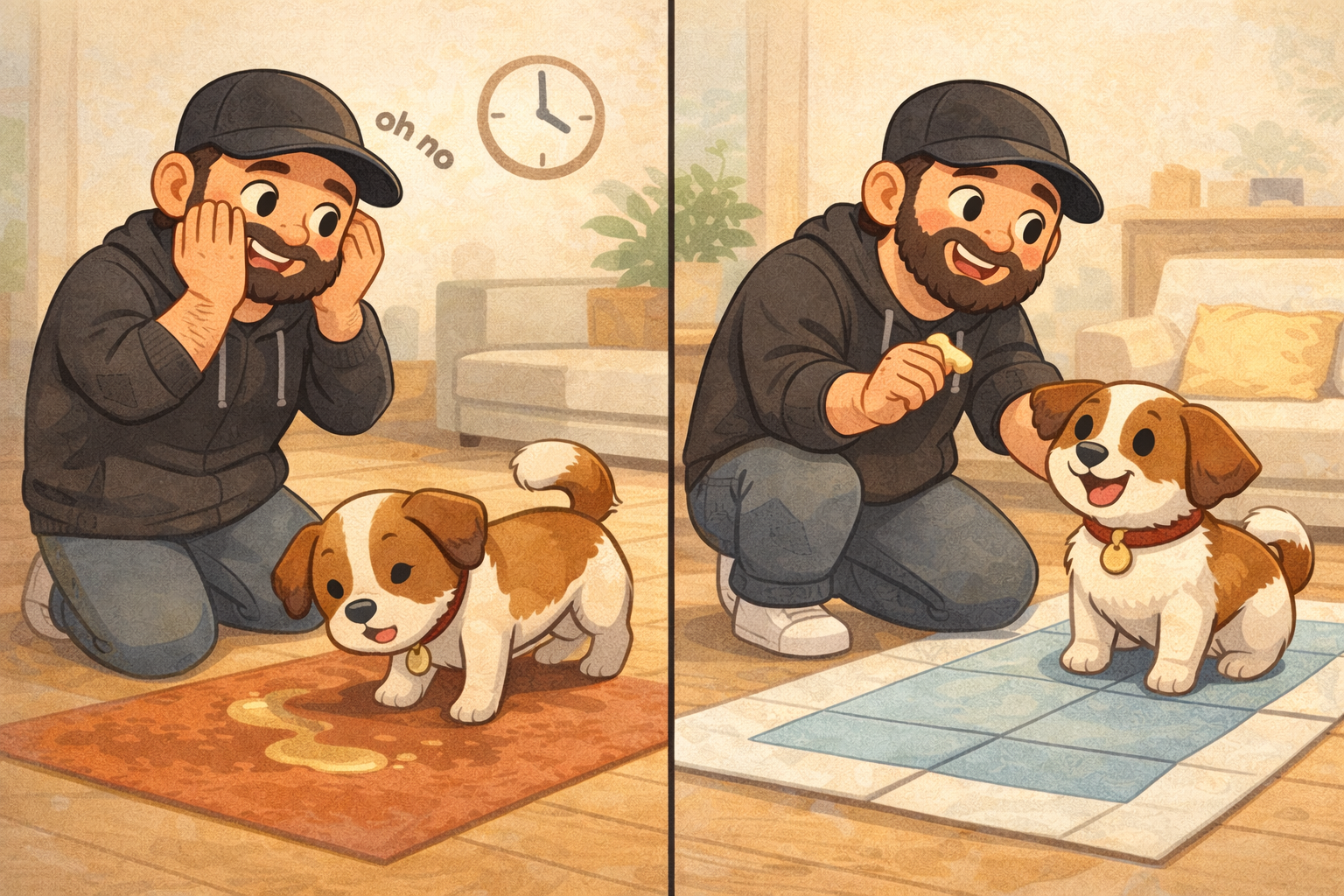
Design for pad success in that situation, and if successful, immediately compensate greatly.
5-piece Saramgom prescription set (effect order)
- Restrict movement: Close fences and doors in times/areas where mistakes are likely to occur
- Pad expansion: “Success rate” before “accuracy”
- Timing catch: Connect directly to the pad after waking up/after eating/playing
- Enzyme Cleaner: Remove real spot reverberation
- Reinforcing success rewards: In the beginning, 3 to 5 snacks in a row (short and loud)
And if you wish, the “7-day correction plan based on mistake guidance” that can be applied immediately based on the record table is also continued in the article below.
6) Checklist to use today
- □ Write down 6 types of mistakes (time/place/type/immediate situation/type of mistake/reaction)
- □ Mark mistake points ●/▲ on the house map
- □ Restrict movement in areas where mistakes are frequent for 7 days
- □ Increase the “success rate” by increasing the size/number of pads
- □ Fixed pad routine for the 3 timings: waking up/after eating/playing
- □ Remove reverberations from mistakes with enzyme cleaner
7) FAQ
Q1. Even if I use a mistake map, I can’t find the cause
There are many cases where records of the previous situation are insufficient. Write down the time you drank water/nap/play intensity/going out/return/guests/noise, and be sure to record any mistakes amount (large/small amount).
Q2. If you don’t get scolded, won’t you keep making mistakes?
Scolding does not “reduce mistakes,” but often increases the number of “hidden mistakes.” Rather than punishing us, we build success by designing the probability of getting the right answer.
Q3. How do you distinguish between marking and mistakes?
Marking is usually a small amount in several places, and it tends to increase after a new smell/stimulation. Mistakes are often large portions at once due to timing (waking up/after eating) or movement issues.
Q4. Can I move the pad location?
Temporary movement to increase success rate is okay. Once your success has stabilized, move little by little every 2-3 days to the desired location.
Q5. Mistakes suddenly increased
If there are changes such as increased water intake/urinary urgency/pain reaction/hematuria, health check before training may be a priority.
A good article to read together
✅ Related causes (anxiety/routine/environment)
- The puppy Reasons for trembling (checking for anxiety signs) — “Check for anxiety signs when your bowel movements are shaking”
- I If you are anxious, will your dog become more anxious? — “Guardian 10 second calming routine”
- Puppy 7 common things in homes where training fails — “Check the timing of rules/rewards”
✅ Related solutions (toilet/seat/routine)
- Puppy Training (4) – Potty Training — “Basic Setting/Pad Reduction Timing”
- Puppy Do you keep making toilet mistakes? Cause/solution of repeating the same position (human style)
- Seat (Mat/Crate) Training — “Getting in Place at the Door/Excitement Routine”
- Whine. Dog coping routine — “Distinguishing needs/anxiety + alternative behavior”
✅ Expansion of situation (outdoor defecation → indoor conversion)
Defecation mistake record
| Date | Time | Location (exactly) | Type | Previous situation (trigger) | Real type | Possible cause note, guardian reaction |
| Example) 3.1 | 7:30 | Living room corner | Shh | Immediately after waking up | Plenty of quantity, hidden | Anxiety about hard-to-see places, clean up quietly |
Related guides
English edition copyedited and supplemented on October 9, 2026.