Practical starting point
Try an easy food search, a short reward-based skill or gentle play suited to the dog's health. Count food rewards within the daily diet and supervise toys. Indoor activity does not replace toilet access, all outdoor exploration or social needs indefinitely. If walks are repeatedly impossible, arrange practical care support rather than relying on one exhausting game.
Behavior • Walking • Training
I missed walking the dog – don’t feel guilty. You can do it at home.
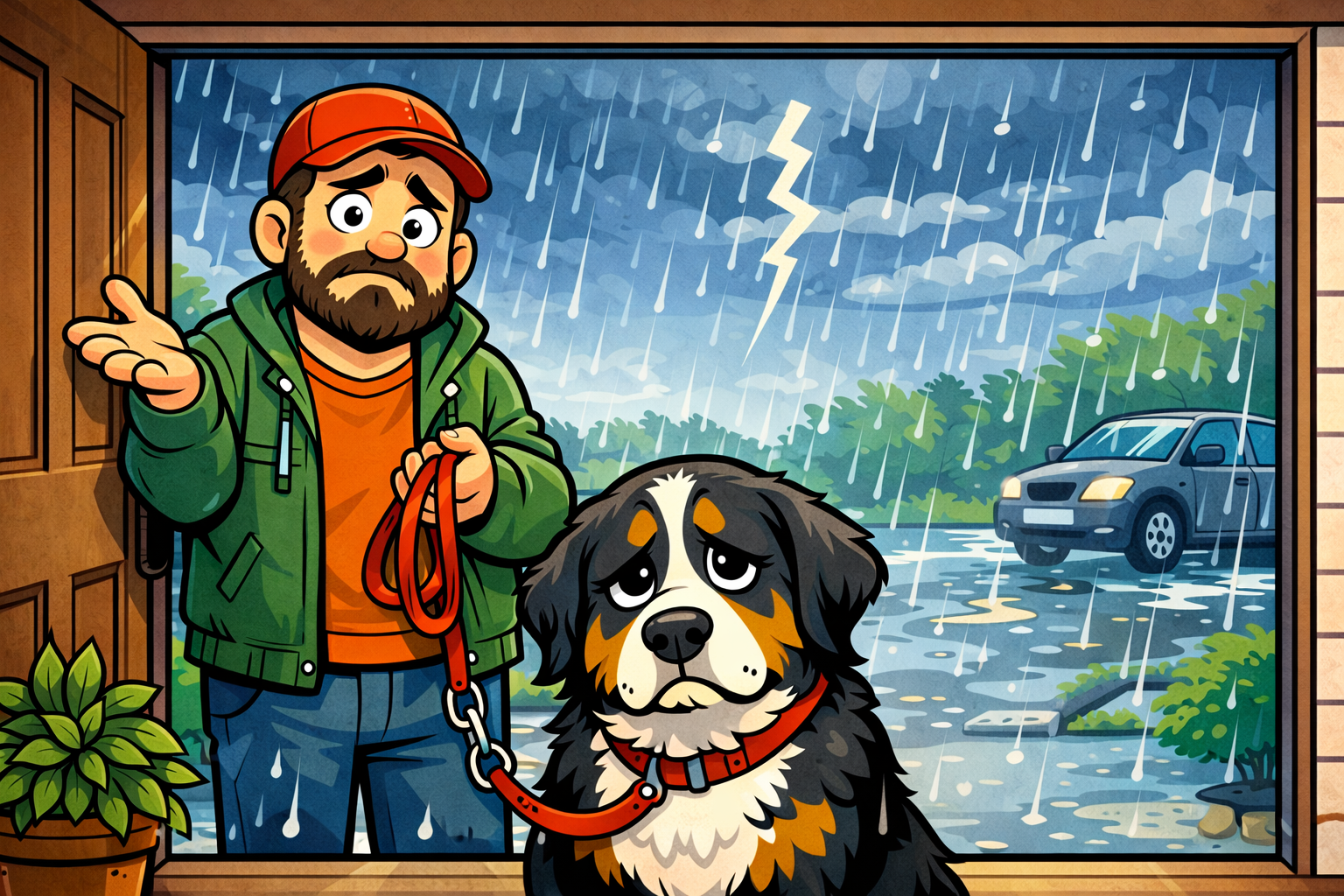
Hello. I am Saramgom, a dog behavior correction expert and trainer. Going for a walk is great for the dog and its owner, but it can’t always be done. In fact, the guardians of friends who defecate outdoors take a walk every day with great determination.
Usually, most guardians do it because it snows, is too cold, rains (rainy season), fine dust is severe, or they suddenly don’t have time… There are days when I can’t go for a walk. But that night, the puppy started running, barking, and biting even more… The house is often in chaos. Some people feel guilty for this reason. We will help you replace walking with alternative play. (It is not a perfect substitute for walking, so it should not be abused indiscriminately.^^)
3 key things
- Top 10 indoor games that are effective instead of walking
- Excitable, anxious, puppy, and even senior dogs Recommended by personality type
- Not “end of play” but calm down (rest) rules at the end
Summary
- On days when I can’t go for a walk, smell, finding food, and the brain are more efficient than body exercise.
- The key to indoor play is several short sessions + calm down at the end.
- It is not a play that increases excitement, but a play that creates options (alternative actions)
Table of Contents
- Checklist before starting (safety settings)
- Why indoor play is more important on days when you can’t go for a walk
- 10 indoor dog games you can do right at home
- Today’s version: 20-minute indoor routine template
- Recommendations by personality type (excited, anxious, puppy, senior dog)
- 7 mistakes that can ruin indoor play
- Safety/Caution: Signal that hospital/expert consultation comes first
- FAQ
- A good article to read together
Checklist (check before starting)
- ☐ If the floor is slippery, use a rug or mat to prevent slipping
- ☐ Breakables, wires, small toys (risk of swallowing) Putting away
- ☐ Prepare rewards (food, snacks) in bite size (if it is too big, excitement ↑ and digestion burden ↑). It can be very small.
- ☐ Decide on one “Stop” signal(Unify family vocabulary)
- ☐ Prepare a place to rest (mat, cushion) in advance
Why indoor play is more important on days when you can’t go for a walk
Walking is good exercise, but in fact, for many dogs, smell exploration (olfactory stimulation) plays a big role.
So, if you add search, exploration, and problem solving even indoors on “days when you can’t go out,” your dog often calms down faster than expected.
The key is this.
- Shortly (3-7 minutes) Multiple times
- Don’t just play games that raise excitement, mix in plays that lower excitement
- At the end, always Close with a break (mat, cushion, licking, gum) ※ Licking means putting a snack on the licking mat and licking it. It can be replaced with a nose work toy.
10 indoor dog games you can do right at home
One thing to keep in mind when playing any kind of play is that even if the dog is excited, the guardian should play calmly. (For a friend who is extremely timid or was born outside (as a wild dog) and is therefore wary of all situations, I may intentionally play with them with hyperactive movements, loud gestures, and excited voices to help them feel the same way.) In most cases, they tend to get overly excited, so we recommend playing with them calmly. Praise can be short and clear. There is no need for excessive physical contact!
1) “Find it!” Hiding snacks (super simple nose work)
- How to: Hide 2-3 items on the floor or under a towel in front of your dog and say, “Find them!”
- Difficulty level up: Expand down to other boxes and cups (use a crumpled paper cup or used milk carton)
- Time: 3-5 minutes (the point is to finish it briefly)
2) Scatter feeding — 1st place in walking replacement efficiency
- Method: Do not feed the feed all at once, but “sprinkle it on” on rugs, mats, and towels
- Point: Where the floor is not slippery!
- Time: 5-8 minutes
3) 3 paper cups “Find the answer” game (puzzle)
- Method: Treat 1 out of 3 cups → mix → puppy chooses with nose
- Caution: If the type of person chews and swallows the cup, operate it only with the guardian’s hands
- Time: 3-5 minutes
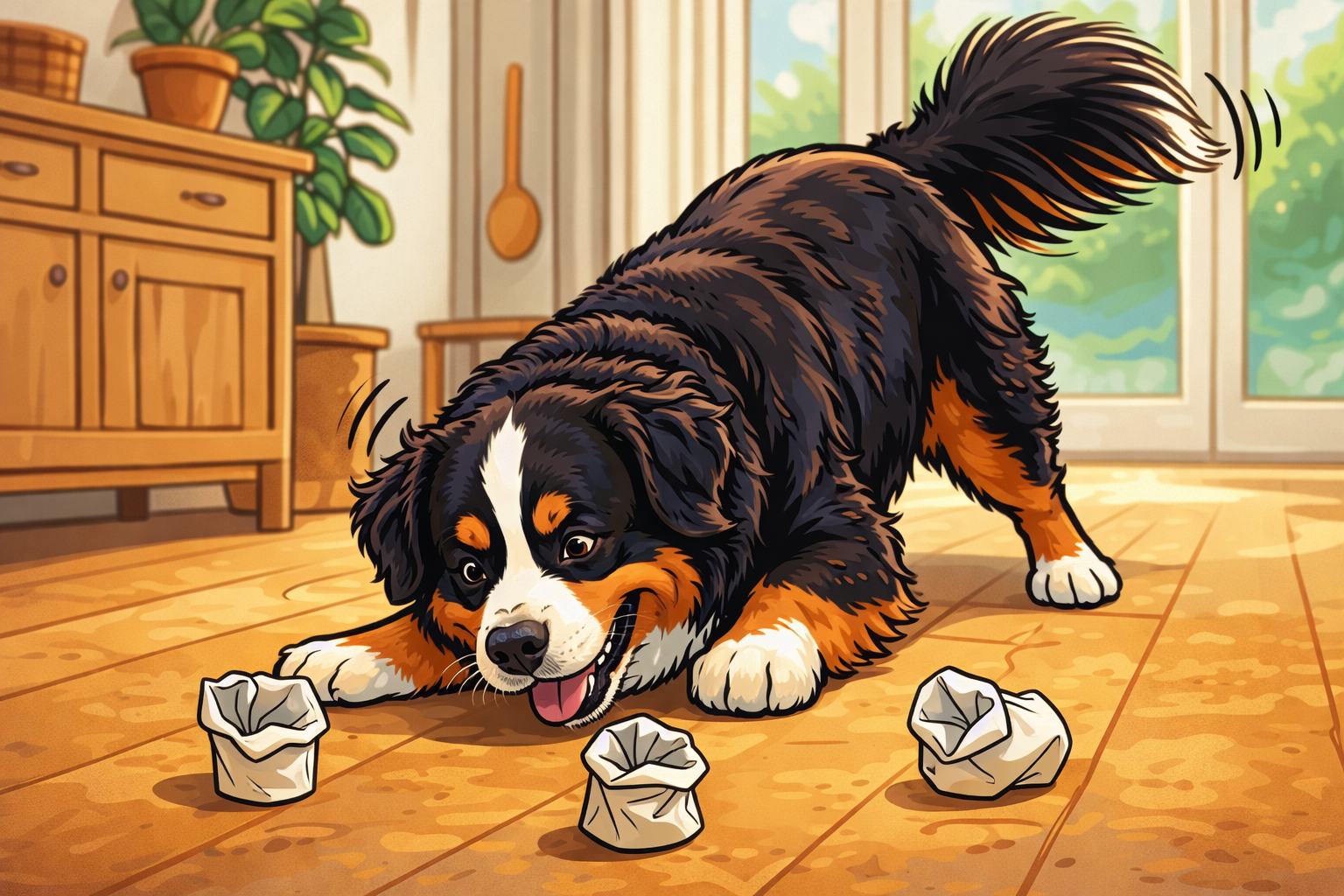
Puppy having fun at home
4) Towel roll (towel nose work) — No equipment required
- Method: Put food and snacks in a towel and roll it up → OK to tie it one more time
- Point: Make it easy at first, experience success first (if you make it too difficult, you may lose interest, so let’s help you succeed.
- Time: Within 5 minutes
5) “Touch” — The most useful basic skill indoors, quite good basic training with attention-getting
- Method: Present palm → The moment noses touch, “That’s right” + reward
- Effectiveness: Recovers concentration when distracted, induces movement, interrupts excitement
- Time: 2-3 minutes
6) Connecting “House, Seat” — The End of Play
- Method: After 2~3 successes (find, touch) → lead to mat → 3 seconds rest reward
- Point: Reward “resting behavior” rather than “stay still!”
- Time: 3 minutes
7) Tug of War (Tug) — The best communication game with just rules
- 3 rules: (1) signal to start, (2) “let go/stop”, (3) restart only when calm
- Caution: If your hand begins to touch your teeth, stop immediately → rest for 10 seconds and resume
- Time: 2-4 minutes (short!)
8) Hallway, living room “Toy recovery” — Focus on ‘retrieval’ instead of throwing
- Method: Throw briefly → “Come here” when bitten → Retrieve by exchange (snack)
- Effect: The excitement explosion type goes up further just by ‘throwing’, so recovery and exchange are the key
- Time: 5 minutes
9) Box exploration (box play)
- How to: Leave 2-3 delivery boxes open and hide a snack or two
- Caution: Supervision required if you are the type to open boxes
- Time: 3-7 minutes
10) Licking + Rest — A particularly powerful finish for excitable types
- How: Rick mat, Kong toy, gum (safe size) → Quiet on mat
- Point: Indoor play can be substituted for walking only when there is a “finish calm”
- Time: 5-10 minutes
Today’s version: 20-minute indoor routine template
Try it in exactly this order. (The effect is better in a house with excessive excitability and barking)
- 0~5 minutes: Sprinkle feed (scatter) or towel nose work
- 5~10 minutes : 10 touches + 5 house (seat) times (short)
- 10-14 minutes: 2 sets of tug-of-war (including “Stop, let go”)
- 14-20 minutes: Licking, gum + rest on mat (finish)
※ It is not a “exercise where you run for 20 minutes,” but it is a structure that uses your brain and calms you down at the end.
Recommendations by personality type (excited, anxious, puppy, senior dog)
Excited type (gets even crazier when running) → Increase the ratio of “searching, searching, spotting”
- Recommendation: Scatter feeding → touch, spot → licking finish
- Less recommended: 10 minutes just throwing the ball (mostly more explosions)
Anxious type (sensitive and easily startled) → From “quiet success”
- Recommendation: Towel nose work (easy difficulty) → mat rest
- Point: It is much faster if the guardian reduces the number of words and movements
Puppy (bite, hyperexcitability) → “Short, frequent, rest at the end”
- Recommendation: 1 minute touch + 3 minutes search + 10 second rest (repeat)
- Caution: Biting often occurs more when you are tired (including sleep routine)
Elderly dog, child with joint strain → Anti-slip + low-intensity exploration
- Recommendation: smell play, box exploration, puzzle game
- Caution: No jumping or sharp turns (slippery floors)
7 mistakes that go wrong when playing indoors
-
- Indoors, “just throw the ball” for a long time (only accumulates excitement)
- Raise the difficulty level of success at once (practice failure)
- Immediately left unattended after playing (the excitement has nowhere to go, so it starts barking and biting)
- I can’t hang up because there is no “stop” signal
- If the reward is too large or sweet, digestion and excitement increase
- Have children run on slippery floors (risk of injury)
- The guardian becomes excited first (as the voice and movements become louder, the dog also rises)
Something to keep in mind while playing is that the guardian should always take the lead (the guardian should start and end the play – this should not be an environment where the dog brings a toy), and it is not good to repeat the same thing too much, so please be careful. Be careful as the guardian’s attitude and timing of engagement and disconnection during play, as well as excessive expectations, can reduce the effectiveness of the play and may also cause side effects. And you must clean up everything after playing.
Safety, caution: Signal that hospital/expert consultation comes first
- Suddenly, aggression and attempts to bite increased significantly. You are doing something wrong.
- Accompanied by suspicion of pain (limping, anger when touched, sudden change in appetite/activity).
- Panic (hyperventilation, escape attempts, self-injurious scratching) is seen even indoors.
- It is difficult to manage because family safety is at stake (children, the elderly).
In this case, a safety plan + expert consultation is faster and safer than just “playing”.
FAQ
Q1. If you can’t go for a walk, is indoor play enough?
A. It’s enough to cover for a day or two. However, if it is long-term (more than a week), it is better to set the rhythm of life with a “short, frequent” routine.
Q2. I actually get more excited when I play indoors. Why?
A. This is because the rate of exciting play (throwing, chasing) is high, or there is no calming down at the end. Try mixing “finding, licking (you can find it by searching for licking mat), and position” and closing the end with a rest.
Q3. I’m worried that nose work involves too many snacks.
A. Instead of snacks, you can use the daily amount of food as a play. Approach puzzles and scatters with the feeling of changing the “pay method.” It must be completed within the daily intake. If you overdo it, you may lose interest and cause health problems such as obesity.
Q4. Doesn’t aggression increase when you play tug of war?
A. Usually, if there are rules, it’s not a problem. As long as you follow the rule of “let go, stop” and stop immediately if your hand touches your teeth, you can play a safe communication game.
Q5. How many minutes per day is appropriate?
A. In most cases, it is much more stable if you break the total of 15-30 minutes into “3-7 minute increments” (adjusted according to the dog’s personality and age).
A word about Saramgom
You don’t have to think of the day you couldn’t go for a walk as a “messed up day, a sorry day, a bad day.”
Smell (searching) → Short training (touch, spot) → Finishing calming (licking, resting) If you keep these three things, the night will be more peaceful than you think.
▶ Check the ‘20-minute indoor routine’ tailored to your home, view consultation information
A good article to read together
Related causes (emotion, stress)
- Starting with the stress signal checklist: “Whether you are burdened or bored right now”
- If you see tremors or signs of anxiety: Summary of normal vs. hospital signs
- The reason why the bigger my reaction, the more it explodes (guardian stress)
Related solutions (applied immediately at home)
- At the end of indoor play, calm down with ‘mat training’
- On days when you whine or whine a lot: How to turn it off with a routine
- When Puppy starts nibbling while playing indoors: 3-day routine
- If sensitive to indoor stimuli (vacuum cleaner, etc.): distance + alternative behavior
Advanced and expanded (on days when walking is possible)
Related guides
English edition copyedited and supplemented on October 9, 2026.