Practical starting point
In learning terminology, positive means adding something and negative means removing something; neither word by itself means kind or cruel. Reinforcement increases a behavior, while punishment decreases it. Judge a method by its actual effect and welfare cost, not the label. This guide recommends reward-based teaching and changing the setup instead of using pain or intimidation.
Hello. I am a Saramgom, a dog trainer and behavior modification expert. If you look at the content of trainers, such as many videos or blogs, there will be many terms that you don’t understand even though they give simple explanations, or training terms that you roughly understand but don’t know for sure.
In addition, technical terms such as “desensitization/threshold/threshold sensitivity/counterconditioning…” have been organized in dictionary form with examples so that even novice guardians can understand them immediately.
A. Basic skeletal terms (why behavior is maintained)
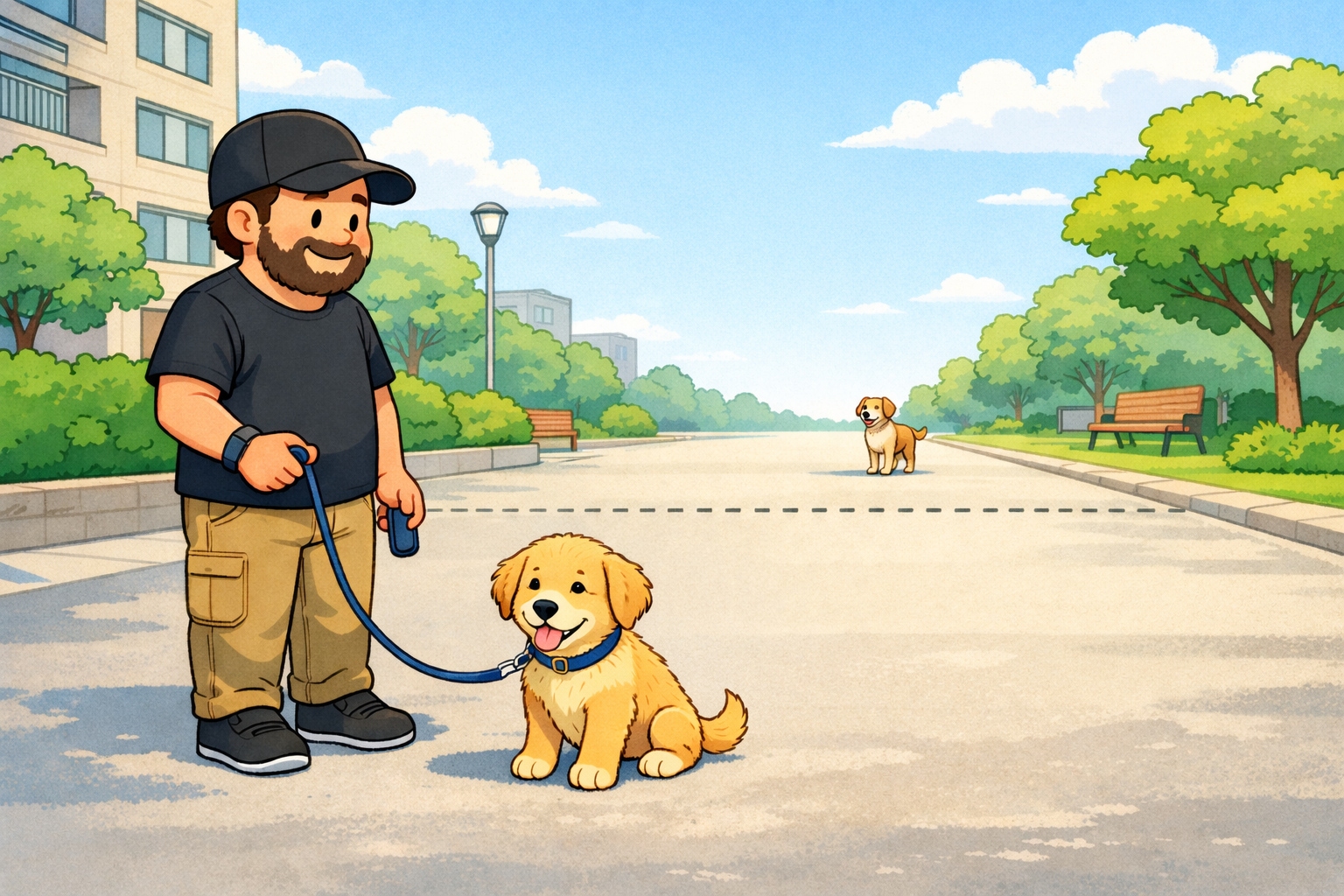
ABC Model (Antecedent-Behavior-Consequence)
Meaning: A basic formula for analyzing behavior. Antecedent (A) → Behavior (B) → Consequence (C) follows, and the result increases or decreases the behavior.
Example: (A) Doorbell → (B) Barking → (C) Guardian runs to soothe/open the door. If C behaves like “interest/success” the barking can be maintained.
Reinforcer
Meaning: A result that causes a behavior to occur “more often.” Not only snacks, but also toys, praise, starting a walk, sniffing, and opening the door can be reinforcers.
Example: In “If you wait quietly, the walking line will fill up,” ‘starting a walk’ becomes the reinforcer.
Positive Reinforcement
Meaning: Increasing behavior by “adding (+)” good things.
Example: When the dog quietly ‘just looks’ at another dog, a treat (+) → ‘quiet look’ increases.
Negative Reinforcement
Meaning: When something uncomfortable “disappears(-)” and behavior increases. (※ This is not the same word as ‘getting scolded’)
Example: When the dog pulls on the lead (leash), the neck/chest becomes uncomfortable (pressure), and the moment the dog takes a step back or stops pulling, the pressure is released.
Positive Punishment
Meaning: Reducing behavior by “adding (+)” something uncomfortable.
Example: The leash tightens every time you pull the leash, causing discomfort (+) → The pulling may be reduced, but caution is required as side effects such as anxiety/avoidance may occur.
Negative Punishment
Meaning: When good things “disappear (-)” and behavior decreases.
Example: When you jump, the guardian turns away and loses interest (-) → jumping decreases (consistency is the key).
Extinction
Meaning: The process where the “reinforcement (reward)” that maintains the behavior is cut off and the behavior becomes weaker.
Example: If a dog that used to get something (attention/treat/open the door) by barking now doesn’t get anything, it may weaken over time.
Extinction Burst
Meaning: The phenomenon of trying “harder/longer/new way” in the early stages of extinction.
Example: A time when a dog that was barking to open the door suddenly barks twice as much and scratches at the door increase. If there is no management at this time, the situation can escalate.
Intermittent Reinforcement
Meaning: A reward that is given occasionally rather than every time. This type of behavior can easily become “persistent.”
Example: If the door opens even if you bark only 1 time out of 10, you can keep trying because “it will open at some point”.
B. Reward timing/technical terminology (‘how to teach’)
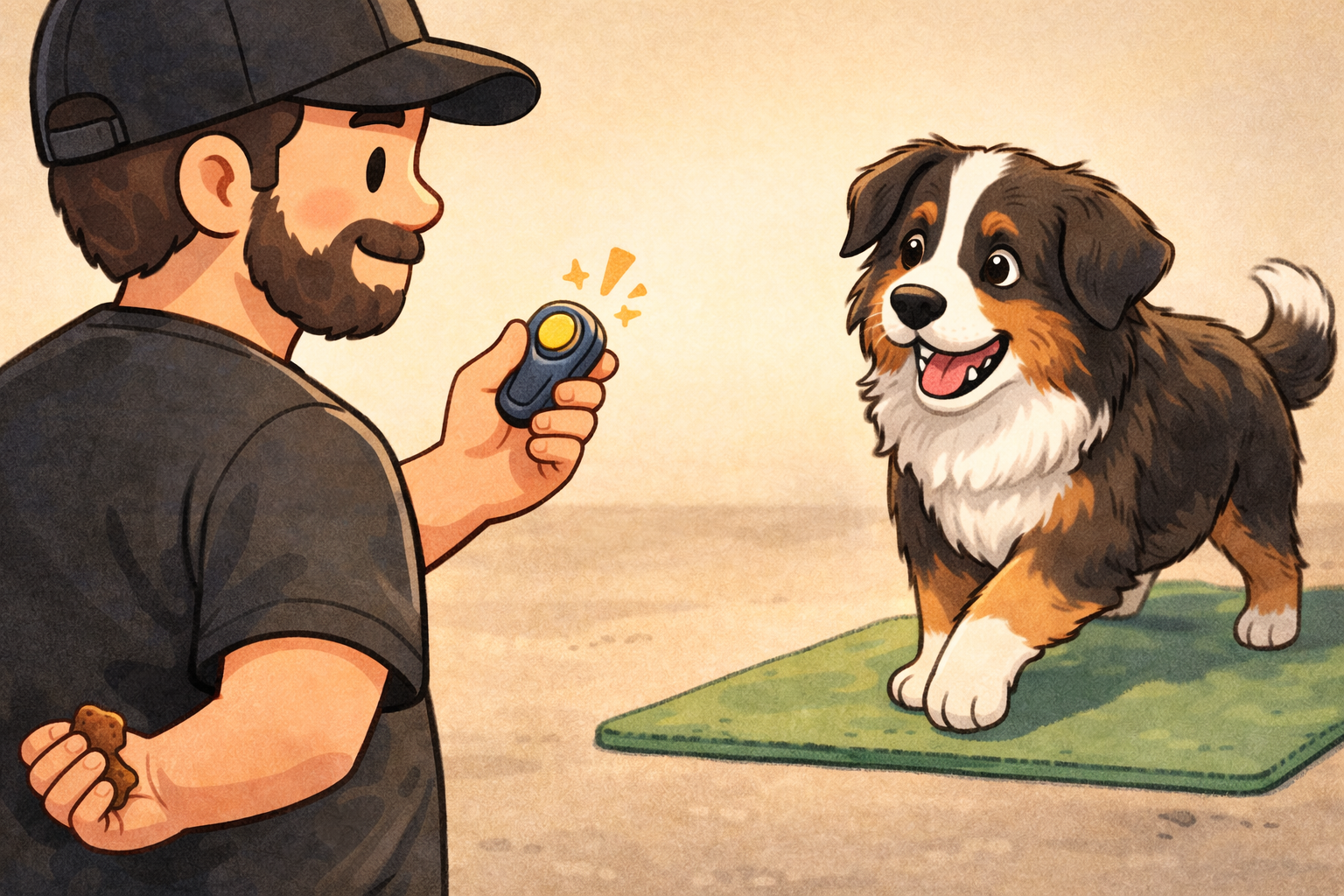
Marker / Bridge
Meaning: A signal (sound/word) indicating “The right moment is the correct answer!” It must be entered before the reward (snack).
Example: At the moment the front foot touches the mat, ‘Right!’ → Snack 0.5 seconds later. The ‘right answer moment’ becomes clearer.
Clicker
Meaning: A tool for using markers more accurately and consistently with a click sound.
Example: When the dog quietly “just looks”, click → reward. The timing is more consistent than words, so it is helpful for beginners.
Cue (signal)
Meaning: A signal that says, “You can do that action now.” If you understand it as a ‘signal’ rather than a ‘command’, training becomes smoother.
Example: A structure where you sit only when there is a “sit” signal, and you can be free when there is no signal.
Luring
Meaning: A method of creating posture by guiding the nose with a snack.
Example: If you place a snack in front of your nose and raise your hands up, your butt will go down and you will sit down.
Bribe (‘bribe’)
Meaning: A form of forcing a dog to do something by “shaking” the treat when the dog has already decided not to do it (not to be confused with lure).
Example: “Sit down!” I did that, but since he didn’t sit down, I could barely sit down while holding a snack up to his nose → I can’t do it anymore if there’s no snack later.
Prompt
Meaning: ‘Help signal’ (hand gesture/guidance/environment setting) to make the correct answer easier.
Example: If “down” is difficult, guide the hand low to achieve success, then gradually reduce the help (fading).
Fading
Meaning: The process of gradually reducing the number of prompts (help) to make people do it “on their own.”
Example: Guided by holding a snack in the hand → Maintain only the hand shape (no snack) → Perform only with verbal cue.
Capturing
Meaning: A method of capturing and reinforcing “good behavior” that a dog accidentally does.
Example: The moment you lie down quietly and rest, marker → reward. ‘Calmness’ increases.
Shaping
Meaning: A method of completing a behavior by gradually reinforcing similar behaviors rather than requiring the completion behavior all at once.
Example: Kennel: Look at the kennel → One step → Two steps → Enter → Sit inside → Comfortable even when the door is closed.
Targeting
Meaning: Tap your hand/stick/object with your nose! A technique that teaches you to move and posture easily.
Example: Moving from the doorway to the mat following the palm target (“Following the hand is a good thing”).
Generalization
Meaning: The process of ‘expanding the scope’ of behavior done at home so that it can also be carried out outside.
Example: I sit in the living room, but not in front of the elevator → Generalization is not yet complete.
Discrimination
Meaning: The ability to distinguish between “you don’t have to do it this time and you don’t have to do it that time.”
Example: Sit only when there is a ‘sit’ cue, and be free when there is no cue.
Stimulus Control
Meaning: A state in which the behavior occurs stably only when there is a specific cue, and does not occur well when there is no cue (close to ‘training has stuck’).
Example: Stops when you say “wait” and stays until the release signal.
C. Distance/emotion terms (threshold/threshold sensitivity are also key)
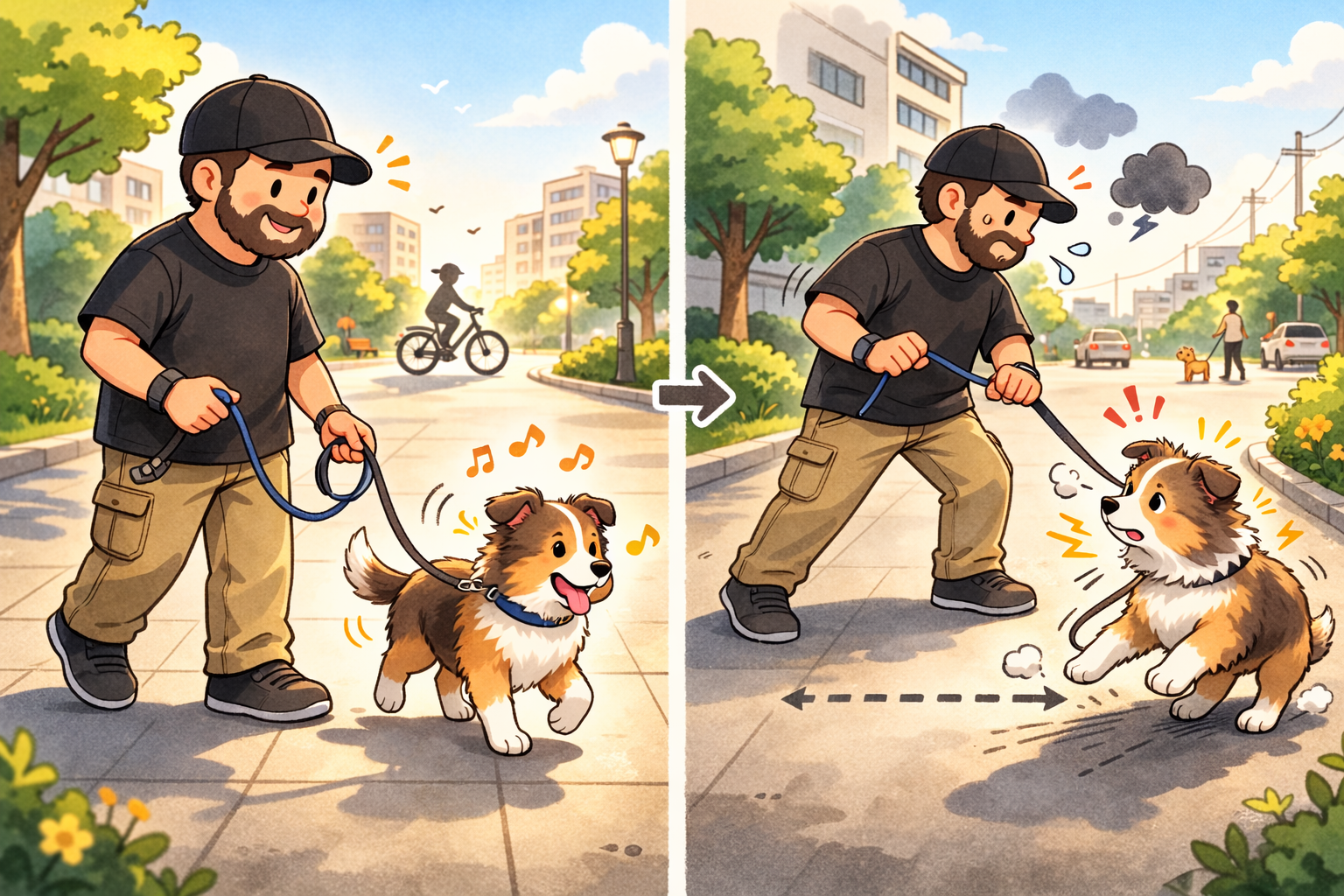
Trigger
Meaning: A stimulus that ‘turns on’ a dog’s hyperreaction (barking/rushing/avoidance).
Examples: Doorbell, visitor, sound of motorcycle, other dog, elevator door opening.
Threshold (Threshold)
Meaning: The boundary at which a response begins when the distance/sound volume/exposure of the stimulus exceeds a certain level. When the threshold is exceeded, learning becomes difficult.
Example: If the other dog is 15m away, it eats the treat, but if it is 5m away, it refuses the treat + barks → 5m is likely to be “over” the threshold.
Threshold Distance
Meaning: “The closest distance you can stay calm” to a specific trigger. It may vary depending on trigger/date/condition.
Example: Even for the same dog, an ‘unknown large dog’ can be as different as 20m, and a ‘small dog’ can be as different as 8m.
Threshold sensitivity (=threshold sensitivity)
Meaning: An expression used to say “how easily a critical value is broken.” I’m closer to being sensitive to conditions/accumulated stress rather than numbers (distance).
Example 1: A child who was normally okay at 10m exploded at 20m on a day when he had trouble sleeping → A day when his threshold sensitivity increased.
Example 2: During a week of consecutive visits to the beauty salon, hospital, and guests, he exploded even at the bell that was normally okay → Increased threshold sensitivity + trigger stacking possible.
Reactivity
Meaning: Excessive response to stimulation (barking/pulling/rushing/avoiding). Aggression is not the same thing.
Example: When he sees another dog, he pulls the lead and barks out of excitement/fear.
Barrier Frustration
Meaning: A phenomenon in which frustration builds up and the reaction explodes when you want to go but cannot go (lead/fence/window).
Example: The reason you bark at people outside the window may not be because you “hate it,” but also because you “can’t go and check.”
Trigger Stacking
Meaning: When multiple small stresses accumulate, the threshold is more easily broken.
Example: Beauty during the day → Noise in the evening → Customers at night. Even bells that are normally fine can explode.
Arousal
Meaning: Excitement gauge. When arousal is high, even easy actions become difficult.
Example: When the tension is at MAX just before going out for a walk, the person spits out snacks and has trouble hearing his/her name.
Over Threshold
Meaning: A state in which the overload has already exceeded the threshold. At this time, “securing distance/recovery/safety” takes priority over training.
Example: Not eating snacks, body stiffening or lunging/barking.
D. Behavior modification protocol (focusing on desensitization/counterconditioning)
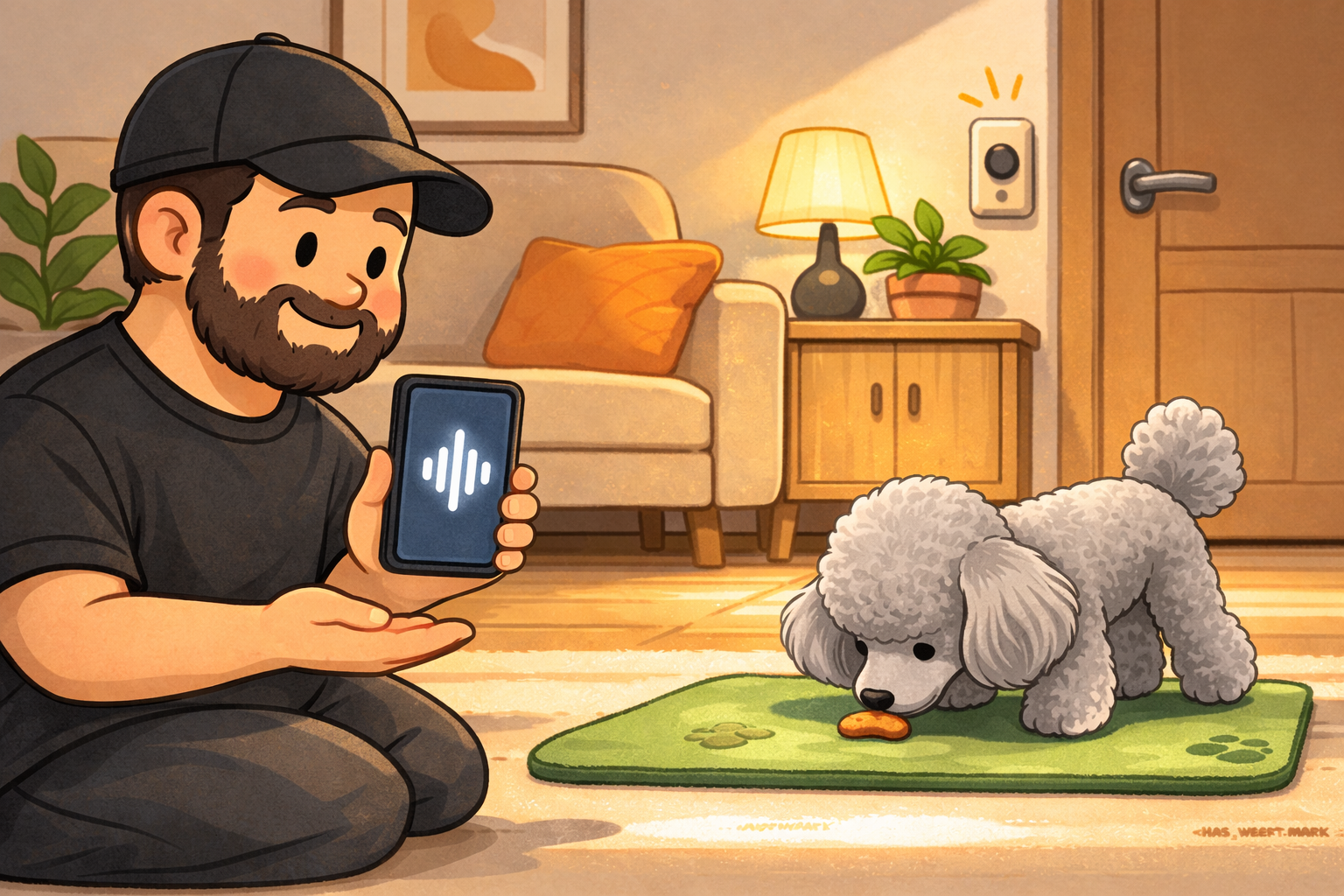
Desensitization (DS)
Meaning: It is the process of getting used to the trigger by briefly exposing it at a “very low intensity” and below the threshold.
The key is not to “make them endure it,” but to build successful experiences that end before the reaction occurs.
Example 1 (Sound Trigger): If the dog barks at the sound of a ringtone → Instead of the actual bell, start recording sound at a ‘very low volume’ for just 1 second (no response level).
Example 2 (Distance Trigger): If the dog responds to another dog → Repeat the short exposure starting at a snack distance even when viewed from 30m and ending with no response.
Example 3 (Common Failure): “If I keep encountering them even if they bark, I’ll get used to it” can lead to over-threshold exposure, which can worsen into sensitization.
Counterconditioning (CC)
Meaning: A method of changing emotional responses by connecting “good things to follow” when a trigger appears.
Example: A treat is given “the moment you see” another dog (dog = treat). If it is repeated, tension can change into anticipation/stability.
Difference between desensitization (DS) and counterconditioning (CC)
Meaning: The key for DS is “lowering the intensity and getting used to it,” and for CC, “changing your emotions to a good one.”
Example: The most common combination is setting up to see another dog from 30m (DS) + providing a treat at that moment (CC).
Habituation
Meaning: A natural adaptation that becomes increasingly unresponsive to harmless and meaningless stimuli.
Example: A dog that was startled by the sound of the refrigerator at first starts ignoring it after a few days.
Sensitization
Meaning: As exposure is repeated, sensitivity becomes more sensitive and the reaction increases.
Example: If the fuss/disturbance is repeated every time the bell rings, the bell may explode faster and louder.
Flooding
Meaning: A method of exposing too strong a stimulus ‘at once’ for a long time. Caution is needed as fear/avoidance may increase.
Example: An attempt to “get used to” a dog that is afraid of people by taking it to the middle of a busy street for a long time.
LAT Game (Look At That)
Meaning: A game-type approach that makes “looking” at the trigger itself safe and directly leads to a reward.
Example: Look at the dog in the distance → marker → reward → reward again when the gaze returns to the guardian.
Engage–Disengage
Meaning: A method of developing the ability to “engage” a trigger, “disengage” oneself, and return to stability.
Example: Reward if you look at the dog for 1 second and then look away yourself. “It’s okay to look” is learned.
Differential Reinforcement
Meaning: A strategy of reinforcing desired behavior and not reinforcing unwanted behavior.
Example: Nothing happens while barking, and immediate reward for one second of silence.
DRA (Reinforcement of Alternative Behaviors)
Meaning: Reinforcing “other behaviors” instead of problem behaviors.
Example: Instead of visitor=jumping, reinforce visitor=sitting on the mat.
DRI (Incompatible Behavior Reinforcement)
Meaning: Reinforcing actions that cannot be performed at the same time (if you do this, you cannot do that).
Example: If you reinforce ‘sit and hold’ instead of lunging, it becomes difficult to lunge at the same time.
DRO (Reinforcement of ‘no’ problem behavior)
Meaning: Reinforcement if there is no problem behavior for a certain period of time.
Example: If you don’t bark for 3 seconds, reward → 5 seconds → 8 seconds (if the standard is set too high, failures will increase).
BAT(Behavior Adjustment Training)
Meaning: It is introduced as an approach to designing the environment to create “stable behavior (turning head/opening distance)” that can be selected by oneself by looking at the trigger.
Example: If you select ‘increase distance on your own’ below the threshold, design the movement line/distance/angle to maintain that choice.
E. Management, equipment, and care terms (reducing practice of failure)
Management
Meaning: Designing an environment that prevents “practice to failure” before training. It’s not training, but it’s just as important.
Example: Reduce the probability of an explosion by wearing a lead when a guest arrives, setting a mat at the door, and preparing a reward before ringing the bell.
Decompression
Meaning: Recovery time/walk to reduce stress.
Example: The day after a stimulating day, take a walk in a quiet place, focusing on smelling, to lower your alertness.
Harness
Meaning: Equipment worn on the body. It can help reduce neck strain.
Example: Using just a leash for a dog with pulling can increase neck/tracheal strain, so a harness may be an option.
Muzzle Training
Meaning: The process of making the muzzle a ‘good experience’ and making it comfortable to wear (forcibly wearing it can be counterproductive).
Example: Put a snack in the muzzle and briefly increase the wearing time, starting with “putting nose = chicken”.
Cooperative Care
Meaning: A step-by-step approach to teaching a dog to “cooperate” with handling/treatment/grooming.
Example: Foot touching 1 second → reward, 2 seconds → reward… Stacked and connected to toenail clipping.
⚠️ Safety Information
If there is bite/aggression, extreme fear, or suspicion of pain (screaming, limping, loss of appetite when touched), safety (management) + expert/hospital consultation is recommended rather than flooding (enforcing strong exposure).
FAQ
Q1. Is desensitization “training to tolerate”?
A. no. Below the threshold, it is an approach to gain short-term success experience with “an intensity that does not cause a reaction.”
Q2. Are desensitization and desensitization different words?
A. In the field, they are usually used with the same meaning, and are often grouped together as Desensitization = DS.
Q3. What is the difference between threshold sensitivity and critical value?
A. The threshold is “a line (distance/strength),” and threshold sensitivity is closer to “how easily that line breaks down (condition/accumulated stress).”
Q4. Is reactivity the same as aggression?
A. It’s not the same thing. Reactivity is an ‘overreaction’, and aggression must be viewed separately, including risk/intention assessment.
Q5. If an extinction explosion occurs, has the training failed?
A. Not necessarily, but the intensity can increase during this time. “Management that can endure safely” must go hand in hand.
Q6. Do DS and CC have to be used together?
A. In practice, a combination of creating a setting below the threshold (DS) and connecting it so that good things follow at that moment (CC) is often used.
I looked into training terms like this. In actual training, in fact, it is mostly used occasionally or explained in an easy-to-understand manner so that guardians can easily understand it. However, if you know the principles and contents, you will understand it more quickly, right? And in actual training, we do not do just one thing, but we mix several things together to achieve the best effect and design it according to the skills and experience of each trainer. Knowing and applying are two different things, right?
If you are having trouble solving a problem, don’t worry too much and contact us. We will be happy to advise you!!!
Related guides
English edition copyedited and supplemented on October 9, 2026.