Practical starting point
Log the trigger, distance, body posture and what happens after the bark. The same sound can occur in different emotional situations, so do not diagnose territorial behavior from pitch alone. Reduce exposure while deciding on a plan. A sudden voice change, cough, discomfort or unexplained increase in vocalization should be discussed with a veterinarian.
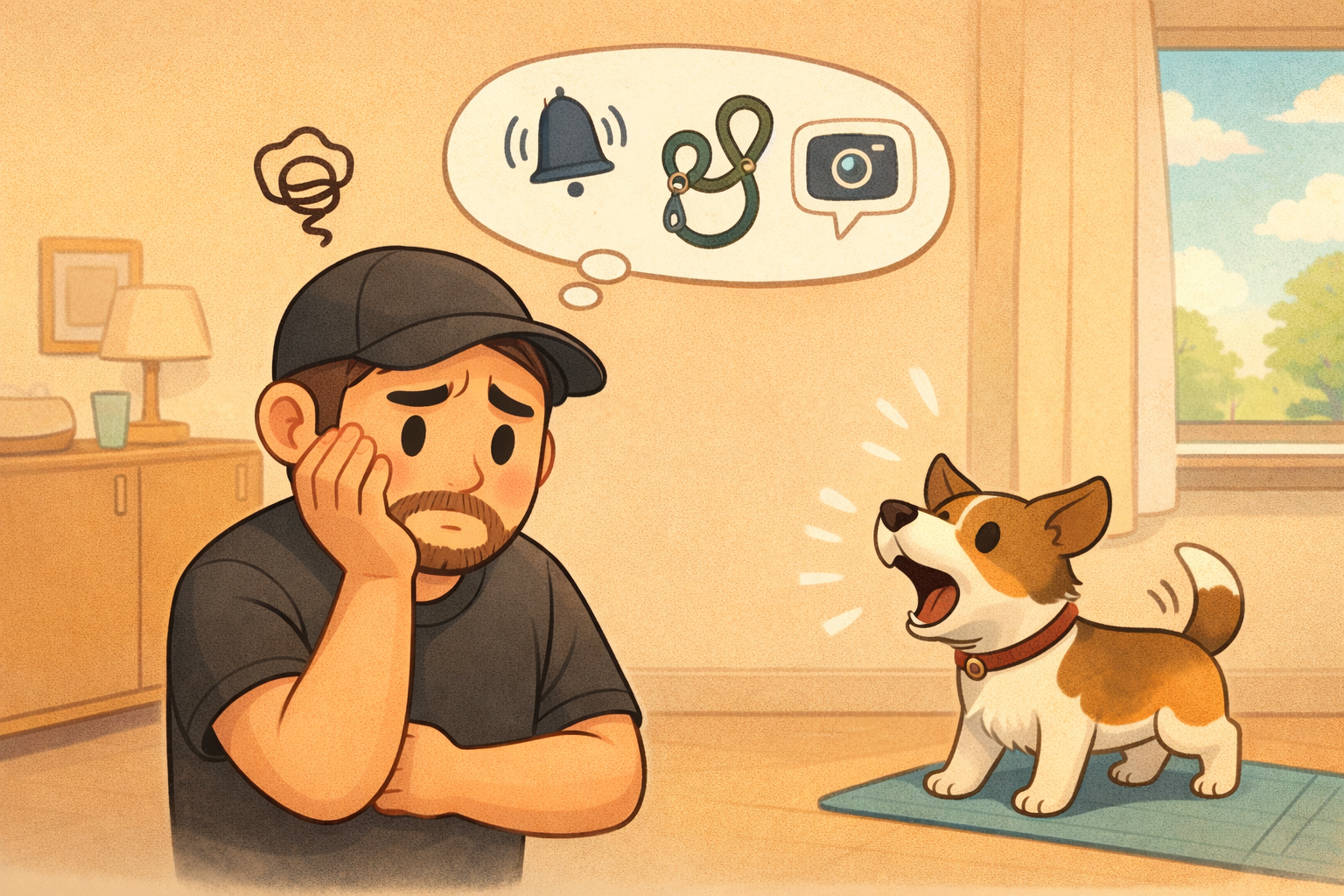
Hello. It’s a Saramgom. One of the many reasons guardians consult is related to barking. Especially, sometimes during counseling, there are many cases where you make arbitrary judgments and interpretations. In fact, if you do this through learning rather than saying something, it is highly likely that you will get this result and then learn it. There are many cases of misunderstanding or misinterpretation like this, but in this article, we will explain the types and meaning of dog barking and how to deal with each situation!
3 key points of dog barking
- There are “types” of barking Standards for distinguishing in 10 seconds (situation, body, recovery)
- Why the first response should be different for each barking warning, demand, anxiety, and frustration
- Barking reduction routine to be executed immediately by dividing it into today, tomorrow, and 7 days
Even if the same barking is a warning, a demand, anxiety, or frustration, the response is completely different (“situation + body + recovery” rather than sound).
If barking suddenly increases, an older dog barks at night, or there is a suspicion of pain, a health check may come first rather than training.
When a dog barks, 3 things to look at before the “sound”
Barking is not a broken alarm, but is “talk” from a dog’s perspective. So, if you judge by only hearing the sound, you are often wrong. (In particular, anxiety, vigilance, and frustration can sound similar.)
- 1) Situation (trigger): What you see, hear, imagine and bark
- 2) Body (body language): stiffness, ears, tail position, signals around the mouth, distance control
- 3) Recovery: How quickly you calm down after the stimulus subsides
※ Note: The meaning of barking increases by looking at height + body tension + situational clues together.
10-second diagnosis: Check “what you get after barking”
There is one most common reason for repeated barking. Because the barking was ‘successful’
- I barked and someone came, spoke, and hugged me → Getting attention
- I barked and the other person backed away, the door closed → Securing distance
- When I barked, it led to a walk, a snack, and the door opening → Getting what I wanted
Point: If you look at “What changed after barking?” rather than “Why does it bark?”, you can quickly find the cause.
Types of dog barking 7+1: Characteristics by type & first response
1) Warning/alarm barking (doorbell, footsteps in the hallway, sounds outside the window)
- Characteristics: Rigid body, fixed gaze, deep or firm tone. “There’s someone over there!”
- First response: Rather than scolding Keep distance + block view + alternative action (seat/mat)
- One-line tip: If you fight with “Quiet!” the moment the dog barks, your dog can learn that “the guardian is also on guard.”
Warning barking is faster if the alternative behavior works. Digit (Matte) Connect with training
2) Demand barking (play, give snacks, open the door)
- Characteristics: Stares intently at the guardian, barks like a “button” in front of certain places (snack box, door, toy)
- First response: Barking is invalid (interrupts response), Quiet is rewarded immediately
- Key Skill: Replace “bark” with request signals such as sit, touch
In most cases, barking demands is consistency. (Even if you lose just once, the dog goes, “Can’t I just make it harder?”)
3) Frustrated/overexcited barking (response to other dogs, people, and leads while walking)
- Characteristics: Barking is fast and continuous, and the body leans forward. “I want to go, but I can’t!”
- First response: Lower the distance (difficulty) first + “View → Snack” pairing + Repeat short successes
- Alternative behaviors: Stabilizing behaviors such as sniffing, U-turns, mats, and sideways
4) Play/greeting bark (Nice to meet you! Excited!)
- Characteristics: Relatively flexible body, tail wagging, high tone. If excessive, it may lead to jumping/biting
- First response: Short break rather than “Stop!” (Do not pull the leash short, stop in space/movement) + Proceed again when you calm down
5) Fear/defensive barking (barking to scare people away)
- Characteristics: Barks while retreating or trying to hide. Sometimes it barks and lunges and then runs away again (distance control)
- First response: Keep your distance first (bringing you closer and “getting used to it!” can backfire)
- Training principles: Desensitization (very easy steps) + Counterconditioning (pairing with something good)
6) Isolation/separation related barking (when alone)
- Characteristics: Starts with signs of preparation to go out (keys/clothes/bag), barks/howling/scratching at the door when left alone
- First response: “Ignoring” alone does not reduce it well. Short separation exercises (seconds) + Stability routine required
- Caution: In severe cases, it may be an area of anxiety rather than a behavioral problem
Stage design is important when it comes to separation, so I have already written Barking It would be a good idea to also read the summary article.
7) Boredom/lack of environment barking (routine, energy issues)
- Characteristics: Repetitive/habitual, lasting for a long time in a specific time frame
- First response: Rather than just increasing walking time, design olfactory activities (nose work), chewing material, and relaxation routines
+1) Barking as a pain, cognitive, and health signal (may be hospital priority)
- Characteristics: Sudden onset, unexplained increase at night, sensitivity and pain when touched, confusion in older dogs, accompanied by wandering
- Priority: Health check is recommended before training.
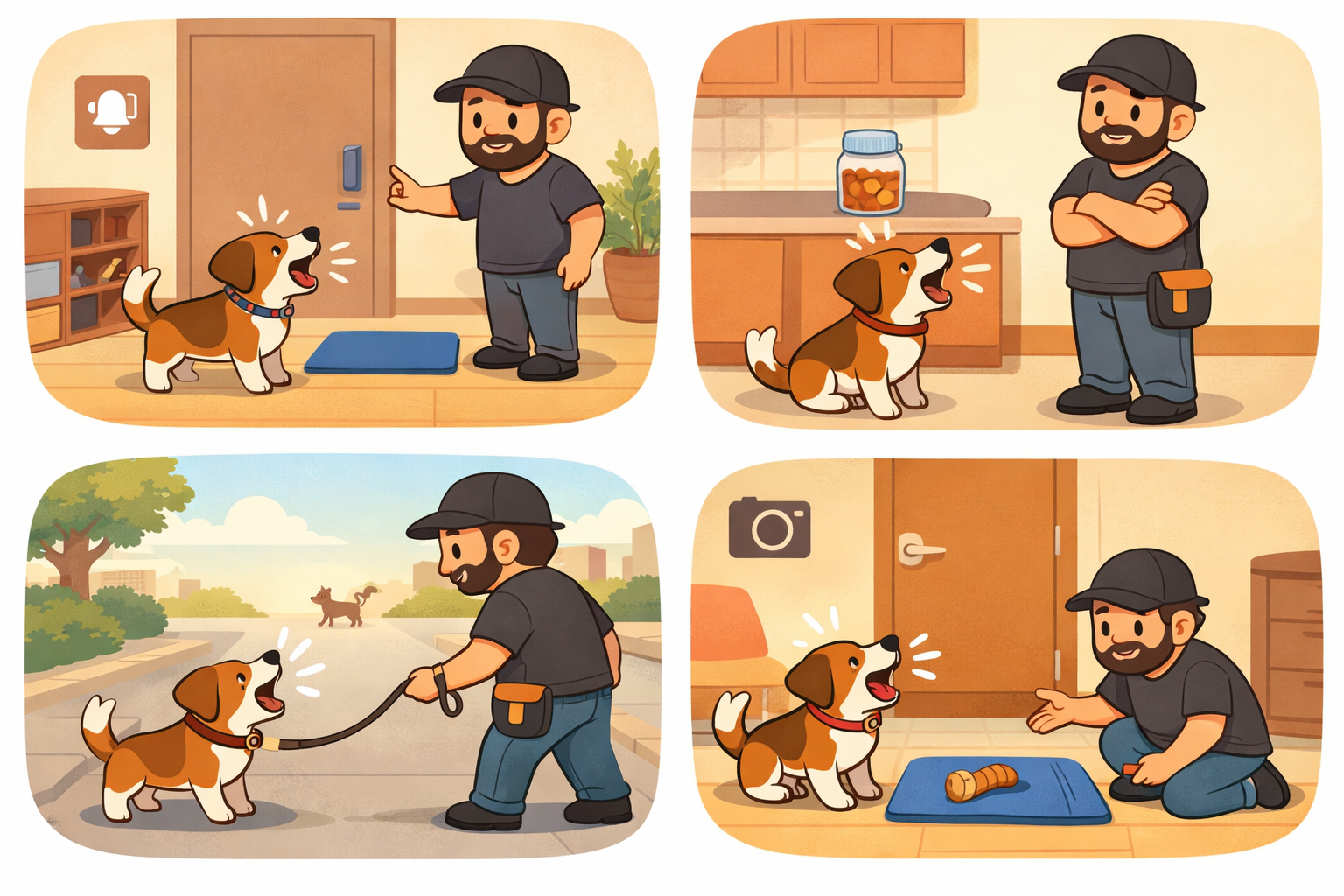
There is a reason for each bark.
5 mistakes parents often make (reasons why barking gets louder)
- Responding with a sound: The dog can interpret this as “being on guard together.”
- ‘Getting closer’ to anxiety-type barking: Unbearable difficulty (exceeding the threshold) can worsen
- Give back once in a while: ‘occasional success’ actually strengthens the habit.
- Judging only by feel, without records: If the pattern is not visible, resolution is delayed.
- Leave the environment/routine as is and only train: If the amount of energy and stimulation is excessive, training will not stick well.
Today, tomorrow, 7-day routine: action plan to reduce barking
Today (10 minutes)
- Barking Diary Start: Write down when/what/how many minutes/end and what changed after 3 days
- If it is a warning barking: Block the view (curtain, fence) + Seat (mat) placement
- If it is a demand bark: Barking invalid + “1 second of quiet” capture reward
Tomorrow (15 minutes)
- Break down the barking situations into Difficulty 1 (e.g. ringing the doorbell very softly, recording footsteps outside the door, etc.)
- 10 “See → Snack” practice (making people eat before barking)
7 days (routineization)
- Fixed 10 minutes of olfactory activity during times when barking occurs frequently
- Tie seat training to “barking situations” (doorbell, guests, outside window)
- If it is related to separation, only build success with separation in seconds
Checklist
- □ Does barking only occur in response to “certain stimuli” (doorbell/out the window/walking)?
- □ Do you gain anything from barking (attention/door opening/distance)?
- □ Is the body rigid and rigid or flexible?
- □ Is recovery slow (continues even after stimulation ends)?
- □ Does it suddenly start/increase/night barking in older dogs? (Consider health check)
5 FAQ
Q1. If a dog barks, should I absolutely ignore it?
A. no. Ignoring is effective for demand barking, but anxiety, fear and separation is difficult to resolve with just “ignoring” and may actually worsen. First, distinguish between types.
Q2. Why does it get worse when you scold, “Stop barking!”
A. In a borderline situation, the caregiver’s reaction can be interpreted as a “signal to be on guard together,” and in the anxious type, emotions can rise further. Instead, it is safer to change it to distance + alternative action + reward.
Q3. When I see another dog on a walk, I bark. Is it a social issue?
A. It’s not just a problem with social skills, but it can be frustration or overexcitability (reaction to lead). You have to start with the distance, and you have to lower the emotions with “see → snack.”
Q4. Suddenly barks for no reason at night.
A. If your dog has recently gained weight suddenly or is an older dog, there is a possibility of pain or cognitive changes, so we recommend a health check first.
Q5. How many days does bark training take?
A. It depends on the type/strength. Demand barking changes quickly within 1-2 weeks, but anxiety, separation, and fear require stage design, so it is safer to keep it longer.
Next Recommended Post
- Puppy Barking!! What should I do? (Summary of solutions)
- Spot (Matte) Catch excitement/barking through training
- Winning too. There are types: needs/anxiety/excitement
- Howling Meaning/Cause/Solution Routine
Routine design is the key in urgent cases due to civil complaints, such as barking at the front door boundary, responding to a walking leash, or barking (separation) when left alone.
Even if you follow the content of the article, if you get stuck, I will organize it based on “barking type + trigger + daily routine”.
Related guides
English edition copyedited and supplemented on October 9, 2026.