Practical starting point
Review several days of comfortable rest, appetite, voluntary play, exploration and social choice. A checklist supports observation but is not a validated happiness test. Notice changes from your own dog's normal pattern rather than comparing with another breed. Persistent withdrawal, agitation or loss of interest warrants a discussion with your veterinarian.
Is my dog happy?
Hello. It’s a Saramgom. Is the dog you live with now happy? “Is the dog happy?” This question is harder than you think. They look happy just by wagging their tails, jumping excitedly, and clinging to their guardians, but we need to look at them a little more broadly from an ethology and animal welfare perspective. A happy dog is not simply momentarily excited, but is closer to a state in which the well-being of both body and mind is stable and positive experiences can occur frequently in daily life.
In this article, we will summarize, first, what criteria should be used to view a happy dog; second, why tail wagging or excessive excitement should not be misunderstood as happiness; and third, what changes the guardian should make at home can actually increase the dog’s happiness.
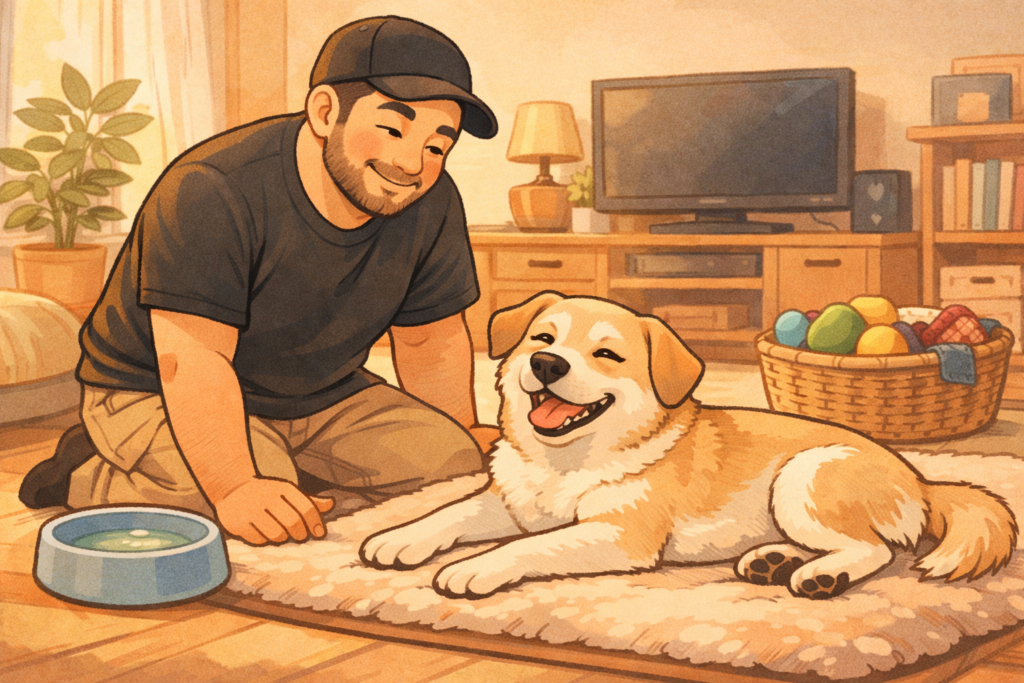
3 key things
- A happy puppy is not just an excited puppy; it is more like a puppy whose welfare is stable and who frequently experiences positive emotions.
- Don’t judge a dog based solely on its tail wagging, but also look at its body tension, play, exploration, rest and recovery
- The keys to increasing happiness are a comfortable environment, choice, opportunities for natural behavior, and reward-based training
.
What is a happy dog?
Rather than viewing a dog’s happiness solely as an emotional expression, it is more accurate to understand it from the perspective of animal welfare and quality of life. In other words, it refers to a state in which negative states such as anxiety or pain are low, and positive experiences such as safety, comfort, exploration, play, and social interaction are consistently present.
The important thing is that happiness should not be determined by one action. Just because I had a quick run today doesn’t mean I’m happy. On the other hand, when you rest calmly, eat steadily, recover well from daily stimulation, and choose to play and interact on your own, it can be seen as a healthier state of happiness.
7 common signs of a happy dog
1. The overall body is soft
Happy or relaxed dogs often do not have excessive tension throughout their bodies. The eyes are soft, the area around the mouth is not too stiff, and the posture is not too low or stiff. On the other hand, if the body is stiff, flinches at the slightest stimulus, and is always on guard, it is closer to a state of tension than happiness.
2. Play and exploration are natural
Happy dogs naturally sniff, look around, and participate in play rather than simply running. Play and exploration are important clues to positive emotional states. Even on walks, satisfaction is often higher when there is sufficient smelling and exploration of the surroundings rather than just walking.
3. Choose your own interactions with people
When you see a happy puppy, what’s important is not “how long it sticks around” but whether it approaches on its own and starts interacting on its own. Forcibly being held or resisting being touched may not be a sign of happiness. Conversely, dogs in a relaxed state often choose to come, lean, and interact when they want.
4. Rest properly when you rest
A puppy that is always excited is not a happy puppy. Rather, if you are unable to rest deeply at home, continue to react to every small sound, and are always excited, it may be overexcitability or accumulated tension. A happy dog has the ability to relax in a safe space.
5. Can behave naturally
Puppies should be able to live like dogs. The more opportunities there are to engage in species-specific behaviors such as sniffing, exploring, chewing, resting, playing and interacting with people, the better the welfare. A life with too much control can be far from happiness, even if it appears quiet on the outside.
6. During training, there are more expressions of anticipation rather than fear
Happy dogs often experience training as a “predictable and rewarding time” rather than a “time of punishment.” Rather than shrinking when looking at the guardian, it is a good direction to focus, try, and not feel too intimidated even if you make a mistake.
7. Fast recovery after stress
A happy puppy is not one who has had nothing happen throughout his life. The important thing is resilience to return to the original state when small stress occurs. Even if there is a daily stimulus such as an unfamiliar sound, a doorbell, or a walk, if it quickly stabilizes and returns to a resting state, it can be considered relatively healthy.
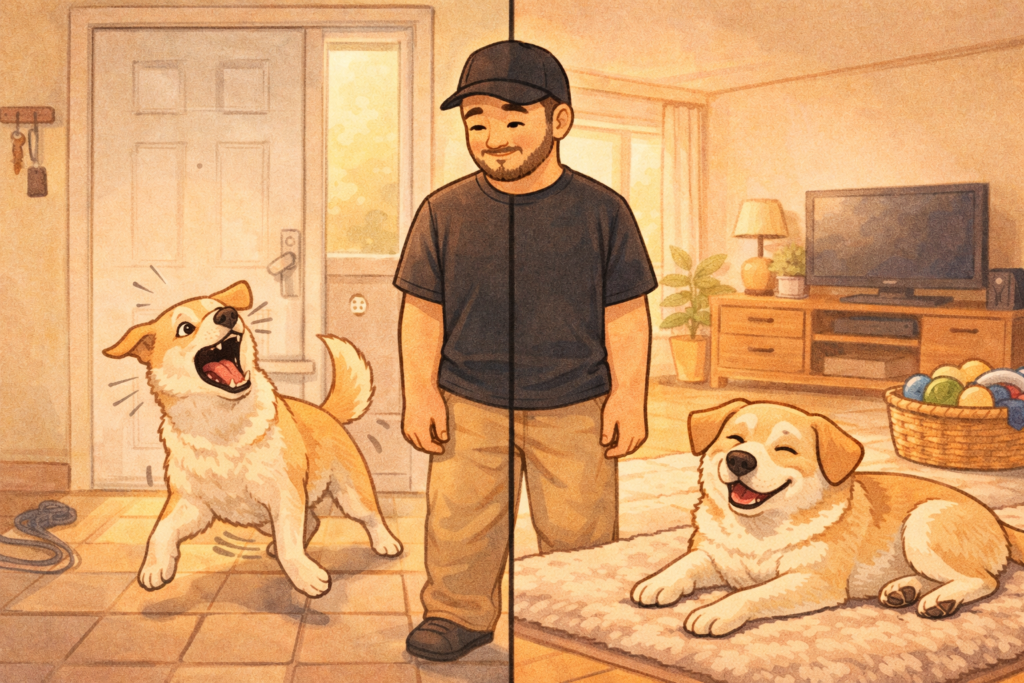
Behavior that can easily be mistaken for happiness
Tail wagging = unconditional happiness?
Tail wagging is an important signal, but it does not in itself mean happiness. You need to look at the height, speed, and stiffness of the tail as well as the tension of the entire body. There are cases where the body is rigid but the tail is rapidly wagging, and tail movement may also occur in situations of excitement or anxiety.
Excessive excitement = happiness?
Vitality and happiness are not the same. If you’re always running, jumping, making noises, and not knowing how to relax, it may be a state of uncontrolled arousal rather than happy energy. It’s easy for guardians to think, “It’s because I’m excited,” but in reality, it may be due to tension buildup or a problem with life structure.
Always attached = satisfied?
It is difficult to view the behavior of only following a guardian as unconditionally happy. It may be a comfortable attachment, but it may also be an inability to let go due to anxiety. The important thing is to check whether the child rests relatively comfortably even when alone and does not collapse excessively due to changes in the distance from the guardian.
Happiness conditions that guardians can create at home
1. Create a quiet place to rest
Please provide a resting place in a relatively stable location, not in places where stimulation is concentrated, such as the entrance, window, or hallway. Happiness is more likely to collapse from relaxation than from excitement. If your resting place is not comfortable, you can easily become sensitive to even small stimuli.
2. Change walks into ‘exploration time’ rather than ‘war of attrition’
Just taking long walks is not the answer. Your dog’s satisfaction and sense of security may be better when it includes sniffing, observing slowly, and maintaining a gentle social distance.
3. Gives a choice
Small choices like where to rest, which toy to choose, and when to approach give your dog a great sense of security. If you continue to live a life where people always touch, lead, and give instructions first, tension can build up.
4. Use reward-based training rather than coercion
It is safer and more sustainable to create and reward desired behavior than to forcefully restrain it. It is much better for your dog to learn “If you do this, good things will happen” rather than “If you make a mistake, you will be scolded.”
5. Do not force relationships with other dogs
Not all dogs have to like other dogs. Having many friends is not the criterion for happiness. Rather, it is more important to respect individual tendencies, experiences, and social preferences.
In these cases, expert consultation comes first
If the child suddenly dislikes being touched, is more sensitive than before, a child who used to play well stops playing, rarely appears to rest at home, or has a stiff expression, it may not be a problem that can be seen simply as “because they are not happy.” Pain, disease, chronic stress, and environmental problems must be checked together.
In particular, aggression, avoidance of touch, decreased activity, and sudden personality changes should not be judged solely as a behavioral problem; it is safe to consider veterinary check-up and consultation with a behavior specialist as well.
Checklist: Is my dog close to happiness now?
- I have time to relax on my own at home
- Play and exploration come naturally
- The body is often soft and less stiff
- Spontaneously approaches and interacts with people
- There is time to smell and explore on the walk
- There are more signs of anticipation than signs of fear during training
- Fast recovery even after minor stress
- No signs of sudden sensitivity or pain
FAQ
Q1. Are you happy if you wag your tail?
Not always. Tail wagging is an important signal, but it does not by itself mean happiness. It is more accurate to look at the height, speed, and stiffness of the tail as well as the tension of the entire body.
Q2. Does taking long walks make you happier?
Quality may be more important than time. A dog’s satisfaction and sense of security can improve when sniffing, exploration, exposure to moderate stimulation, and a comfortable resting environment at home are provided.
Q3. Do you have to have many other dog friends to be happy?
Not necessarily. Some dogs enjoy interacting with other dogs, while others feel more comfortable in a stable relationship with people. Happiness depends more on individual dispositions and feelings of security than on the amount of social contact.
Q4. Does training more make you happier?
The method is more important than the amount of training. Reward-based training helps your dog learn predictably and safely, but forceful methods can actually increase stress and tension.
Q5. What should I do if I suddenly seem depressed or irritable?
Sudden behavioral changes may be related to pain, discomfort, illness, or chronic stress rather than just mood issues. In these cases, it is safer to check your health and living environment rather than just pushing training.
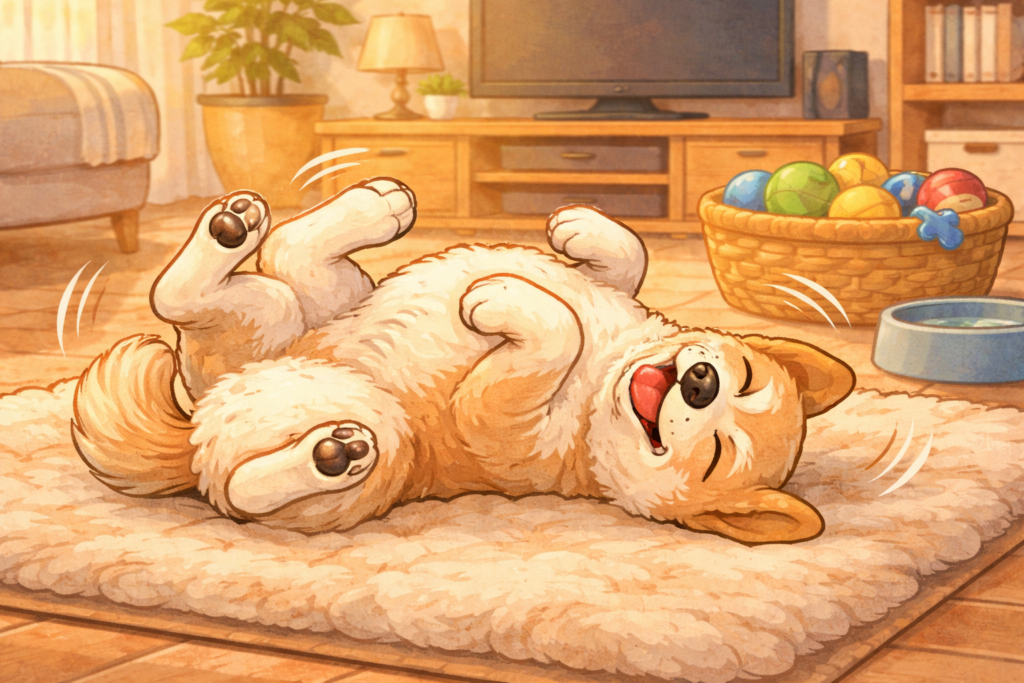
Finish
A happy puppy is not always an excited puppy. Puppies who can relax, explore naturally, choose their own relationships with people, and recover from daily stimulation are often happier. In the end, what a guardian should do is not to keep adding more stimulation, but to create a living structure in which the dog can live stably.
If you look active on the outside but don’t know how to relax at home, or are always sensitive and easily break down at the slightest stimulus, it may not be a problem of happiness but a problem of life structure. In this case, it is much more helpful to check the home environment, rest, exploration, and training methods rather than just increasing the walking time.
Next Recommended Post
To understand a happy dog, you need to look at its environment in the home, its level of excitement, stress, and relationship with its owner, rather than just “whether it looks excited.” If you continue reading the article below, you can understand it in a much more three-dimensional way.
If you are curious about the causes that reduce happiness
- Reasons for being sensitive at home, the environment to look at before training — If you can’t rest comfortably at home, your happiness level also drops.
- Why is my dog shaking? Is it? — Even if it looks like a happiness issue, it could be a sign of anxiety, excitement, or health.
- stress!! Causes, symptoms and management of dog stress — As stress accumulates, happiness signals become blurred.
If you are curious about the direction to increase happiness
- The puppy Why is it not good to be too excited? Why calm is important — Looking excited and feeling relaxed can be different.
- To the puppy Good guardian standards, why too much is not good — A dog’s happiness is created from the balance of relationships.
- Only this Even if you know this, many problems can be prevented – Correct principles and rules for raising a dog — Daily life structure is more important than special skills.
Easier to understand when viewed together
- Kindergarten I’ve been here for 2 years, but why doesn’t my dog change? — A lot of stimulation doesn’t automatically create stability and happiness.
- Even for beginners An easy-to-understand glossary of dog training terms — Helps you distinguish between happy and excited signals
- To the puppy Self-esteem? Characteristics of dogs with high self-esteem and dogs with low self-esteem — It becomes easier to understand why confidence and resilience are linked to happiness.
Related guides
English edition copyedited and supplemented on October 9, 2026.