Practical starting point
Give your dog safe space for ordinary ground scratching without treating it as disobedience. Keep distance from people and fragile surfaces, then pick up waste once the dog has moved aside. New, excessive scratching, skin injury or difficulty using a limb needs a different assessment. Context matters more than assigning one emotional meaning to every kick.
Behavior • Walking • Communication
Why do dogs paw in the dirt or grass: Marking? stress? Clean up after defecation and kick your back foot

- In most cases, a dog’s rear paw kicking is a normal behavior, and is often a combination of “marking territory” + “routine” + “emotional discharge (excitement/relief of tension)”.
- It often appears right after a bowel movement or in places where there are a lot of other dog odors (parks, trails)
- However, if it suddenly becomes excessive or causes excessive licking and limping of the feet, check irritation/pain in the soles as well.
1) What is dog kicking? (Kicking the back foot in the dirt/grass)
It’s a Saramgom. While taking a walk, your dog suddenly kicks or scratches the ground with its hind feet in the dirt or grass. In particular, it is often performed as a “closing ritual” after defecation. From the guardian’s perspective, “Are you angry now?”, “Are you anxious about something?” You may want to.
To conclude, rear kicking is generally close to normal communication behavior. However, the meaning may vary depending on the situation. So today, I will not be rigid about “why we do it”, but instead exactly explain it by situation.
2) Reason 1) Marking (area display) upgraded version
Puppies communicate through smell. Also, there are areas on the soles (pads) of the feet that carry body odor, so scratching the floor with the hind feet has the effect of spreading the smell more widely. Dirt and grass retain a good odor, and as the dirt splashes, visual traces are left behind.
- A place with a lot of other dog smells(park/walkway/around electric poles)
- Immediately after a bowel movement (when the odor is strong)
- Unfamiliar Place (When you want to leave a message saying “I came here!”)
The point is communication rather than “domination”. It feels natural to leave a message like “I was here” or “This is the information for this area.”
3) Reason 2) Kicking on the heels after defecation: routine + pleasure
There are many dogs that kick their hind legs after defecating. Rather than simply “cleaning up because it’s dirty,” this often becomes a finishing routine. Just as humans shake their hands after finishing a task, dogs also say “Finish!” The signal is to kick with the back foot.
Furthermore, dirt/grass feels good to the touch, so the feeling of scratching itself is stimulating (fun). So, if a child is excited, he or she may say louder “Pappap!”, while a cautious child may end with a short “tuktuk”.
4) Reason 3) Relief of excitement and tension (energy discharge)
Walking is a time when dogs can easily experience ‘information overload.’ Smells, sounds, people, other dogs… As the stimulation builds up, at some point the hind foot may pop out like a short discharge button.
- Right after passing an unfamiliar dog
- After seeing sudden stimuli such as motorcycles/bicycles
- Days when caregiver tension was high (pulling the rope/hurried walking, etc.)
In this case, the child may suddenly paw at something unrelated to defecation. It’s good to understand it as a way to use your body to control emotional fluctuations, such as “I’m a little excited/nervous right now.”
5) Reason 4) “This place is good!” Tactile + playability
Some dogs enjoy grass or dirt like play. Scratching → splashing dirt → sniffing again → scratching again… This loop itself is fun.
In particular, if you see the combination below often, it is most likely because you are “just excited.”
- Kick your heels on the grass → Immediately Roll your body (rolling)
- Digging in the dirt → sticking your nose in searching for smell
- Suddenly after kicking with the back foot Jumies (crying)
6) Reason 5) Learned habits (response, success experience)
If the owner laughs at the paw print (“It’s cute!”) or if other dogs show interest in the trace, the dog can learn like this. “If you do this, something interesting will happen.”
Then, the rear kick becomes stronger “whenever the place is good” and “whenever the mood rises.” In particular, it may be seen more often if you are an active person or in an environment that stimulates a lot of walking.
7) When caution is required (check exceptions)
- Suddenly excessive hind leg kicking difficult to stop (like an obsession)
- Excessive licking of the soles of the feet or limping
- Redness, odor, and oozing on pads/between toes (suspected dermatitis/allergy)
- There are signs of diarrhea/constipation/discomfort around the anus
In this case, checking body condition (pain/irritation) takes priority before “training”.
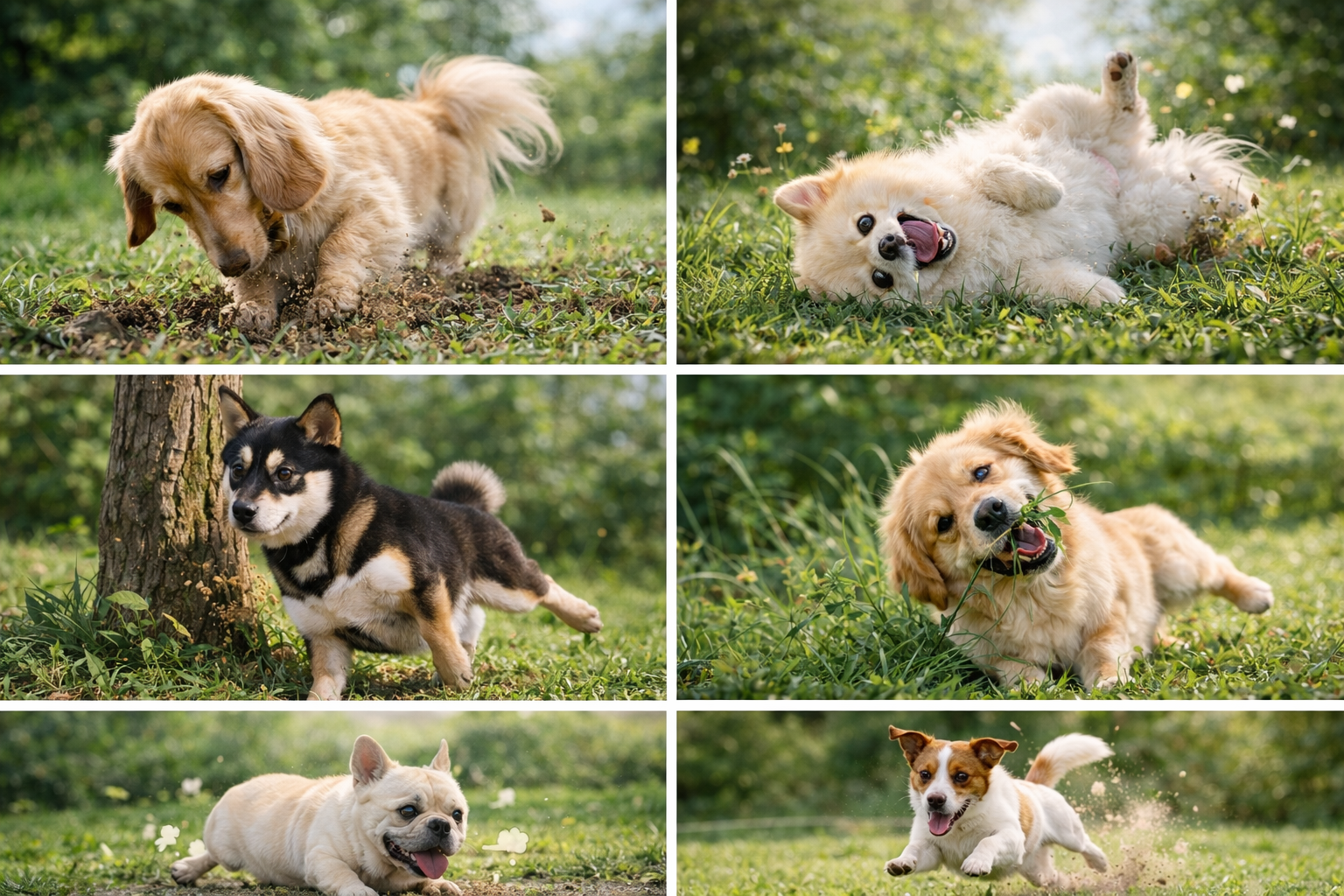
8) Similar behaviors (confusing ‘relative behavior’)
It is easier to understand if you look at the actions that frequently appear together with kicking.
- Forepaw digging: Check scent points deeper or indicate “here’s important”
- Rolling your body: soaking in scent/enjoying touch/relieving tension
- Urine marking: Message left by smell (especially on electric poles/trees)
- Grassing: ‘Frequency/situation’ is important as it ranges from simple taste to internal discomfort
- Scooting (butt dragging): May be a sign of anal gland/skin irritation, etc. check
- Jumizu (Udada, xx time): Excited discharge. If you get stuck after kicking with your heels, there is a chance that you will be “excited” ↑
9) Tips for managing reality when it’s too much (alternative actions)
Skidding is a normal behavior, but if it’s too extreme and you feel like it’s going to ruin the grass (yard/garden), be slippery (rainy days), or hurt your feet, it’s better to neatly control it with alternative behavior rather than just repeating “Don’t do it!”
- Create an alternate spot: If you have a yard, create a sand/dirt box area on one side and allow “digging/stepping only here”
- Brief break: Start kicking back → After 1-2 seconds, move to “come here” → If successful, treat/praise
- Lowering the tension while walking: Organize your breathing with ‘sit-wait-let’ before a highly stimulating section
- Manage foot condition: Long toenails can become more aggressive, so trim them regularly
10) Frequently Asked Questions (FAQ)
Q1. Is wiping your hind feet after defecation because it is dirty?
Most of them are closer to marking (leaving traces) + routine + emotional discharge rather than “wiping”.
Q2. Are you a dominant personality when you kick back?
Not necessarily. In many cases it is communication (marking territory) or expression of excitement.
Q3. Should I stop it?
If it’s normal behavior, why not? However, if it is excessive or dangerous, it is more effective to control it with alternative action.
Q4. Suddenly, the back footing increased. Why?
There are various causes, including changes in the walking environment, increased surrounding stimulation, stress, excitement, and irritation of the soles of the feet. If you record the frequency, location, and context, hints will come out quickly.
Q5. After kicking, the dog licks its feet or limps. Do I have to go to the hospital?
If accompanied by redness/oozing/limping, there is a possibility of irritation, dermatitis, or pain in the soles of the feet, so consultation with a veterinarian is recommended.
A good article to read together
- Why dogs tremble (check for anxiety signals) — There are already signals before they start shaking.
- Complete summary of seat (mat/house) training — A ‘basic technique’ to suppress excitement.
- 7 things that homes where dog training fails — When routine/environment is the problem rather than temperament.
- Realistic routine to reduce walking tension — If walking tension is lowered, it can also reduce rear foot kicking.
In many cases, rear pawing is a form of dog-style communication rather than a “problem behavior.” However, if the frequency or intensity suddenly increases, or licking the feet and limping are seen together, please check the physical condition first.
.post-wrap{max-width:820px;margin:0 auto;line-height:1.75;font-size:16px}
.post-kicker{letter-spacing:.08em;text-transform:uppercase;opacity:.7;margin:0 0 6px}
.post-header h1{font-size:30px;line-height:1.25;margin:0 0 10px}
.post-meta{opacity:.75;margin:8px 0 18px}
.post-hero{margin:12px 0 8px}
.post-hero img{width:100%;height:auto;border-radius:14px;display:block}
.caption{font-size:13px;opacity:.7;margin-top:6px}
.toc{border:1px solid rgba(0,0,0,.08);border-radius:14px;padding:14px 16px;margin:18px 0 24px;background:rgba(0,0,0,.02)}
.toc strong{display:block;margin-bottom:8px}
.toc ol{margin:0;padding-left:18px}
.toc a{text-decoration:none}
.callout{border-radius:14px;padding:14px 16px;margin:18px 0}
.callout-summary{background:rgba(0,0,0,.03);border:1px solid rgba(0,0,0,.08)}
.callout-warn{background:rgba(255,170,0,.10);border:1px solid rgba(255,170,0,.25)}
.callout-cta{background:rgba(0,120,255,.08);border:1px solid rgba(0,120,255,.20)}
.callout ul{margin:8px 0 0;padding-left:18px}
.post-body h2{margin-top:28px;font-size:22px}
.post-body h3{margin-top:22px;font-size:18px}
.post-body p{margin:10px 0}
.post-body ul,.post-body ol{margin:10px 0;padding-left:20px}
.faq{border:1px solid rgba(0,0,0,.08);border-radius:14px;padding:10px 12px;margin:10px 0;background:#fff}
.faq summary{cursor:pointer;font-weight:700}
.internal-links{border:1px dashed rgba(0,0,0,.18);border-radius:14px;padding:14px 16px;margin:22px 0;background:rgba(0,0,0,.015)}
.internal-links .note{font-size:13px;opacity:.75;margin:8px 0 0}
Related guides
English edition copyedited and supplemented on October 9, 2026.