Practical starting point
Map where barking or startle responses occur and note windows, shared walls, door sounds and interrupted sleep. Try one environmental change at a time, such as a visual screen or a quieter bed location, and compare recovery. Sudden sensitivity or inability to rest also merits a health check. Environmental management supports training; it does not prove a medical cause is absent.
Hello. I am Saramgom, a dog trainer, behavior correction expert, and director of a dog daycare. If your puppy keeps barking at home, cannot rest, and reacts sensitively to insignificant sounds, the problem may not be due to lack of training. In reality, the home environment makes the child more nervous, and that tension often leads to barking, destructive behavior, separation anxiety, and irritability.
In this article, we will explain how to create an appropriate home environment for dogs so that the guardian can apply it right away. Rather than thinking of it as how to make a pretty house, it’s closer to how to make a house where your dog can rest comfortably and feel secure
3 key things
- How to create a really comfortable resting place for your dog
- What environmental factors should be changed first to reduce barking, anxiety, and irritability
- Home environment checklist
that you can try starting today
A good home for a dog is not a spacious home, but a ‘predictable home’
Many people ask, “Is it because my house is small?” He asks. Of course, for a very active child, it may be advantageous to have more space. However, in most cases, the key to a dog’s comfort lies in the amount of structure and stimulation rather than the size of the house.
Puppies continue to receive information even inside the house. Sounds from the front door, people moving outside the window, the sound of the TV, family movements, and even the approach of other pets can all be stimulating. So, even if the house is large, if you can’t rest, it can be an uncomfortable home, and even if the house is not big, if you can rest well, be predictable, and not overstimulated, it can be a stable environment.
Especially for children with problematic behavior, the environment must be organized first before starting training. If the environment continues to stimulate the child, no matter how good the education is, the speed of correction may slow down or fail.
The first thing to create is a ‘quiet resting space’
When talking about an appropriate home environment for a dog, the most important thing is a resting spot before toys. The resting place should not be just a cushion; it should be a place where the child can really relax.
A good resting place usually has these conditions.
- Not right in front of the front door
- Not directly in front of the window
- Be a little further away from the place where you can hear the TV sound loudly
- Not in the middle of a line where people keep passing by
- A place where children are not frequently touched or woken up
- It should not be a place with a view of the entire house
Guardians want to touch the sleeping figure because it’s pretty, but for sensitive children, it can be an environment where they have to be constantly on guard even while resting. In particular, when entering a mat, house, or cushion, the experience that the space is safe must be repeated.
If you create a good resting space, the barking may not disappear immediately, but overall tension and sensitivity often decrease. Because behavior is often a result of the environment.
Common mistakes made when creating a rest area
- Putting a cushion in a place where sunlight is good but there is too much window stimulation
- Create a resting place in the middle of the living room so that family members can continue to pass by
- Keeps calling or touching the child after entering the house
- There is no distinction between rest and play areas
Space in the house should be divided by function to make it more convenient
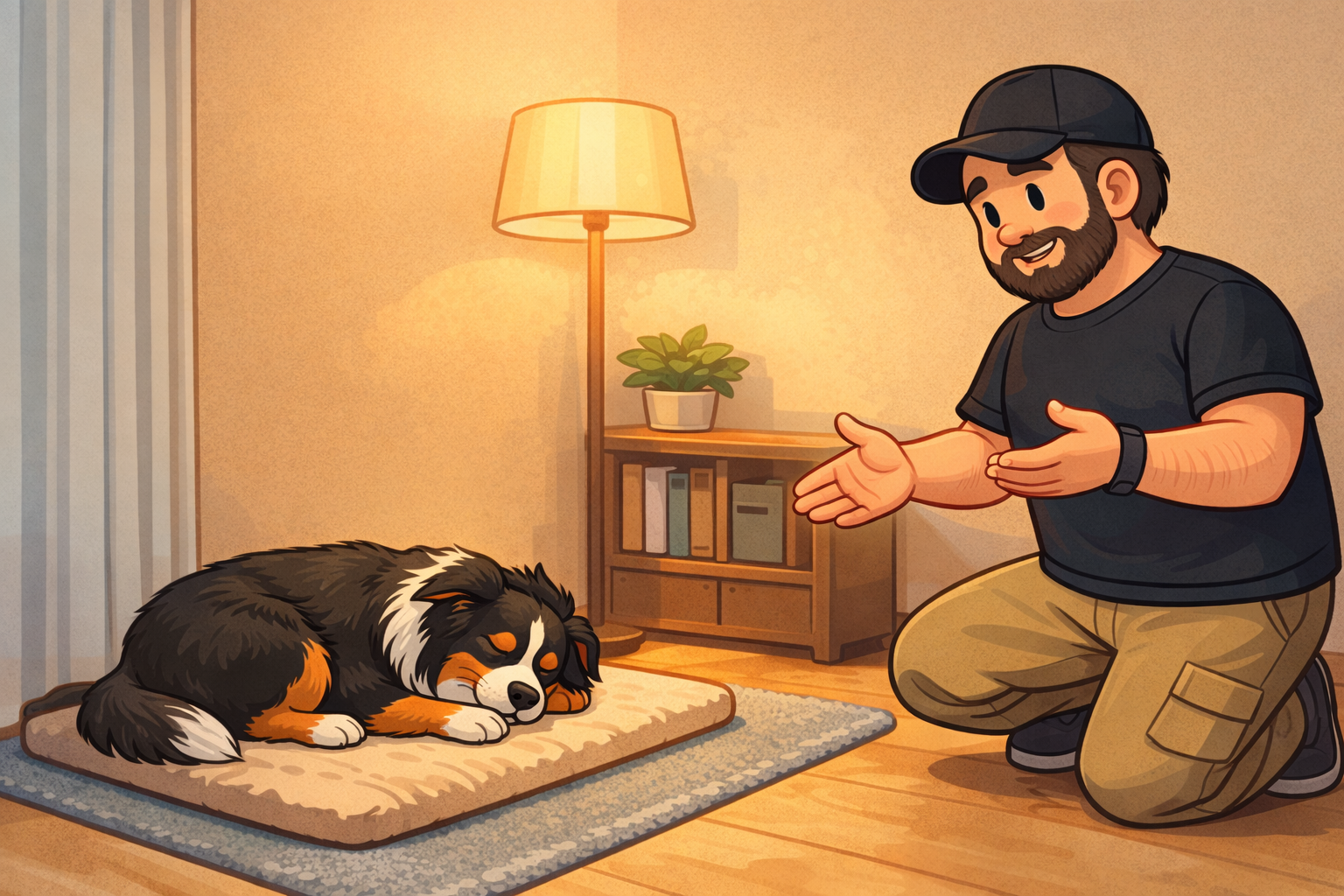
For a good home environment for dogs, zoning is much more important than interior design. Just as humans need their bedroom, dining table, bathroom, and study to be somewhat divided by function, the same goes for dogs.
1. Rest area
This is a space where you can lay down your body and mind without doing anything. A place that is not too noisy or has too much of an open view is best, and there needs to be a rule of not forcibly touching it.
2. Eating space
It is best to always place the rice bowl and water bowl in similar locations. If the family’s movements are too complicated or the dog is constantly disturbed by other dogs, the child may eat hastily or show caution.
3. Toilet area
It is better for the toilet seat not to be too close to the dining area, and it is disadvantageous to place it in a place that is too noisy or where people keep passing by. The more sensitive a child is, the less likely he or she will be to be disturbed during a bowel movement, so choosing a seat is very important. So, in apartments, there are quite a few children who make mistakes by going to the bathroom in the corner of the kitchen.
4. Play/training space
You also need space for indoor play. However, it is better to have a space where you can engage in activities where you can use your nose, think, and concentrate calmly, rather than just repeating excessively exciting play. It is best to avoid slippery floors.
If you want to reduce barking and irritability, start by reducing ‘what you see’
One of the most common problems at home is window security. Sometimes they bark continuously even when they hear a person passing by, a dog, a car, a motorcycle, or a package outside. In this case, the guardian may feel, “Why is the child so sensitive?”, but in reality, it is often because the child is being stimulated too often. Rather than seeing it only as a personality issue, it is much more realistic to start with environmental management.
If you have a house with a lot of window stimulation
- Reduce the number of permanent waiting areas by rearranging sofas or furniture in front of the window
- If necessary, use curtains or other methods that can block the view
- Separately practice moving to the mat instead of reacting in front of the window
- Distribute your attention to other activities during times when there is a lot of stimulation outside the window
If the house has a lot of stimulation at the entrance
- Avoid resting places too close to the entrance
- Revisit the movement lines that tend to get excited immediately after the doorbell/door sound
- Create a routine of moving to a designated spot instead of rushing to the front door
The important thing is not “don’t bark,” but reducing structures that are prone to barking first. Behavior modification is most effective when combined with environmental management.
Puppies should be ‘properly stimulated’ rather than ‘not bored’
Creating a better environment doesn’t mean you just have to take out a bunch of toys. Even if there are lots of toys, your dog may become more sensitive and excited. The reason is simple. This is because what dogs need is not just exciting stimulation, but natural activities such as using their nose, chewing, licking, and exploring
Helpful stimulation at home
- Nosework mat or snack hunting game
- Activities that allow you to safely chew for a long time
- Calm, immersive stimulation like a licking mat
- Short and easy reward-based training
- Rotation using 2 to 3 toys
- Activities done with the owner’s body – light movements such as passing under the legs or between the legs.
The key here is not just to increase “exciting play,” but to create calm, immersive time. Even if the indoor environment is good, if the quality of stimulation is not right, it is easy for a child to remain excited.
Home setup becomes more important if you spend time alone
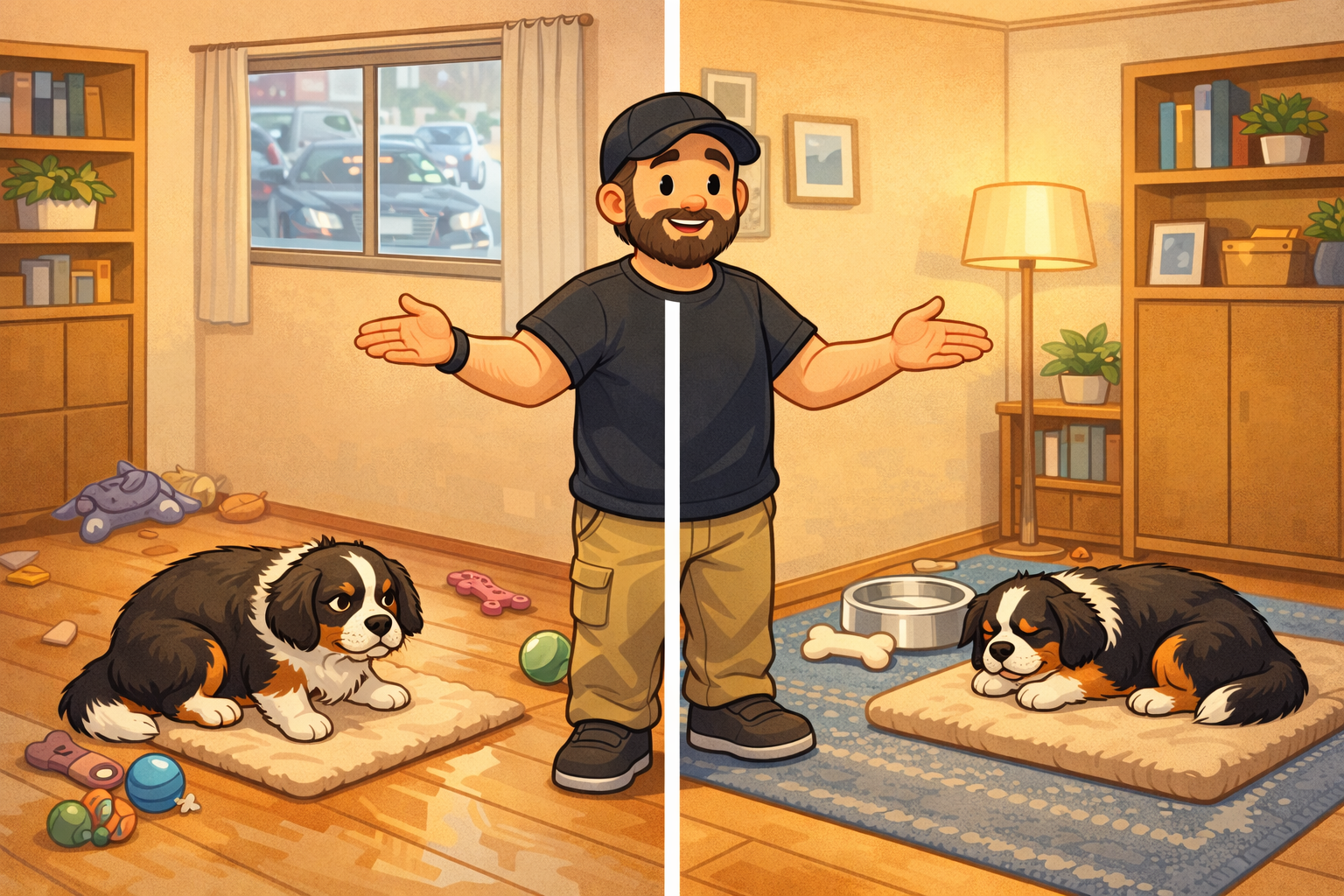
If a dog spends time alone during the day, the home environment is not just a living condition, but a problem behavior prevention device. Even if the dog does not suffer from separation anxiety, barking, destruction, and anxious behavior may increase if the dog is overly bored or overstimulated when alone.
Basic settings when alone
- Quiet resting area
- 1 chewing stimulus safe to use
- Water accessible at any time
- Structure that prevents too much stimulation from being seen outside the window
- An environment where sudden loud sounds are not repeated
- An area where you can stay stable rather than leaving it too wide
Especially for sensitive children, “letting go” may be a burden rather than freedom. Depending on the child’s personality, there are times when it is better to provide a stable range of rest.
A good environment ultimately includes ‘predictable routines’
No matter how good the house structure is, it is difficult for the dog to settle down easily if its life pattern changes significantly every day. If meal times, break times, walk times, play times, and alone time are too irregular, reactivity may increase even to small stimuli.
Puppies gain stability from repetition and predictability more than you might think. So, a good home environment is not simply a house equipped with supplies, but is closer to a house in which the following four things are kept somewhat constant.
- A place to rest well
- Predictable flow of life
- Not excessive stimulation
- Indoor activities suitable for children
In this case, simply changing the environment may not be enough
Changing the environment is very important, but not all problems can be explained solely by the structure of the house. In the cases below, it is not just a simple environmental issue, but also the possibility of pain, health problems, and high levels of anxiety.
- Suddenly my personality changed
- Exceptionally sensitive or growling when touched
- Reacts aggressively while resting
- I suddenly dislike slippery floors
- Sudden increase in bowel movements
- Exhibits severe anxiety or destructive behavior only at home
In this case, rather than seeing it as “the behavior has worsened,” it is better to first check for possible veterinary problems and, if necessary, seek behavioral counseling. In particular, it is safer to approach aggression or severe separation anxiety with environmental adjustment + routine + reward-based training rather than scolding.
Checklist: Check this level of your home environment
- There is a quiet place for the dog to rest
- The location is not a place with a lot of stimulation, such as the entrance, window, or in front of the TV
- Do not frequently wake or touch a child who is sleeping in the rest area
- The floor is not too slippery
- Eating and defecation spots are not too close
- It is not structured to continuously bark due to stimulation outside the window
- There are activities that use the nose more than once a day
- Rotate toys rather than keeping them all out
- There is a space where you can stay safely even when you are alone
- If you suddenly become sensitive, consider the possibility of health problems
What to do right away / What to fix in the future
Do it right away
- Observe where your dog stays the longest.
- If the spot is in front of a window, next to the entrance, or in front of the TV, try rearranging it first.
- Place anti-slip mats on frequently passed traffic routes.
- Please take out toys and play under the guidance of a guardian.
- Try doing one 5-minute nose walk.
To be modified
- Distinguish between eating, resting, and playing areas.
- If there is a reaction from the doorbell, front door, or window, record under what circumstances it increases.
- If you spend time alone, reexamine your safe space.
- If you suddenly become sensitive, check for changes in your health as well.
Frequently Asked Questions FAQ
Q1. Is a spacious home a good home environment for a dog?
Not necessarily. What is more important than space is a quiet resting space, predictable routines, not too much stimulation, and safe movement routes. Even a small house can be a good environment if you can rest and live comfortably.
Q2. I keep barking when I look out the window. Is this an environmental problem?
That is highly likely. If you have a structure where you see outside stimuli too often, it is a good idea to manage your vision and move your seat before training. Barking is not just a personality problem, but can be the result of environmental stimulation.
Q3. Does giving more toys make the environment better?
Method is more important than quantity. Even if there are a lot of toys, if they are not suitable for your child, it can be distracting. It is better to organize your activities around activities that allow you to use your nose, chew, and calmly engage yourself.
Q4. Is it better to place the dog’s resting place next to the family?
This is not necessarily the case. Although some children feel secure near their caregivers, if there is too much stimulation passing by, they may not be able to rest deeply. A location that is not too far from your family but is not disturbed is more important.
Q5. What should I do if I am sensitive even after changing the environment?
If there is a sudden change, sensitivity when touched, guarding the resting place, avoiding slippery floors, or changes in bowel movements, it is a good idea to check for pain or health problems first. It is more accurate to receive behavioral counseling afterwards.
A suitable home environment for a dog does not mean buying a lot of expensive supplies. The key is to create a well-rested place, not too much stimulation, stable movement lines, and predictable routines
Once your home environment is organized, your dog will be more trainable and barking, irritability and anxiety will be much easier to manage. Conversely, if the environment continues to stimulate the child, no matter how hard the guardian teaches, the child may feel stuck.
If your child is particularly sensitive or unable to rest at home, check the home environment before training today. More problems than you might think begin to be solved from there.
A good article to read together
Related Cause
- Why dogs tremble (signs of anxiety) check) — If you are not comfortable at home, small signs of anxiety may appear first.
- Puppy How to check temperament — Even in the same family environment, each child may have different sensitive points.
- Guardian Effect of stress on dog behavior — The atmosphere at home and the tension of caregivers also have a significant impact on a child’s sense of security.
Related solutions
- Seat (Mat/House) Complete training summary — If you want to create a comfortable resting space at home, try connecting first.
- Puppy Routine for dealing with whining — If whining and demanding behavior are repeated at home, check your daily routine first.
- Puppy Causes and Prevention of Separation Anxiety — If a child becomes more anxious when left alone, environmental settings and separation routines should be looked at together.
- <a href=”https://saramgomdog.com/%ea%b0%95%ec%95%84%ec%a7%80-%ec%82%b0%ec%b1%85%ec%9d%84-%eb%aa%bb%ed%96%88%ec%96%b4%ec Go for a walk Games to play at home when you can’t go out — Even if the indoor environment is good, if you don’t have a routine to expel energy, you can become sensitive again.
Advanced/Expanded
- The puppy Fight with the vacuum cleaner — Children who are sensitive to household noise must also manage sound stimulation.
- Puppy What should I do if she licks her feet — See also how boredom, stress, and irritability manifest themselves in behavior.
If consultation is needed
If barking, anxiety, destructive behavior, resting-place defense, and irritability continue even after changing the home environment, it may not be a simple habit problem. In particular, aggression or severe anxiety requires a life routine and environment design tailored to the child’s condition, so if necessary, try to establish a structure through behavioral counseling first.
Related guides
English edition copyedited and supplemented on October 9, 2026.