Practical starting point
Prepare a quiet resting area, an easy toilet route and a plan for supervision before the puppy arrives. Introduce the home gradually and postpone a crowd of visitors. Arrange veterinary guidance on vaccination and safe social experiences. Crying, poor appetite or disrupted sleep needs context; marked lethargy, vomiting or other illness signs should not be treated as a training problem.
Hello, this is Saramgom. When you first get a puppy, they all look the same.
She’s so pretty, nice to meet you, and I want to get to know her quickly. But in reality, slowing down the speed of getting closer will help you stabilize more quickly.
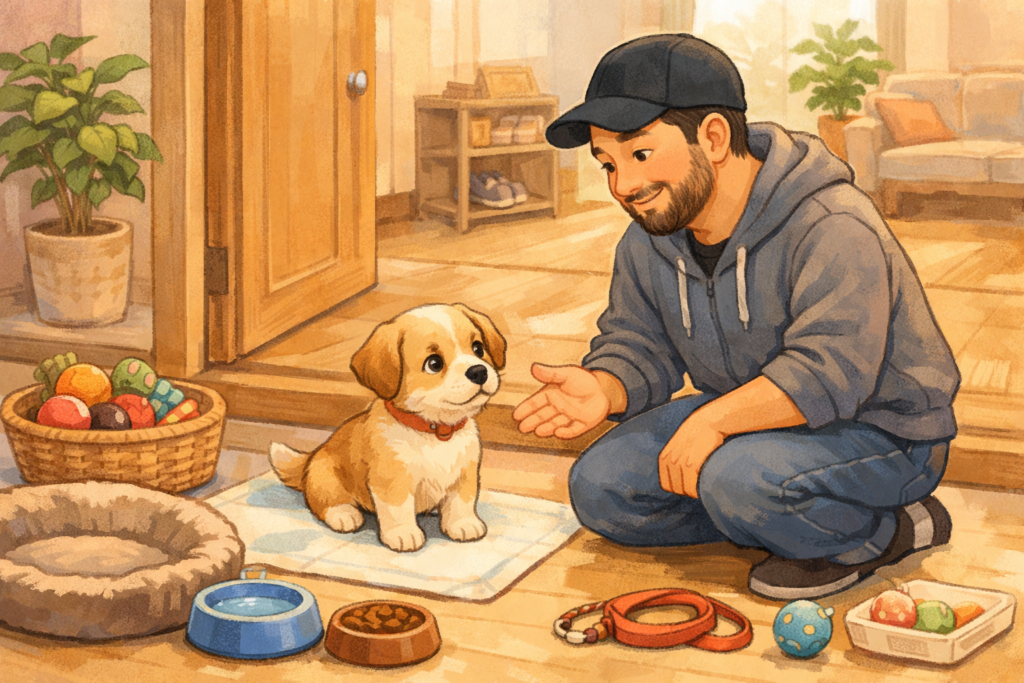
3 key things
- What to do first when you come home on the first day of adoption
- Common mistakes made by beginner guardians and common sense safety rules
- Foods you should not eat, risk factors at home, signs to go to the hospital quickly
When you first adopt a puppy, you feel anxious. I want to get to know you quickly, and I want to give you all the good things first. But in reality, it is much more important to touch less and let it settle more in the first few days. I especially want to touch it so much!! You have to be patient.
A new home is a space where a puppy is bombarded with unfamiliar smells, sounds, people, and rules. So, rather than doing a lot of things just because they’re pretty at first, it’s better to create a quiet resting space and a predictable routine
Things to remember first
The most important thing on the first day of adoption is stability, not attention bombing.
Mistakes in defecation, hiding, or refusal to eat may be adaptive responses, but if they persist or become severe, a health check is required.
Making desired behavior easier and rewarding is more stable in the long run than scolding.
1. The first thing you need to do when you first bring your puppy
1-1. Guide them to the place to defecate first
As soon as you enter the house, the first thing to do before taking pictures, taking out toys, and greeting the whole family is guiding to the bathroom location. If you mainly defecate outdoors, it is better to go to a quiet place for short periods of time. If you defecate indoors, it is better not to change the pad location frequently.
1-2. Please make a place to rest first
The reason your dog keeps following you around may not be because he or she is very attached, but because he or she is anxious. So, at first, choose a quiet place with fewer people passing by as a resting area than the middle of the living room.
- Avoid places with a lot of stimulation, such as right in front of the front door
- Avoid near power cords, chargers, small plastics, and trash cans
- Avoid locations frequently touched by children
1-3. For the first meal, give only a small amount of the food you normally eat
When you’re nervous, you may eat less. So, rather than giving a lot of snacks from the beginning, it is better to give the dog the food it was eating quietly in small amounts. If you suddenly change the food or mix a lot of treats, diarrhea or rejection may become worse.
2. Things you must be careful of based on common sense
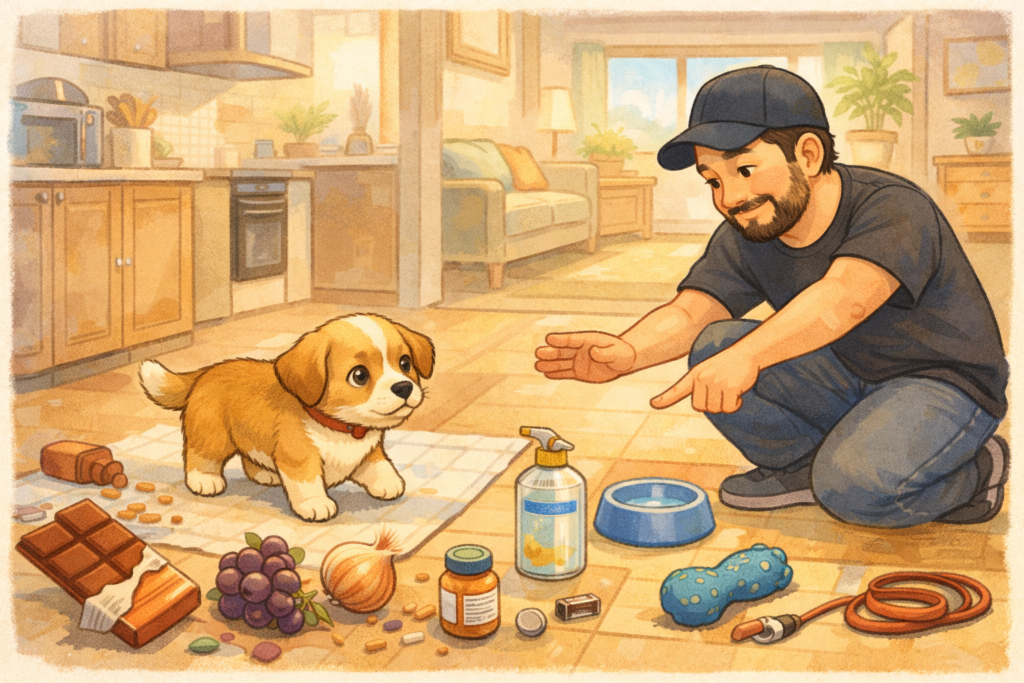
This is the part that new guardians miss the most. What may not be a big deal to humans can be dangerous to dogs.
2-1. Foods you should not eat
- Chocolate: The higher the cacao content, the more dangerous it may be.
- Grapes, raisins: Even small amounts can be problematic, so it is best to avoid them.
- Onions, garlic, green onions, chives: Even if cooked, it is not safe.
- Xylitol: Can be found in gum, candy, some peanut butter, and diet foods.
- Caffeine drinks: Do not give coffee, energy drinks, or strong tea.
- Alcohol: Leftover beer, soju, and wine can also be dangerous.
- Macadamia: Some nuts should be specifically avoided.
- Uncooked dough: It may swell and cause stomach problems
- Oil and salty foods: It is best not to give chicken skin, seasoned pig’s feet, spicy foods, or soups.
- Cooked bones: They may break into small pieces and cause swallowing accidents.
In particular, “I guess it’s okay for a little bit” is the most dangerous. Human food often comes with seasonings, fats, sugars, sweeteners, bones, and unknown additives
.
2-2. Never give human medicine arbitrarily
Cold medicines, painkillers, patches, ointments, and digestive medications for humans can be dangerous to dogs. Even if the symptoms seem similar, weight, metabolism, and toxicity standards are different, so you should avoid giving human medicine at the discretion of the guardian
.
2-3. Common dangerous substances in the house
- Wire, charger, power strip
- Battery, lithium battery
- Detergent, bleach, air freshener, capsule detergent
- Essential oils, diffuser liquids
- Food waste in trash can
- Small toys, rubber bands, hair ties, socks
- Cigarette butts, electronic cigarette liquid
- Vinyl, packaging string, children’s toy parts
2-4. Plants can also be dangerous if left careless
Some lilies, some foliage plants, succulents, and flower bouquet materials may be problematic for pets. If you have a lot of plants in your house, it is a good idea to check them first from the height that your dog can reach.
2-5. Common sense based on human standards may not apply to dogs
- “Keep hugging people because they’re pretty” can be a burden.
- “Lots of walking to begin with” can be more overstimulating than adaptive.
- “Giving human food as an expression of affection” can be the beginning of health problems.
- It may be a misunderstanding that “I made a toilet mistake so I have to scold myself to learn.”
- The interpretation that “I like you because you wag your tail” can be dangerous.
3. 9 common mistakes new caregivers make
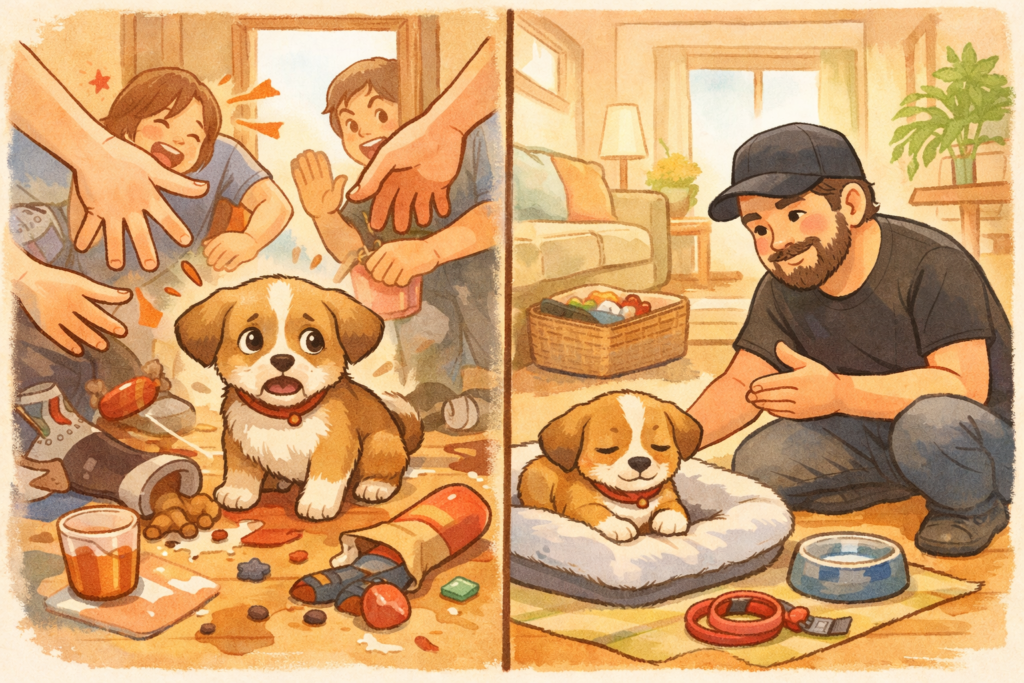
- Touching and calling too much from the first day
The speed of recovery comes before the speed of getting closer.
- Each family has different rules
If couch allowance, snack standards, and jump reactions are different, confusion can quickly arise.
- Emotionally scolding you when you make a mistake
Cause You may become more afraid of people’s reactions than learning
- Focus more on mistakes than on potty success
At first, the priority is to create more successes rather than reduce failures.
- Stretching strangers, unfamiliar dogs, and going out all at once
Socialization is a “safe, good experience” rather than “a lot”
- Giving small portions of human food
comes with the risk of picky eating, begging, digestive problems, and toxicity
- Relegating health signals to adaptation issues
Continuous diarrhea, vomiting, lethargy, and pain reactions require confirmation
- Get scolded by name
If you start getting scolded by name, you will hear the name in passing and it will become difficult to recall it.
- React to the dog’s every action
The dog becomes dependent on the person and whining or barking may continue.
The speed of recovery comes before the speed of getting closer.
If couch allowance, snack standards, and jump reactions are different, confusion can quickly arise.
Cause You may become more afraid of people’s reactions than learning
At first, the priority is to create more successes rather than reduce failures.
Socialization is a “safe, good experience” rather than “a lot”
comes with the risk of picky eating, begging, digestive problems, and toxicity
Continuous diarrhea, vomiting, lethargy, and pain reactions require confirmation
If you start getting scolded by name, you will hear the name in passing and it will become difficult to recall it.
The dog becomes dependent on the person and whining or barking may continue.
4. Something you need to be more careful about if you are a puppy
Puppies still have little experience in the world and have good resilience, but on the other hand, it is a time when one excessive experience can linger for a long time. Therefore, short and safe adaptation is important rather than applying a lot of large stimulation from the beginning.
- Slowly avoid loud spaces, crowds of children, and groups of unfamiliar dogs
- Harness, leash, foot touching, and adjusting to the carrier are divided into short sections
- Start with easy actions such as looking up when your name is called or resting on the mat
5. It’s easy to do your first week’s routine like this
First day
- Information on toilet location
- Organize your resting area
- Provide water and familiar food
- Keep family greetings short and quiet
Day 2-3
- Roughly fixed meal, toilet, and sleep times
- Short acclimatization walk or indoor observation
- Reward for looking at someone when their name is called
- Create short time to rest alone
Days 4 to 7
- Leash and harness adaptation, foot cleaning, light care practice
- Make a plan for smooth socialization
- View records of appetite, stool status, sleep, and activity level
- Schedule a hospital check-up if necessary
6. When you need to get hospital or professional help quickly
- I barely eat rice or water
- Recurrent vomiting or severe diarrhea
- Cough, runny nose, severe lethargy
- It hurts or is very sensitive when touched
- Be very careful around people’s hands, food bowls, and places to sleep
- Charges at or bites the child
- If left alone, escape attempts or severe panic occur
If aggression, extreme fear, or pain is suspected, a health check may be required prior to training. In this part, safety and checking the cause take priority over “Is it the original personality?”
7. Adoption First Week Checklist
- ☐ A designated place to defecate
- ☐ Rest area is in a quiet location
- ☐ The family agreed not to give human food
- ☐ Removed wires, detergent, trash cans, and small items
- ☐ Rules were agreed upon among family members
- ☐ Record the condition of rice, water, and stool for several days
- ☐ Reduce excessive outings, visitors, and contact
- ☐ There is a plan to check hospital records and basic health conditions
8. Frequently Asked Questions
Q1. Is it a problem if I don’t eat on the first day of adoption?
Stress can cause you to lose your appetite. However, if the patient does not drink water or has vomiting, diarrhea, or lethargy, it is better not to dismiss it as a simple adaptation issue.
Q2. Will taking a lot of walks from the beginning help with adaptation?
Not necessarily. At first, the intensity of stimulation is more important than the amount of exercise. Excessive exposure to unfamiliar environments can actually increase sensitivity.
Q3. Isn’t it okay to give people a little food?
Not recommended. In addition to the risk of toxicity, they are also prone to picky eating, begging, digestive problems, and bowel instability.
Q4. Should I be scolded immediately if I make a toilet mistake?
Normally this is not the case. Scolding a person for a past mistake is more likely to cause discomfort in a person’s reaction than learning the cause. Environmental management and timing reward for success are more important.
Q5. Is it okay if my child likes it so much that he keeps holding and touching it?
In the early stages of adoption, short, quiet interactions are better. It is safer to first teach your child to “not mess with recess.”
Finish
When you first adopt a puppy, the most important thing is not great skills, but basic safety and stability. Rather than trying to do everything perfectly from day one, it becomes much easier just to get rid of dangerous things, give up human food, and establish a resting area and toilet routine.
If the hiding, hyperexcitability, vigilance, toileting mistakes, and whining continue, it is much easier to get direction early on than to endure it alone. Especially in the Pohang area, if you are struggling with problems related to initial adoption, bowel movement, excitement, or separation, it is also a good idea to organize your routine through counseling or on-site training.
Good article to read together
The puppy Reasons for being sensitive at home, an environment to watch before training
Related guides
English edition copyedited and supplemented on October 9, 2026.