Practical starting point
Pick a skill that solves a current daily need: comfortable harness handling for a puppy, disengaging from distractions for an adolescent, or an easy station on a non-slip mat for a senior. Adjust repetitions to the individual rather than a birthday deadline. A sudden loss of a familiar skill can reflect pain or sensory change and deserves veterinary assessment.
The puppy next door can already stay. Yours is carrying a toilet pad around the living room like a parade banner. Are they following different school curricula? Perhaps the more useful question is what your dog is ready to learn today.
Training is not a race to complete commands by a birthday. It means building experiences and skills that fit the dog’s current body, emotions and history. The ages below overlap and vary with size, breed, health and experience.
Before roughly eight weeks: a safe beginning
Appropriate time with the mother and littermates, gentle human contact and a safe environment matter more than formal lessons. Bringing a puppy home early to get a head start on training is not an advantage. If maternal care is unavailable, work with a veterinarian on a suitable care plan.
Keep handling gentle and brief, watch the puppy’s response, and protect sleep. Even an ambitious parent does not need to schedule evening exam preparation for a baby.
About eight to sixteen weeks: make the world manageable
Early puppyhood is an important period for social learning, especially the first few months. Socialization means comfortable exposure to everyday life, not collecting the largest number of dog friends. A person passing at a distance, a new surface or a quiet household sound can be enough for one experience.
Let the puppy observe and move away. A puppy hiding or freezing does not need to be pushed closer. Ask your veterinarian how to balance local infection risks and vaccination status with safe social experiences. Neither total isolation nor unrestricted access to places full of unfamiliar dogs is a universal solution.
Toileting, recall and handling
Offer toilet opportunities after waking, eating and playing, and reward promptly after the puppy finishes in the intended place. Accidents are information about timing and setup, not a reason to punish. A young puppy cannot hold on like an adult.
Reward looking toward you when you say the puppy’s name, then approaching over a short distance. Keep the name from becoming a warning that trouble is coming. Break care into tiny steps: sniff the harness, see the brush, accept a brief comfortable touch. Four paws of nail trimming need not be the first lesson.
Comfortable separation starts small
Begin with settling a little distance from you. An actual absence may initially last only seconds. Adjust to the puppy’s response rather than extending time through crying or pacing. Check toileting, hunger and the need for contact. The goal is comfort, not exhausted surrender.
About four to six months: chewing, play and everyday skills
Provide safe chewing options and redirect mouthy play toward suitable toys. If play becomes painful or frantic, pause calmly and consider fatigue. Do not clamp the mouth shut or wrestle the puppy into submission.
Put dangerous objects out of reach. Teach exchanges with safe items in easy situations instead of repeatedly chasing and grabbing possessions. Stiffening or growling calls for a safer setup and professional help, not a stealing contest.
On walks, practise comfortable equipment use, a few loose-leash steps and turning attention back to you. Start somewhere quiet. Exercise should suit the individual growing body; repeated high jumps or forced long runs are not necessary.
Adolescence: revisit the basics
Adolescence often becomes noticeable around six months, but timing varies and maturation can extend toward two years or beyond in some dogs. A birthday is not a switch.
A recall that worked in the kitchen may struggle around exciting smells and dogs. Reduce distance, distractions and waiting time, and use worthwhile rewards. This is practice under harder conditions, not automatic proof that your dog is challenging your authority.
Use a secure enclosure or an appropriately handled long line where suitable. Do not test an unreliable recall off leash near traffic. Balance activity with sleep and recovery. Sudden or marked behavior changes deserve a health check rather than being dismissed as teenage behavior.
Adult dogs: maintain skills and adapt
Keep rewarding recall, safe doorway behavior, settling and cooperative care. Moving home or changing schedules may require easier practice again. A newly adopted five-year-old still has to learn where this home’s toilet area is. Age is not a substitute for experience.
Senior dogs: make success comfortable
Slow responses can reflect hearing, vision, pain or mobility changes. New accidents, nighttime pacing or irritability should prompt veterinary advice before stricter training. Use visible hand signals where helpful, avoid startling contact, and provide nonslip surfaces and easy routes.
Short familiar activities and simple searching games can remain enjoyable. The target is choice and comfort today, not the speed of a younger dog.
Move forward when your dog is ready
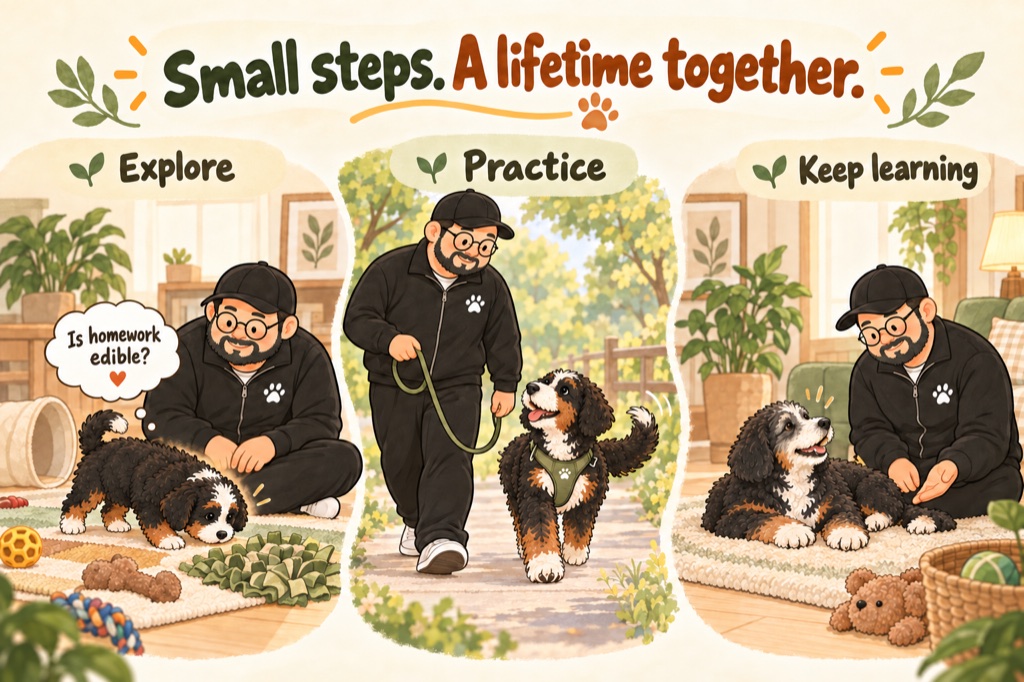
Look for a loose body, willing participation, easy recovery and the ability to return attention after a distraction. Eating a treat alone does not prove comfort. If a task is hard, shorten it or reduce the challenge. Choose one current strength and one difficulty, then build a small step between them. The calendar is your reference sheet, not homework your puppy has to hand in—preferably before chewing it.
Read the original Korean guide · Browse all English stories
Related guides
- Help Your Dog Settle: Give Attention Before the Demands Begin
- Rough Dog Play: How to Tell When to Step In
- Is It Really Dominance? Seven Dog Behaviors and Better Ways to Respond
Related guides
English edition copyedited and supplemented on October 9, 2026.