Practical starting point
Pause play before either dog is overwhelmed, using a familiar recall or barrier when safe. After a brief break, watch whether both voluntarily return with loose movement. One dog repeatedly hiding, being pinned or trying to leave is a reason to end the interaction. Do not put hands between fighting dogs or assume equal size makes a pairing safe.
The dogs start with a happy chase. Soon the soundtrack becomes thumping paws, body slams and growls. You thought you had arranged a playdate; apparently a wrestling tournament was included.
Rough-looking play is not always a fight. But one excited dog does not make it good play for both. Watch whether each dog can participate willingly, pause and leave.
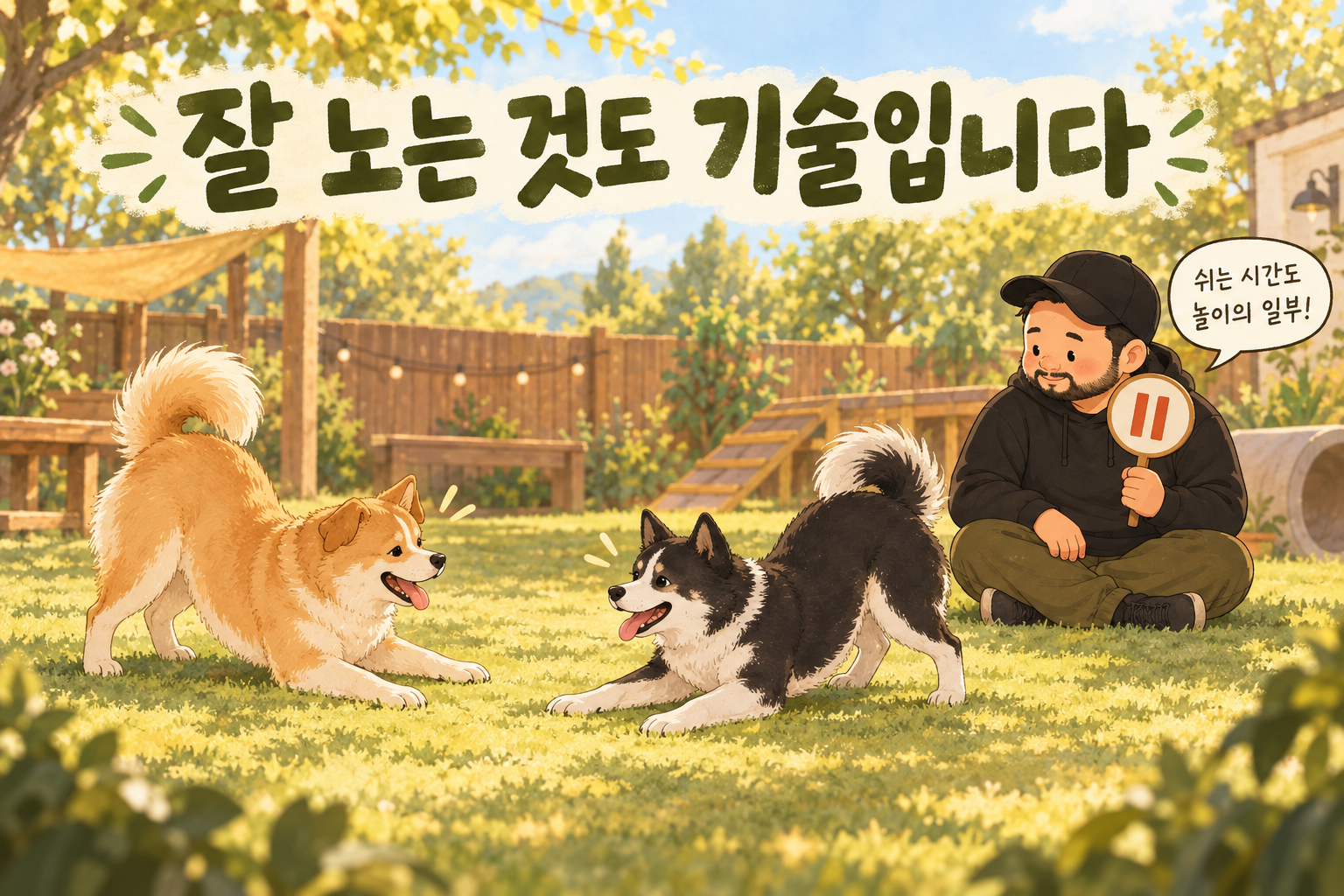
“I am having fun” is not the same as “we are having fun”
Some dogs enjoy chasing, some enjoy wrestling, and others would rather sniff and walk beside a friend. Problems arise when one dog keeps insisting on its preferred activity while the other avoids it.
Consider the effect rather than the intention. Can the other dog rest? Is your dog repeatedly invading another dog’s or person’s space? Can you interrupt before arousal becomes too high? You do not need to label your dog bad, or ask the other dog to tolerate it.
Look at the whole interaction
- Loose movement: bouncy, curved movements rather than stiff pressure and fixed staring.
- Adjustment: roles may change, or a stronger dog may reduce its force. An exact fifty-fifty split is not required, but constant one-sided pressure matters.
- Natural pauses: dogs separate, sniff or look around before choosing to return.
- Freedom to leave: one dog does not pursue relentlessly whenever the other withdraws.
A wagging tail or one play bow is not a permanent permission slip. A dog can enjoy the beginning and want to stop later. Rolling onto the back can also mean different things: look at whether the dog is loose and able to get away, or stiff and trapped.
Interrupt these patterns
Pause when one dog keeps fleeing or hiding, gets repeatedly pinned or mounted, has its route blocked, or faces stiff staring and persistent pursuit. If the same pressure resumes immediately after a break, finish body-contact play for that meeting.
A large size or strength difference can cause injury even when both dogs want to play. Consent to participate and physical safety need separate attention. A yelp, limping, injury or biting that does not release ends the question of whether to keep watching: prioritize safety and assessment.
Use a break while the dogs can still respond
- Call the more persistent dog away. Each handler guides their own dog apart; do not reach between excited dogs to grab collars.
- Create enough separation that they cannot reach each other. Wait for easier breathing, sniffing and looser movement rather than a fixed number of seconds.
- Let the other dog choose. If it walks away or stays beside its person, allow that. Do not bring it back for another greeting.
- Resume briefly only if both dogs approach with relaxed bodies and both handlers agree. End the interaction if pressure quickly returns.
Approaching again alone does not prove enjoyment; a tense dog may be checking the situation. This is an early observation tool, not an experiment to try after a fight starts.
Teach “take a break” before the dog park
Start with gentle toy play at home. Pause the toy and say “take a break.” Reward a head turn or a step toward you. When your dog is comfortable, sometimes restart with “go play.” If dropping the toy is difficult, teach calm exchanges separately instead of prying the mouth open.
A recall should not always predict the end of fun. Returning to safe, mutually welcome play can sometimes be the reward. Never use that reward when the other dog is uncomfortable.
Progress to one familiar, compatible dog in a safe space. Reward each dog with its own handler, well apart; scattering treats among unfamiliar dogs may create competition. Practise breaks while play is still going well.
Good manners for shared spaces
“Mine is getting a little wound up, so we are taking a break” is usually more helpful than “That is just how mine plays.” Stop when the other handler asks. Follow leash and size-group rules, manage crowded entrances, and prevent several dogs from chasing one.
If you cannot recall or safely separate your dog, choose an easier environment. Not every dog needs a crowd of friends. Comfortably passing another dog on a walk is a useful social skill too.
When play targets people or turns into a fight
For painful mouthing or body slamming, offer an appropriate toy, reduce intensity and create a calm pause. Adults should prevent rough chase-and-grab games between children and dogs. Use separate spaces when active adult supervision is unavailable.
In a fight, keep bare hands away from mouths and collars. Move bystanders away and use a door or solid barrier only if you can do so without putting yourself at risk. Seek help; do not force a reunion afterward. Suspected injury, repeated threats or sudden changes need veterinary and behavior assessment.
Ask three questions: Are both dogs participating? Can either leave? Can they pause before overheating? Play is a shared activity. If only one is enjoying it, the other may feel stuck at an office party.
Read the original Korean guide · Browse all English stories
Related guides
- Help Your Dog Settle: Give Attention Before the Demands Begin
- Dog Training by Life Stage: What to Teach from Puppyhood to Senior Years
- Is It Really Dominance? Seven Dog Behaviors and Better Ways to Respond
Related guides
English edition copyedited and supplemented on October 9, 2026.